Metal detectorist uncovers rare Evesham Diamond Ring, set for auction
A detectorist’s 16th-century diamond ring surfaced in Gloucestershire and is now headed to auction with a £15,000 to £20,000 estimate.
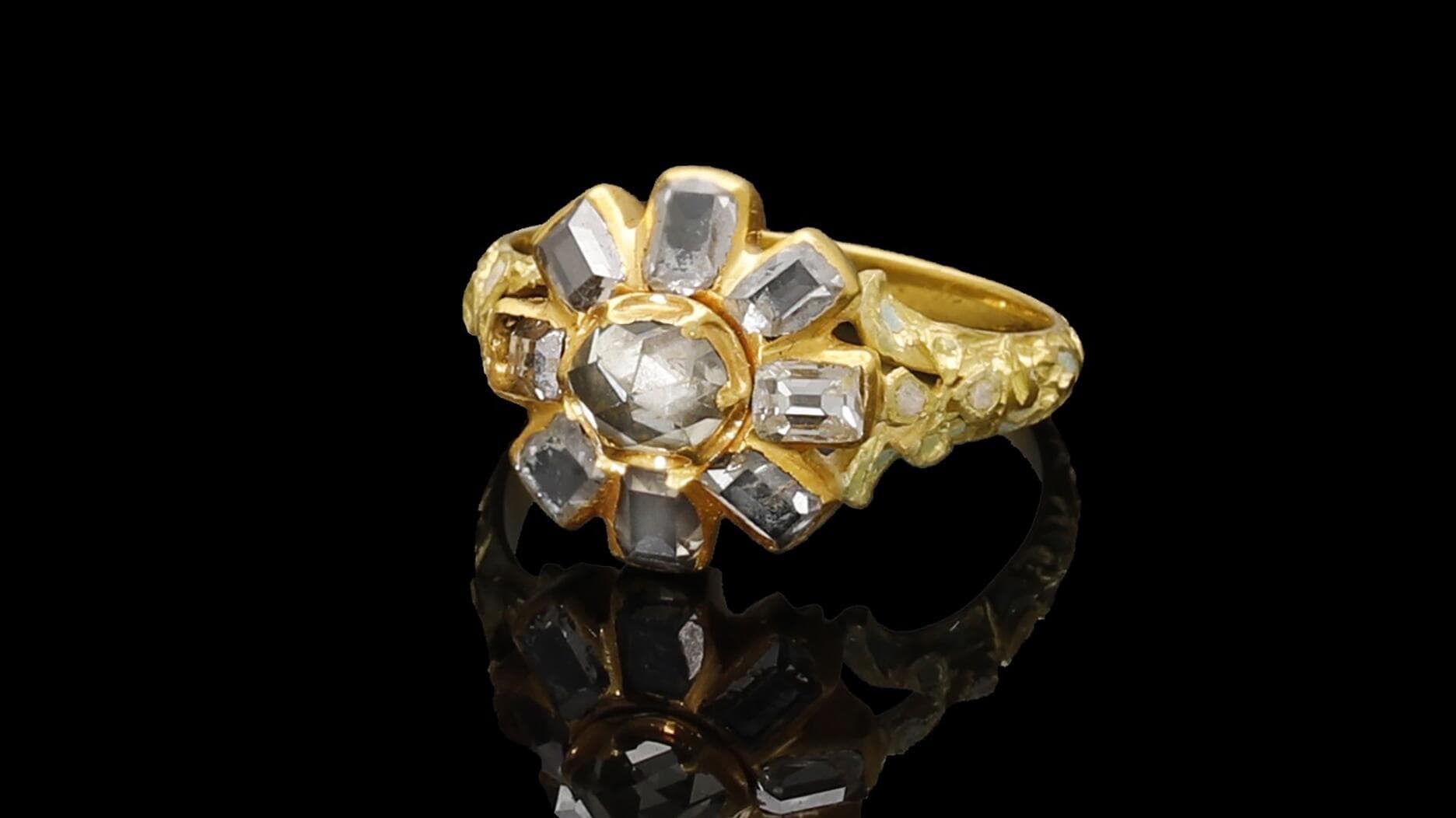
A rare cluster ring with a flowerhead bezel and eight hogback diamonds is headed to London with an estimate of £15,000 to £20,000, a price that reflects both its survival and its startling freshness. Found by 42-year-old Stuart Jones of Solihull during a detecting session in Wormington, Gloucestershire, in November 2024, the Evesham Diamond Ring has the kind of early modern presence collectors prize: intimate in scale, lavish in detail, and unmistakably designed to be seen.
Noonans has catalogued the jewel as a late-16th- to early-17th-century diamond and enamel ring, and it is being offered as lot 106 in the Jewellery sale on Tuesday, June 23, 2026. The ring centers on a rose-cut stone surrounded by eight hogback diamonds, a cluster arrangement that feels emphatically period-correct rather than decorative for decoration’s sake. Two of the diamonds are loose, a reminder that four centuries of wear and burial can leave a jewel with as much vulnerability as romance. The underside of the bezel is finished with a turquoise-and-white enamel flowerhead, while the shoulders carry applied quatrefoil flowerheads on a scroll- and foliate-engraved band.

That combination of gem setting and surface ornament is what makes the ring more than a treasure-finder headline. Frances Noble, Noonans’ head of jewellery, said early 17th-century baroque taste demanded grand rings that made an impression, and fashions were moving away from solitary stones toward more elaborate group settings, including rosettes, pansies, crosses and fleur-de-lys. In other words, this is not simply a diamond ring that survived; it is a ring that documents a style shift, when the language of jewels became more theatrical and more architectural.
Its value will ultimately depend on the same forces that drive any serious historical jewel at auction: provenance, rarity, condition and the quality of the design. Noonans has called the eight-hogback-diamond cluster very rare, and rarity is exactly what collectors pay for when a piece arrives with both a compelling story and a recognizably sophisticated period hand. Stuart Jones described the discovery as a “once in a lifetime find,” but for buyers, the greater question is whether objects like this are becoming a more durable niche within the diamond market.
Noonans has already shown that detectorist-discovered jewels can command real momentum, with sales including the Ashfield Ring, the George Grenville seal ring, the Charles I hawking ring and a medieval diamond ring that sold for £38,000 in 2022. That record suggests a market that is increasingly willing to reward historical diamond jewels not just as curiosities, but as scarce works of wearable art.
This article was produced by Prism’s automated news system from verified source data, official records, and press releases, then run through automated quality and moderation checks before publishing. The system is built and supervised by the people who set the standards it runs under. Read our full AI policy.
Did this article answer your question?