Paris Haute Couture Week spotlights diamond-heavy high jewelry from top maisons
White diamonds became architecture this season, with Dior, Chaumet and Cartier using precision settings, tiaras and ribbons of light to redefine high jewelry.
The season's new code
Paris couture’s strongest diamond story is not about bigger stones for their own sake. It is about control: white diamonds used as line, lift and rhythm, with Dior, Chaumet and Cartier each proving that high jewelry feels freshest when it behaves more like design than display.
Diorissima: fantasy built with discipline
Diorissima is the most expansive of the trio, a 141-piece universe that moves through lush vegetation, aquatic depths and mysterious constellations. Clover, wisteria, fruit, algae, coral, bubbles, suns, eclipses and “happy clouds” all surface in the collection, but the important part is how they are built: through the doublet technique, lacquer, layered color and exacting gemsetting rather than through sheer stone size alone.
That matters because Dior is not selling a flat floral fantasy. Jonathan Anderson’s couture silhouettes for the presentation, from bustier dresses and draped pieces to flowing suits, micro-pleated chiffons, velvet, organza and pearls, give the jewels a body to move against, while diamonds and opals keep the compositions from tipping into illustration. In practical terms, this is the look most likely to filter down into fine jewelry: mixed materials, brighter color and settings that let a jewel read like a collage rather than a single hard-edged object.
Dior’s strongest signal is restraint inside abundance. The collection is vivid, but the sparkle is controlled, and that balance makes the pieces feel wearable in the way collectors want from modern high jewelry. Instead of a pure diamond hegemony, the house uses white stones as a frame around opal, mother-of-pearl and saturated gemstone color, which gives the season a more painterly and less literal kind of luxury.
Chaumet: the tiara becomes a frame
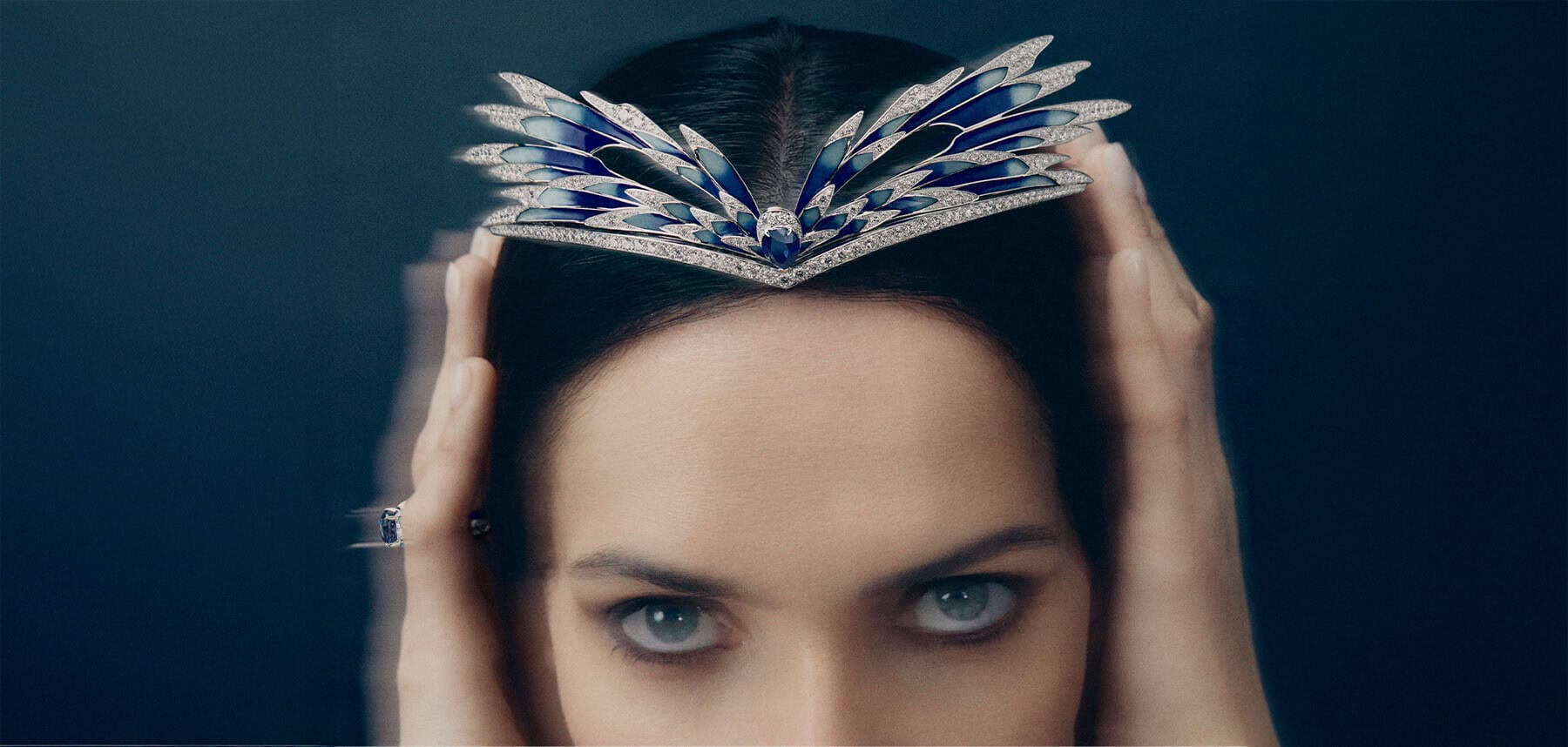
Chaumet’s Peppercorn tiara is the cleanest diamond statement of the season, a spray of glittering white diamonds set in white gold. It sits alongside the Mint Leaf suite, a five-piece group set with emerald-cut aquamarines weighing up to 17.46 carats and paired with Akoya pearls and white diamonds, which gives the collection a cooler, more botanical register without losing the house’s formal polish.
The house has framed this chapter through flora seen through a culinary lens, using plants, herbs and spices as inspiration. That makes the Peppercorn tiara especially telling: it strips the idea down to light and contour, letting the diamonds read as a spray rather than a mass. The effect is more contemporary than nostalgic, and it suggests that Chaumet’s tiara vocabulary is moving toward lighter, more modular pieces that could just as easily inspire necklaces, hair jewels or openwork collars in the fine-jewelry tier.
What is useful here is the discipline of the silhouette. Chaumet is not simply reviving court jewelry for spectacle’s sake. It is reducing the tiara to a line drawing in diamond and white gold, which is exactly the sort of idea that can travel beyond couture into smaller, daily-wear pieces with more negative space and less visual weight.
Cartier: precision, not excess
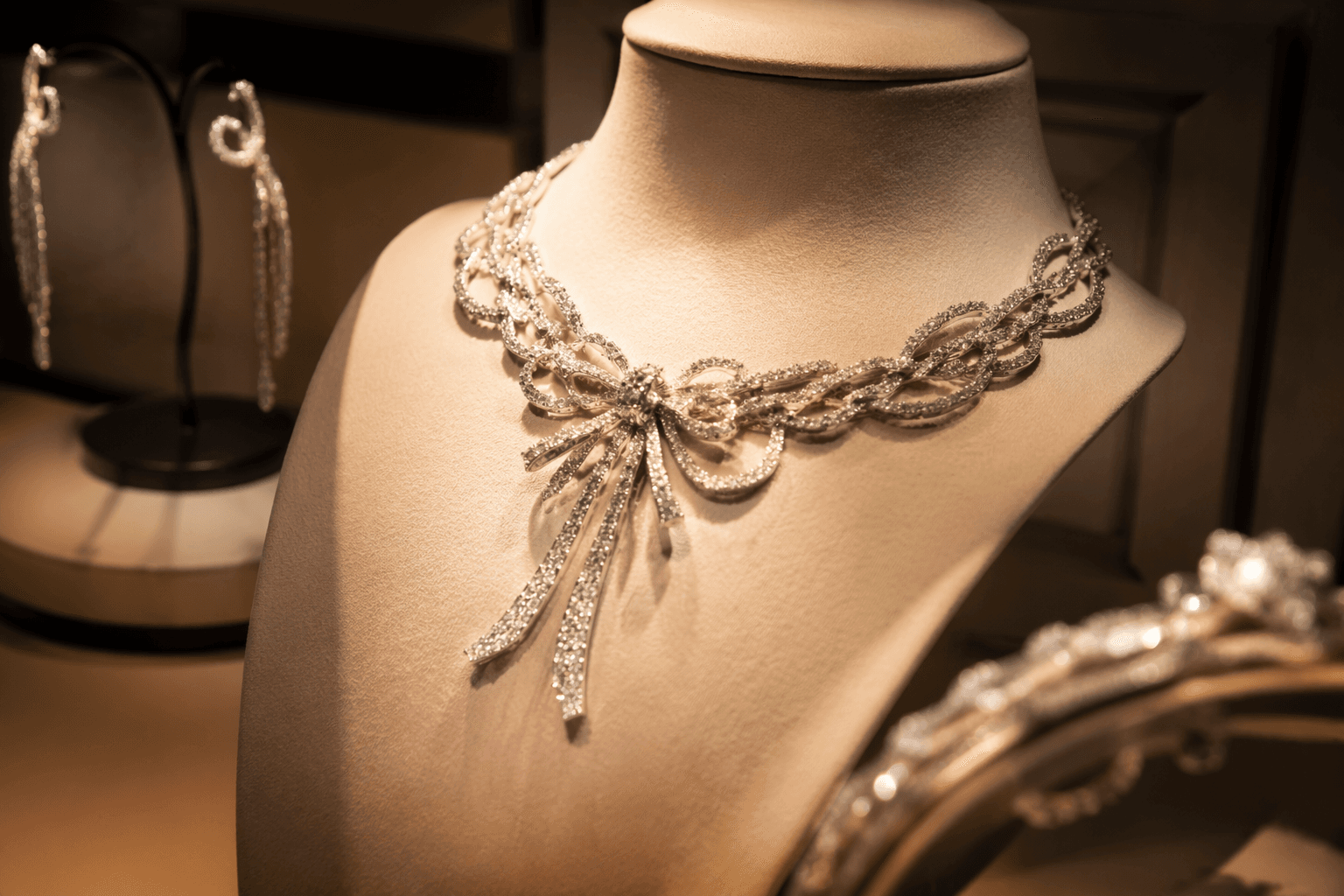
Cartier’s En Équilibre is the season’s clearest argument that restraint can still look sumptuous. Presented at the Musée des Arts Décoratifs, the third chapter is led by the Euphonia necklace, where 34 perfectly matched diamonds create a continuous ribbon of light, with square, baguette and brilliant cuts alternating to set the rhythm. The adjustable clasp is not a footnote; it is part of the design language, making the jewel feel fluid instead of fixed.
The rest of the collection keeps pushing that idea of balance through contrast. Splendea pairs three pear-shaped Madagascar sapphires totaling 16.59 carats with diamond strands, while Parcae and Ondora bring in platinum, sapphires, chrysoprase, spinels and turquoise, all held against diamonds in both organic and geometric forms. Cartier’s high-jewelry workshops describe the result as “emotional resonance achieved through technical mastery,” and that is exactly what the pieces communicate: the stones feel calm because the structure is so exact.
Cartier also shows how diamond jewelry can become sharper without becoming severe. The house’s use of geometric cuts, openwork and transformable elements points toward a fine-jewelry future where the most desirable pieces may be the ones that move, adjust and reshape themselves rather than simply sit on the body like trophies.
What this season is really saying
Taken together, these maisons are converging on a single idea: diamond high jewelry in 2026 is less about volume than about structure. Dior turns diamonds into luminous punctuation around color, Chaumet uses them to sketch a lighter tiara silhouette, and Cartier builds entire necklaces around proportion, adjustability and matched stones.
The practical lesson for the wider market is clear. The motifs most likely to trickle down are the ones that can survive simplification: ribbon lines, spray tiaras, articulated pendants, openwork settings and gemstone pairings that create contrast instead of clutter. Couture may be the stage, but the design vocabulary here is already pointing toward fine jewelry that values precision, movement and clarity over blunt carat count.
This article was produced by Prism’s automated news system from verified source data, official records, and press releases, then run through automated quality and moderation checks before publishing. The system is built and supervised by the people who set the standards it runs under. Read our full AI policy.
Did this article answer your question?