Queer-owned brands helped reshape modern diamond engagement rings
Queer couples and queer-owned brands pushed engagement rings beyond the solitaire, and the mainstream market now looks more custom, gender-neutral, and lab-grown than ever.
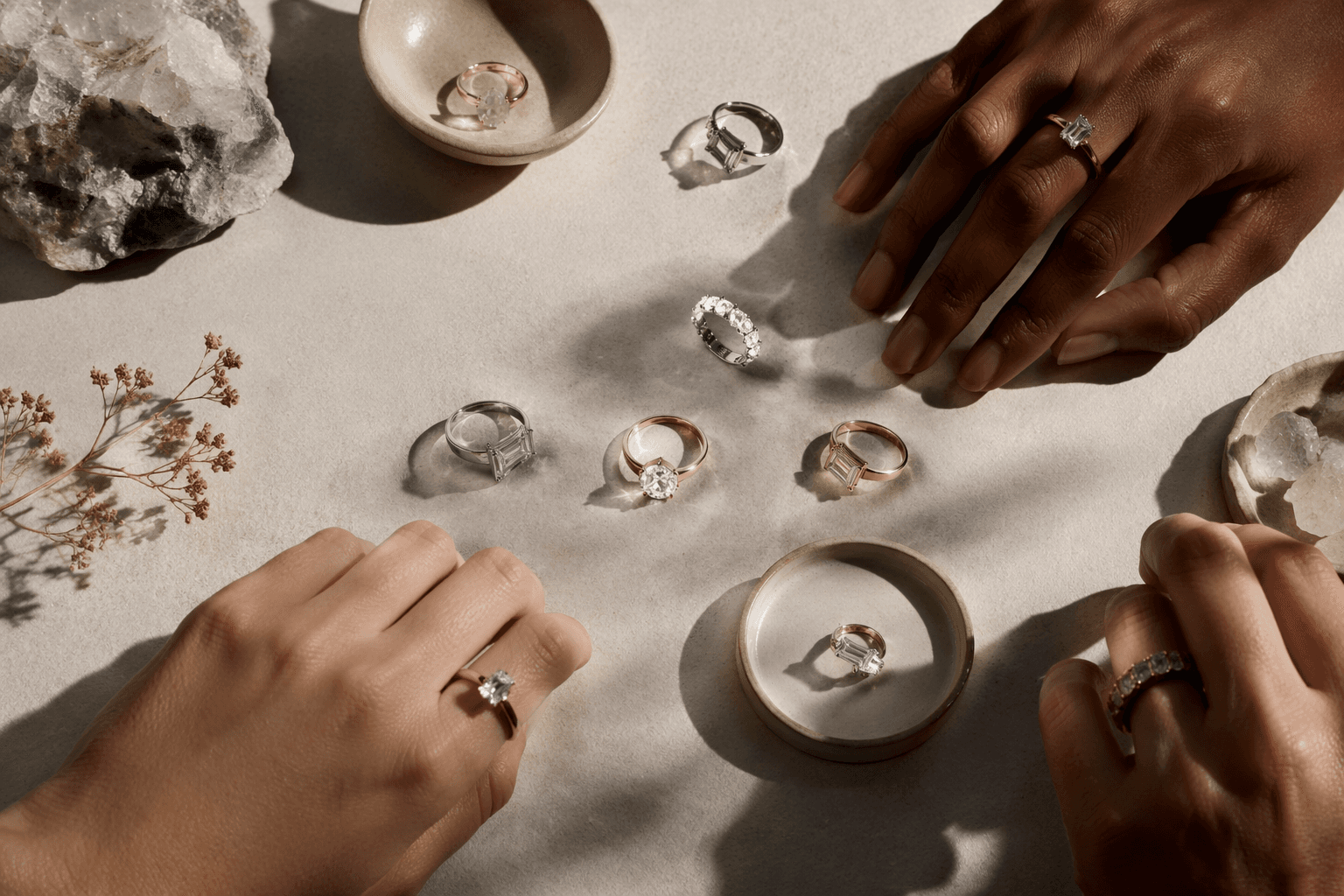
The modern engagement ring no longer owes everything to the round solitaire. Queer couples and queer-owned brands normalized custom silhouettes, gender-neutral styling, and lab-grown stones long before those choices became standard bridal language. What many shoppers now read as “classic” is often the result of that earlier refusal to fit a single template.
How queer design changed the center stone
The clearest shift is in silhouette. An east-west setting turns a marquise, oval, or emerald-cut diamond across the finger instead of letting it stand upright, and that small rotation changes the whole mood of the ring: less inherited formality, more intentional line. A bezel, which frames the stone in metal, reads sleeker and more architectural than prongs, while prongs keep the diamond visually open and high-set. Those choices matter because they move the ring away from one universal bridal formula and toward a language of proportion, protection, and personal taste.
That language is now visible on celebrity hands. Zendaya’s east-west diamond, Selena Gomez’s marquise stone, and Taylor Swift’s antique-inspired Old Mine cut have all helped make unconventional or historically specific cuts feel familiar to a much wider audience. Each one points to a broader appetite for rings that look chosen rather than prescribed, with vintage references and off-axis shapes standing in for individuality instead of ornament alone.
The brands that made customization feel normal
Long before those styles were red-carpet shorthand, queer-owned brands were building an alternate bridal culture from the ground up. Holden launched in 2018 after its founders heard repeated stories from friends who felt judged, pressured, or excluded while ring shopping. Its engagement rings and wedding bands are gender-neutral, custom-made in New York City, and built with lab-grown diamonds and recycled metals, which makes the shopping experience itself part of the design statement.
Automic Gold pushed that conversation in a different but equally important direction. The company identifies as queer- and trans-owned, and its founder, AL Sandimir, describes themself as an indigenous, queer, non-binary refugee who has worked in fine jewelry since 2009. The brand uses recycled gold and platinum with reclaimed and or ethically sourced diamonds and gemstones, a material mix that gives its pieces a distinct point of view: precious, but not precious in the old, guarded sense.
Together, these brands helped shift the meaning of engagement jewelry. The ring was no longer a fixed symbol with a narrow visual code; it became a custom object that could reflect identity, ethics, and relationship style all at once. That is why their influence reaches beyond queer customers. The wider market has inherited their instinct for flexibility.
Why the market finally caught up
The numbers explain how complete that shift has become. De Beers’ latest U.S. consumer research says natural diamonds remain the most desired luxury jewelry product in the country, average purchase prices have risen 25%, Gen Z is now the second-largest generation buying diamonds, and non-bridal occasions account for 75% of U.S. diamond demand. The same research says the United States remains the largest end-market for diamond jewelry, while retail sales of laboratory-grown diamonds continue to affect the category.
That is not a picture of a market abandoning natural diamonds. It is a picture of a market widening, with consumers buying diamonds for more occasions and expecting more design options in return. De Beers’ own materials point to the same pressure: the industry must keep investing in consumer demand through compelling designs, colors, and sizes across bridal, gifting, and self-purchase. In other words, the old solitaire still matters, but it no longer monopolizes desire.
Lab-grown diamonds have accelerated that change. BriteCo’s 2025 research says lab-grown stones account for more than 45% of U.S. engagement ring purchases, and a market update using Tenoris data said 52% of engagement rings sold in the U.S. last year had a lab-grown diamond. Once that share becomes the norm, the center stone stops functioning only as a status marker and starts acting as a design decision, which is exactly where queer-led bridal culture has been headed for years.
How to read the new classic
A ring that looks modern without losing its sense of ceremony usually has three things working together: a considered setting, a shape with a strong profile, and metal that reinforces the stone’s line instead of hiding it. If the stone is elongated, an east-west mount can make it feel less literal and more tailored. If the wearer wants the ring to sit close to the hand, a bezel or low-profile setting offers a cleaner, more protective silhouette than tall prongs.
When the look needs more light and lift, prongs still have their place. Four or six prongs leave more of the diamond exposed, which can make a round brilliant or antique cut seem brighter and more traditionally bridal. The choice is less about “correct” and more about what the ring needs to say on the finger: a bezel reads decisive, prongs read airy, and a custom mount can make either feel distinctly personal.
- Do you want the stone upright or turned sideways?
- Do you want the setting to protect the edges or keep the diamond visually open?
- Do you want the ring to read gender-neutral, vintage, architectural, or unmistakably bridal?
- Do recycled metals or lab-grown stones matter to you as much as the cut itself?
For shoppers balancing style and symbolism, the most useful questions are concrete:
That is the lasting influence of queer-owned brands and queer couples on engagement jewelry. They made room for rings that do not begin with a rulebook, and the market has spent the last few years catching up to that idea, one east-west mount, one bezel, and one custom order at a time.
This article was produced by Prism’s automated news system from verified source data, official records, and press releases, then run through automated quality and moderation checks before publishing. The system is built and supervised by the people who set the standards it runs under. Read our full AI policy.
Did this article answer your question?