Rare Pink Diamonds Emerge as a Premier Alternative Hard Asset
The Argyle mine's 2020 closure eliminated 90% of the world's pink diamond supply; here's how to shop one of the rarest hard assets on earth without getting burned.
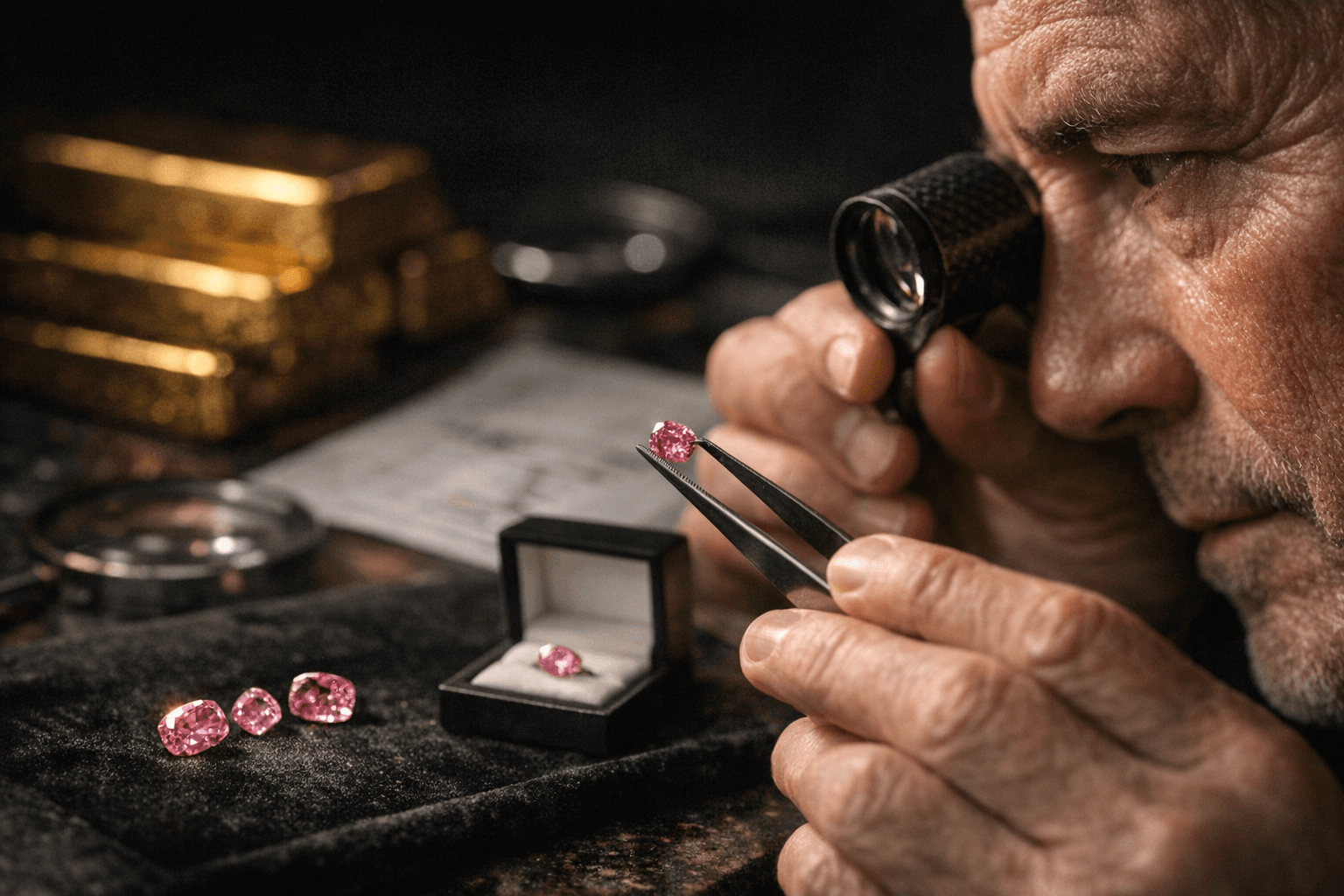
Before you spend a single dollar on a pink diamond, understand the one fact that changes how this entire market works: in November 2020, Rio Tinto permanently closed the Argyle mine in Western Australia's East Kimberley region, and roughly 90% of the world's natural pink diamond supply vanished with it. Not redirected. Not replaced. Gone. The closure was geologically final, and in its wake, prices at Christie's, Sotheby's, and Phillips have more than doubled at the investment-grade tier, with per-carat records now regularly exceeding $2 million for the finest certified stones.
What followed was a surge of dealer activity and investment pitches that ranges from genuinely compelling to dangerously misleading. The pink diamond market has always demanded specialist knowledge; today it demands it more urgently than ever. The divide between a stone that will hold and grow its value and one that will disappoint you at resale begins with a single question: does it carry Argyle provenance, or not?
The Supply Shock That Defined a Market
The Argyle mine, which opened in 1983, once accounted for more than 90% of the world's pink diamond production. But the output was never plentiful. Of the mine's total production, only 5% ever reached gem quality, and of that already scarce fraction, just one in 10,000 stones was pink. That is not a marketing exaggeration; it is the geological reality that justified an entire annual ritual: the Argyle Pink Diamond Tender, a sealed-bid, invitation-only auction held each December, offering roughly 60 extraordinary stones to a controlled global network of select ateliers including Tiffany & Co. in New York, Chow Tai Fook in Hong Kong, Calleija in Australia, and Boodles in London. When the mine closed, that pipeline closed permanently with it.
The Fancy Colour Research Foundation documented an average appreciation of 398% in pink diamond values between 2005 and January 2024, with post-closure annual gains running between 8% and 12% for Argyle-certified stones. At Christie's New York, the Eden Rose, a 10.20-carat fancy-intense-pink brilliant, sold for $13.3 million. At Phillips Geneva, a 6.21-carat fancy-vivid-pink achieved $12 million. In November 2020, weeks before the mine's final closure, Sotheby's sold a 14.83-carat vivid purple-pink in Geneva for $26.6 million. Most recently, in December 2025, a 3.27-carat Fancy Vivid Orangy Pink ring sold at Sotheby's for $920,750, confirming that even mid-size stones with vivid grades command serious money when documentation is airtight.
Argyle vs. Non-Argyle: The Provenance Divide That Determines Everything
Not every pink diamond on the market carries Argyle provenance, and understanding this distinction is the foundation of intelligent buying. The Argyle mine produced stones with a distinctive warm, often purplish-pink hue quite different from the cooler, sometimes more orange-inflected pinks from African or Russian sources, or the historically revered gems from India's ancient Golconda region. The Daria-i-Noor, a pale pink of roughly 186 carats from the Golconda kingdom's Kollur mine, remains one of history's most celebrated examples of the non-Argyle tradition. Lawrence Graff's acquisition of a 24.78-carat Fancy Intense Pink at Sotheby's Geneva for $46.16 million, later repolished to become the 23.88-carat Fancy Vivid Pink known as the Graff Pink, demonstrated that non-Argyle stones of extraordinary quality command extraordinary prices. But such stones are the exception, and their value hinges entirely on intrinsic quality rather than a built-in provenance narrative.
What makes Argyle provenance financially consequential is its documentation. Every stone sold through the official Argyle Pink Diamond Tender received an Argyle Certificate of Authenticity, issued by Rio Tinto's own gemologists, that recorded the exact weight, color grade, and tender lot number. No new certificates can ever be issued. They function as an irreplaceable title deed. Combined with a GIA grading report, the global standard in independent gemological certification, an Argyle-certified stone carries dual authentication that an uncertified or non-Argyle pink cannot replicate. For buyers of post-closure stones seeking to verify Argyle origin independently, the Delta Diamond Laboratory now performs spectroscopic analysis, including photoluminescence and infrared absorption testing, and issues Delta certificates for stones confirmed to have the geological characteristics consistent with the Argyle deposit.
Color Above All: Grading Hue, Saturation, and the Fluorescence Question
The GIA grades fancy-colored diamonds on a scale that progresses from Faint and Very Light through Fancy Light, Fancy, Fancy Intense, and Fancy Vivid at the pinnacle. For pink diamonds, this hierarchy is the price schedule. A Fancy Vivid Pink of one carat can command multiples of a Fancy Pink of identical weight and clarity, because that depth of natural saturation is extraordinarily rare. The hue modifier compounds the premium: purplish-pink stones consistently outperform orangy-pink or brownish-pink at major auction houses, with the Argyle mine's own designations, particularly its rare "Fancy Red" classification, representing some of the rarest gemstones on earth.
Fluorescence adds another layer of nuance that sophisticated buyers can use strategically. Approximately 70% of Argyle diamonds exhibit some degree of blue fluorescence under ultraviolet light, a characteristic that, unlike in colorless diamonds where strong fluorescence is often penalized, can enhance the visual richness of a pink stone's color in certain lighting conditions. However, sellers who present fluorescence as an unambiguous positive are simplifying a complex variable. Auction specialists assess it case by case, and a stone whose color profile shifts unpredictably under different light sources may underperform in a major sale compared to a fluorescence-free stone with a pure, saturated natural hue. When evaluating any pink diamond, request to view it under both natural daylight and UV light before committing.
Setting Choices: Showing the Stone at Its Best Without Sacrificing the Asset
If you intend to wear your pink diamond rather than vault it, the setting carries real consequences for both the stone's appearance and its long-term condition. A prong setting lifts the diamond above the metal band, allowing light to enter from all angles and project the color and brilliance of the stone to maximum effect. It is the default choice of major auction houses when presenting important pink diamonds in ring form, precisely because it communicates confidence in the quality of the stone itself. The exposure also carries risk: prongs wear down over decades and can catch on fabric, making professional inspection every few years essential for any prong-set stone of value.
A bezel setting, which encircles the diamond's girdle in a continuous band of metal, offers substantially greater protection for daily wear. The tradeoff is a reduction in lateral light entry, which for a pink diamond, where color saturation is the primary value driver, is a meaningful consideration. Low-profile bezels set in rose gold offer a practical compromise: the warm metal tone reflects pink light into the diamond's pavilion, optically enriching the color while keeping the stone secure. For collectors who genuinely intend to wear their stone daily, this combination of protection and color enhancement makes a compelling case.
The Reality Check: What Sellers Claim vs. What Auctions Actually Reward
Here is where the buying guide becomes genuinely protective. A category of dealers and advisors now presents pink diamonds as straightforwardly liquid, steadily appreciating assets comparable to gold bullion. The comparison is appealing and significantly misleading. Gold's daily global trade volume reached approximately $130 billion in 2025. You can convert a gold position to cash in minutes through a standardized, globally recognized instrument. A pink diamond is, by nature, unique. It has one potential buyer at any given moment, and finding that buyer requires time, expertise, and institutional access.
Transaction costs at major auction houses, where the most transparent price discovery happens, typically run to 15-30% when both buyer's premium and seller's commission are combined. Add storage, insurance, and the opportunity cost of illiquidity, and the arithmetic of resale becomes far less forgiving than dealer pitch decks suggest. A stone without airtight GIA certification and clear provenance documentation will struggle at auction regardless of the broader market narrative around Argyle scarcity.
What the auction results consistently confirm is that the premium is real but narrowly concentrated. Certified Argyle stones with Fancy Vivid or Fancy Intense grades, above one carat, with a clean and documented chain of custody, perform. Smaller, lighter-colored, or inadequately certified stones frequently disappoint sellers who bought the category rather than the stone. Growing collector demand from Asia and the Middle East is genuine, with firms like Chow Tai Fook and institutional bidders from Hong Kong and beyond regularly competing at major sales. But that demand is selectively concentrated on the finest material with the strongest documentation.
The scarcity story is real. The Argyle mine is closed, and no equivalent source has emerged. What the market rewards, at auction and in private sales alike, is not the narrative alone but the specific, certifiable, irreplaceable quality behind it. A pink diamond that earns a place in a serious collection must be able to stand on its own, stone by stone, certificate by certificate, carat by carat. That is the standard worth shopping to.
This article was produced by Prism’s automated news system from verified source data, official records, and press releases, then run through automated quality and moderation checks before publishing. The system is built and supervised by the people who set the standards it runs under. Read our full AI policy.
Did this article answer your question?