Simple Steps to Keep Your Diamond Rings and Gemstones Sparkling Clean
A 20-minute soak and the right solution can restore a diamond's fire — but the wrong cleaner on an opal or turquoise will cause irreversible damage.

Diamonds are magnets for the mundane. Every time you reach into a bag, apply hand lotion, or cook dinner, microscopic films of oil, skin cells, and soap residue settle onto the facets and beneath the settings where light is supposed to travel freely. The result is a stone that looks cloudy rather than brilliant, not because it has changed, but because the surface hiding its fire has. The good news: restoring that sparkle requires nothing more exotic than warm water, mild dish soap, and a soft brush — with a few important caveats depending on what's actually set in your ring.
Why diamonds lose their brilliance
A diamond's optical performance depends on light entering through the table, bouncing off internal facets, and returning to your eye as fire and scintillation. Any film on the crown or pavilion interrupts that path. Skin oils are the primary culprit, but lotions, perfumes, cleaning sprays, and even hard water deposits compound over time. The cumulative effect is gradual enough that many wearers don't notice the decline until they see the stone cleaned and are startled by the difference.
The at-home cleaning method for diamond rings
The most effective home protocol combines two simple ingredients: a warm solution of mild liquid detergent, a splash of ammonia, and water. The ammonia cuts through the oil films that soap alone sometimes struggles to dissolve, and it's what gives cleaned diamonds that sharp, almost electric transparency. The process, as recommended by Christopher Duquet, the Evanston, Illinois-based jeweler known for handcrafted fine jewelry, moves through four clear steps:
1. Soak the ring in the warm detergent-and-ammonia solution.
2. Use a soft brush if necessary to loosen any embedded dirt.
3. Swish the ring around in the solution, then rinse well with warm water.
4. Pat dry with a lint-free cloth, or use a blow-dryer if you're short on time.
For the soak itself, twenty to thirty minutes gives the solution adequate time to penetrate and lift the buildup from underneath prongs and around the girdle, where grime tends to concentrate. The soft brush — a dedicated soft-bristled toothbrush works well — is most useful for scrubbing behind the stone, where the pavilion meets the setting and where a surprising amount of debris accumulates invisibly.
A note on ammonia: while it is effective for diamonds and certain other hard stones, it is not universally safe across all metal types and all settings. If your ring has plated metal components or unusual alloys, check with a jeweler before using it. The guidance here is drawn directly from Christopher Duquet's care protocol and is most applicable to standard gold and platinum settings.
Cleaning other gemstones: a stone-by-stone guide
Not every gemstone responds the way a diamond does, and using the wrong method on the wrong stone can cause lasting damage. The material category of your stone dictates the approach.
*Transparent crystalline gemstones* — aquamarine, topaz, tourmaline, and similar stones — are generally robust but benefit from a gentler solution than ammonia. Soak them in water with a touch of gentle soap, and if there is residue caught behind the stone in the setting, use a soft toothbrush to scrub carefully in that area.
*Rubies, sapphires, and other single-crystal gems* are corundum-family stones with a hardness of 9 on the Mohs scale, making them well-suited to a slightly stronger approach. A touch of ammonia in water removes the surface films that dull their color saturation and restores the vivid transparency that makes these stones so prized. The ammonia lift is particularly effective on blue sapphires, where a film can shift the apparent color toward gray.
*Opal and opaque gemstones* require an entirely different standard of care, and the rules here are absolute. Lapis lazuli, turquoise, and malachite are highly porous materials that will absorb chemicals, and that absorption is irreversible. Never use an ultrasonic cleaner, ammonia, or any chemical solution on these stones. The appropriate method is the simplest one: wipe carefully with a moist cloth. The same prohibition applies to opal, which is additionally sensitive to sudden temperature changes that can cause crazing, a fine network of surface fractures that permanently destroys the stone's play-of-color.
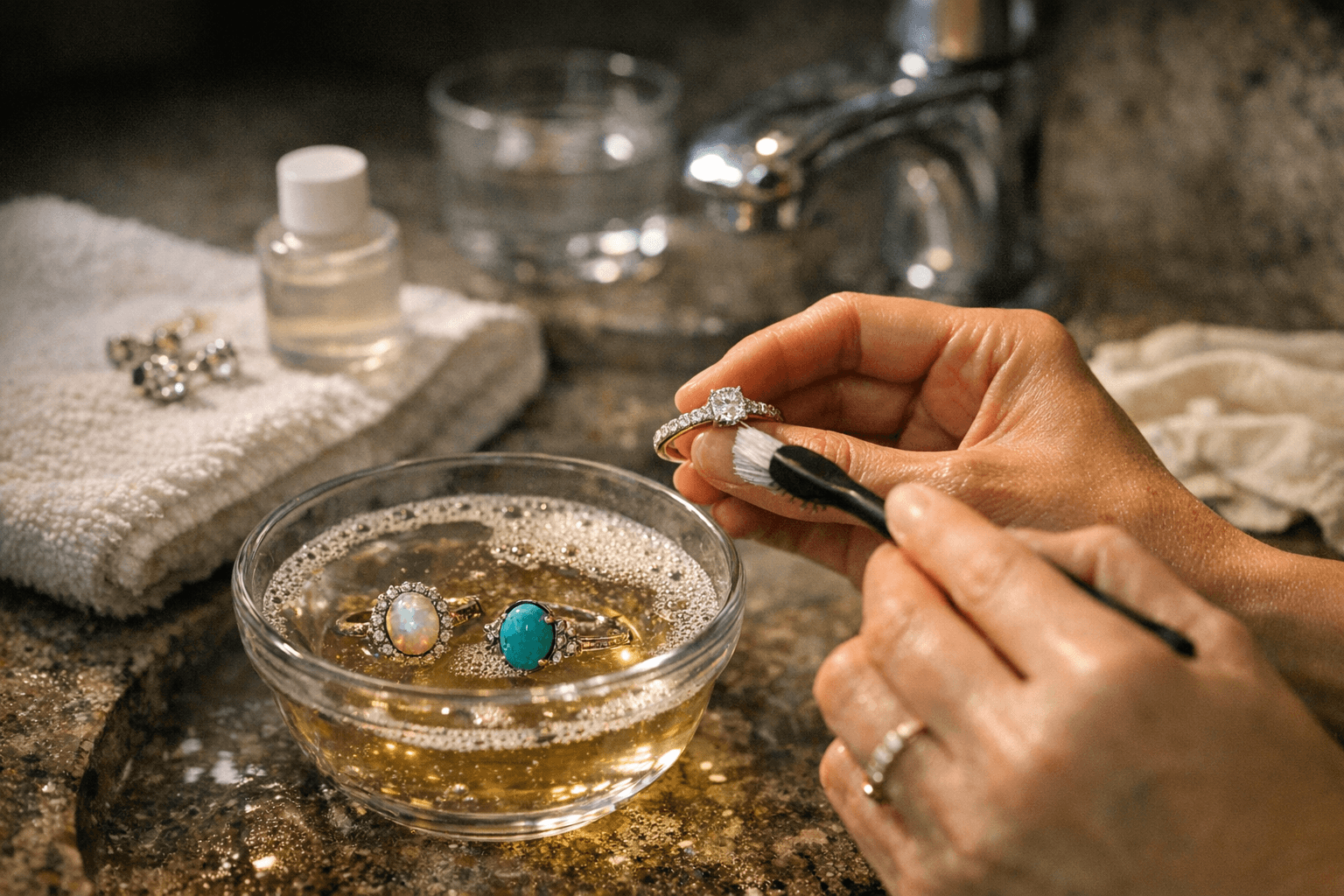
The distinction between these categories is not arbitrary. It reflects the fundamental material science of each stone: its porosity, its hardness, and its sensitivity to chemical or mechanical agitation. Treating a turquoise cabochon the way you treat a diamond solitaire is a common mistake with uncommon consequences.
Wear habits that protect your jewelry
Cleaning frequency matters less if the jewelry is being exposed to conditions that accelerate damage. Even though diamonds rank 10 on the Mohs hardness scale, making them the hardest natural material on earth, hardness measures scratch resistance, not impact resistance. A diamond can chip if struck at the right angle, particularly along the girdle or at the culet. Christopher Duquet's care guidelines state it plainly: "Even though diamonds are very sturdy, a tough blow can still chip them; therefore, it is best to avoid wearing your diamonds while engaging in rough work, such as yard work, household chores, or sports."
The other habit worth building is a routine inspection of your prongs and settings. Prongs wear down, and a stone that was secure six months ago may have shifted slightly. "If you do notice any loose stones, take the piece off and have it checked by a professional before wearing it." That advice applies to all fine jewelry, not just diamonds. Catching a loose prong before the stone falls out is dramatically less expensive than sourcing a replacement stone.
Storing your jewelry properly
How you store your jewelry when you're not wearing it determines a significant portion of its long-term condition. The single most important rule: gemstones should never touch each other. Diamonds, as the hardest material, will scratch everything else they contact — including other gold components and softer gemstones. Store pieces in a fabric-lined case or wrap individual items in a soft cloth, ensuring they remain separated. The goal, as Christopher Duquet puts it, is to ensure "the gems do not touch each other or scratch the surfaces of your other fine jewelry."
When professional care matters
Home cleaning maintains brilliance between professional visits, but it is not a substitute for hands-on assessment by a skilled jeweler. Christopher Duquet's Evanston studio, located at 1224 Chicago Ave. #102, offers an unusually comprehensive service commitment: cleaning, polishing, and overall check-ups are free for life for pieces purchased there. The professional jewelers there can assess prong integrity, check for hairline fractures in settings, and perform the kind of precision polishing that returns a metal band to its original finish.
Even if you didn't purchase a piece from a specific jeweler, an annual professional inspection is worth building into your routine. A jeweler with a loupe can identify wear that is invisible to the naked eye. For pieces worn daily, twice-yearly check-ins are not excessive.
A note on gemstone categories not fully covered here
Pearls occupy a category of their own, distinct from crystalline gems and opaque stones, and require separate guidance that goes beyond the scope of this article. Pearl care involves specific precautions around acids, perfumes, and even perspiration, and cleaning methods differ meaningfully from anything appropriate for a faceted stone. If your collection includes pearl jewelry, seek dedicated guidance from a jeweler familiar with organic gem materials.
The foundation of good jewelry care is not complicated: know what material you're working with, use the mildest effective method, and don't skip the professional check-ins. A diamond that has been properly maintained over decades will look as alive on its fiftieth anniversary as it did the day it was set.
This article was produced by Prism’s automated news system from verified source data, official records, and press releases, then run through automated quality and moderation checks before publishing. The system is built and supervised by the people who set the standards it runs under. Read our full AI policy.
Did this article answer your question?