Smithsonian acquires first contemporary painting for gem collection
The Smithsonian added a painting, not just a diamond, signaling that the story of rarity now lives in both the stone and the art around it.
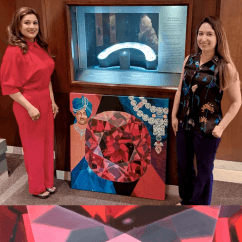
The Smithsonian has widened the frame around one of the world’s rarest diamonds by adding Reena Ahluwalia’s The Legacy of the Winston Red Diamond to the National Gem Collection, making it the first contemporary painting to enter that archive. The acquisition matters because it treats a red diamond not only as a mineral specimen, but as a cultural object whose meaning can be carried by art, science and provenance at once.
The work centers on the 2.33-carat Winston Red Diamond, a fancy red stone now publicly displayed at the Smithsonian National Museum of Natural History in Washington, D.C. Smithsonian sources say fewer than two dozen pure red diamonds over one carat are known in the public record, and the Winston Red is the only red diamond of its kind available for public viewing. It is also described as the largest red diamond going on public display, a distinction that gives the gem unusual weight even in a collection already built on exceptional stones.

Ronald Winston gave the diamond to the museum in 2023, extending a family relationship with the Smithsonian that began in 1958, when Harry Winston donated the Hope Diamond. A Smithsonian paper described the gift as one of the most significant donations to the National Gem Collection in the last decade, a reminder that the museum’s most consequential additions often arrive with a chain of history attached.
Ahluwalia’s painting was shaped by that history and by science. The artist said the work was inspired by Ronald Winston’s gift and by a spring 2025 Gems & Gemology study by Dr. Gabriela A. Farfan and her team. That study connected the Winston Red’s color to absorption features associated with plastic deformation and nitrogen-related defects, turning a visual mystery into a mineralogical story. Ahluwalia translated that finding into a single composition, bringing the gem’s internal structure into the realm of contemporary interpretation.

For collectors and jewelers, the acquisition signals a subtle but important shift. Museums are no longer preserving rare diamonds only as isolated objects under glass; they are building a broader narrative ecosystem around them, one that includes scholarship, display and commissioned art. In that sense, the Winston Red is doing double duty: it remains a superlative natural diamond, but it is also becoming a piece of cultural IP, its rarity amplified by the stories built around it. That is how extraordinary stones stay visible, legible and relevant.
This article was produced by Prism’s automated news system from verified source data, official records, and press releases, then run through automated quality and moderation checks before publishing. The system is built and supervised by the people who set the standards it runs under. Read our full AI policy.
Did this article answer your question?