Tiffany unveils Hidden Garden Blue Book, a new high-jewelry chapter
Tiffany’s Hidden Garden leans into yellow diamonds, butterfly form and the house’s gemstone lore, from kunzite to tsavorite. Its boldest pieces read like future cues for statement jewelry.

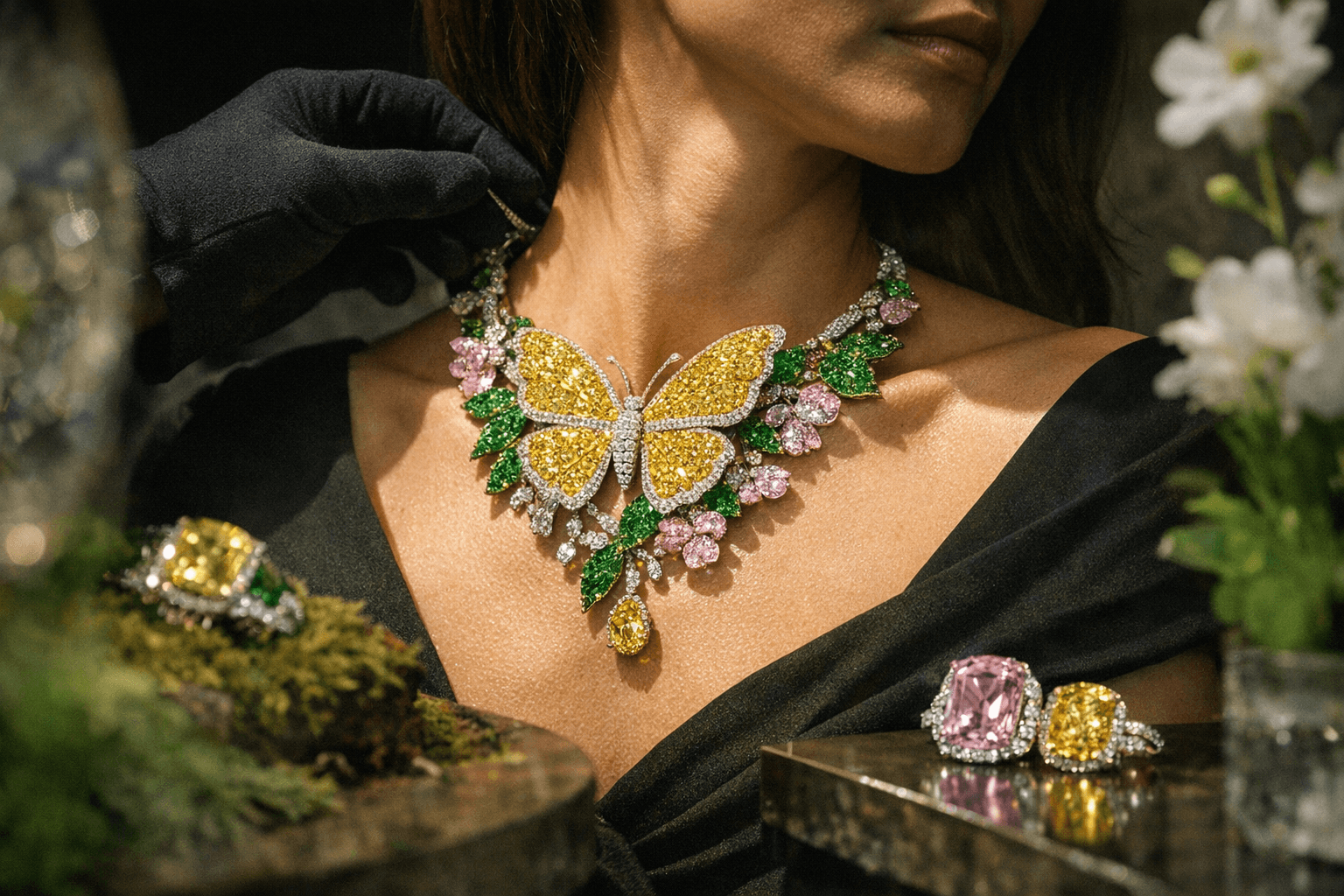
Tiffany’s new Hidden Garden Blue Book chapter arrives with the kind of visual authority that can reset a season: a butterfly necklace worn by Gwyneth Paltrow at the 98th Academy Awards, built around three oval fancy vivid yellow diamonds, 830 round brilliant diamonds and eight pear-shaped diamonds. It is the sort of piece that turns diamond jewelry from ornament into spectacle, pairing saturated color with dense, architectural sparkle.
That necklace also reveals where high jewelry is moving next. Tiffany is leaning hard into nature motifs, but not in a soft, sentimental register. Under Nathalie Verdeille, the house has been pushing archival references through a more sculptural lens, and Hidden Garden suggests that the next wave of statement diamond jewelry will favor controlled drama, high-contrast stone pairings and jewel-encrusted silhouettes that read almost like miniature set pieces. Yellow diamonds, especially when framed by brilliant and pear-shaped whites, give the eye a clear focal point. The effect is cleaner and more modern than a fully pavé white-diamond surface, while still feeling lavish enough for the red carpet.
Hidden Garden sits inside Tiffany’s Blue Book tradition, which the house says dates to 1845, when it launched the first mail-order catalog in the United States. Tiffany also describes itself as the first American high-jewelry house, and the collection is meant to reinforce that lineage rather than simply decorate it. The brand’s gemological history runs from Charles Lewis Tiffany’s appetite for rare stones to Dr. George Frederick Kunz, who joined in 1876 and helped identify kunzite in 1902 and morganite in 1910. Tiffany says it introduced tanzanite in 1968 and, in 1974, Henry B. Platt named tsavorite. Its latest acquisition, an approximately 7,500-carat kunzite, underscores how aggressively the house still courts extraordinary material.
The timing matters, too. Tiffany’s 2025 Blue Book, Sea of Wonder, unfolded in six chapters, Ocean Flora, Seahorse, Starfish, Urchin, Sea Turtle and Wave, and the house said that collection helped bring home the Jury’s Special Prize and the Heritage Prize at the inaugural Grand Prix de la Haute Joaillerie in Monaco. Hidden Garden feels like the next step in that strategy: less a discrete theme than a signal that collectible high jewelry is moving toward bolder color, more emphatic natural forms and diamonds deployed in compositions that reward distance, not just close inspection. Tiffany says every Blue Book creation is one of one and offered at price upon request, which is exactly what keeps this conversation firmly in the realm of connoisseurship.
This article was produced by Prism’s automated news system from verified source data, official records, and press releases, then run through automated quality and moderation checks before publishing. The system is built and supervised by the people who set the standards it runs under. Read our full AI policy.
Did this article answer your question?