Top Color, Clarity, and Cut Standards for Investment-Grade Diamonds
Only about 1–2% of all mined diamonds qualify as Type IIa — and when D color, IF clarity, and an Excellent cut converge in a stone of 3 carats or more, you're looking at one of the rarest objects on earth.
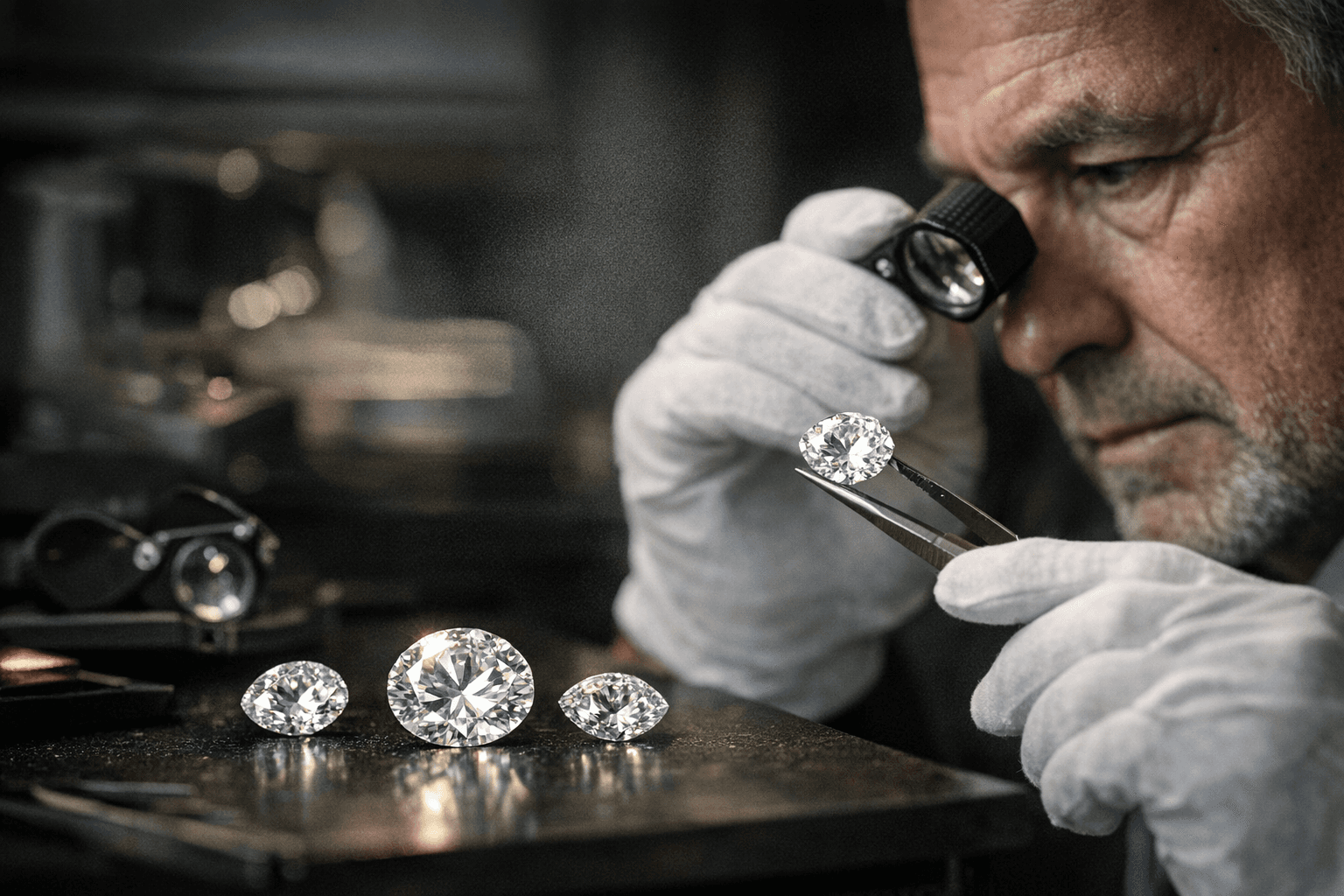
Pick up a 3-carat, D-color round brilliant and hold it under the light. What you're seeing isn't just a gem — it's the convergence of geological accident, human craftsmanship, and institutional trust. Investment-grade diamonds are defined by an extraordinarily precise set of standards, and understanding each one is the difference between buying a beautiful stone and buying an asset.
Color: The Colorless Tier
The diamond color scale runs from D to Z, where D represents a perfectly colorless stone and Z indicates visible yellow or brown tinting. For collectors focused on long-term value, only the top three grades matter. Diamonds graded D, E, and F are considered colorless; G through J fall into the near-colorless range, where any tint is difficult or impossible to detect with the naked eye, especially once a stone is set in metal.
D color is the undisputed apex. The scale was designed by the GIA with no A, B, or C grades precisely so the system would start fresh, without legacy associations from earlier, inconsistent grading methods. That institutional intentionality matters: it means D is not merely a marketing superlative, but a defined scientific endpoint. When paired with a Type IIa classification, the colorlessness of a D-grade stone reaches an almost uncanny purity — what the trade historically called a "Super D," a stone so absent of warmth that white stones of this class with a D color grade are often whiter than other D grade quality stones.
Clarity: Internally Flawless to VVS1
Clarity measures how free a diamond is from inclusions (internal characteristics) and blemishes (surface flaws). The GIA Clarity Scale consists of categories ranging from Flawless to Included, and it contains 11 specific grades. For investment purposes, the threshold sits firmly at the top: Internally Flawless (IF) and VVS1.
An Internally Flawless diamond has no inclusions visible under 10x magnification, though it may have minor blemishes. VVS1 diamonds contain inclusions so slight they are extremely difficult even for a skilled grader to detect. The practical difference between VVS1 and VS1 may be invisible to the naked eye, but in the investment market, that single grade can represent a significant price differential — particularly as carat weight climbs above three carats, where minor inclusions become proportionally more visible and more consequential to value.
For those seeking the ideal combination, Type IIa with D color, no fluorescence, and IF or VVS1 clarity represents the pinnacle of investment-grade quality.
Cut: The Human Variable
Color and clarity are gifts of geology. Cut is where human skill either honors or squanders them. While nature determines the color and clarity of a natural diamond, man is responsible for the cut quality that brings it to life; the planning, proportions, cutting precision, and details of the finish determine how brilliant, dispersive, and scintillating the diamond will be.
The GIA Cut Grading System evaluates round brilliant diamonds on a five-point scale: Excellent, Very Good, Good, Fair, or Poor. GIA evaluates cut using seven key components: brightness, fire, scintillation, weight ratio, durability, polish, and symmetry. For investment-grade stones, only Excellent (or its equivalent, Ideal) is acceptable. These cuts are well-proportioned with optimal facet angles, allowing brilliance and fire to pass through the table for all to see, which is why excellent cuts are more valuable and more luminous.
There is an important nuance for fancy shapes. The round brilliant diamond is currently the only diamond shape that receives an official cut grade on GIA diamond reports. For emerald cuts, ovals, and pears — shapes that appear with some frequency in important stones — the collector must look instead at individual polish and symmetry grades, and weigh them against a careful visual assessment. The absence of an official cut grade is not a disqualifier, but it demands more due diligence.
For round brilliants specifically, the target is what the trade calls a "triple Excellent": a Super Ideal cut diamond whose proportion, polish, and symmetry have all received a top grade (known by GIA/IGI as Triple Excellent), representing the highest-quality stones with incredible, eye-catching sparkle.
Type IIa Classification: Beyond the 4Cs
The 4Cs capture what a diamond looks like. Type classification captures what it actually is at the atomic level. Type IIa diamonds are the purest form of diamonds, with no measurable nitrogen or boron impurities. They represent only 1% to 2% of all diamonds. That statistical rarity alone commands a price premium, but the premium is justified by something deeper than scarcity.
Type IIa diamonds are formed under high-pressure and high-temperature conditions, which can give them higher clarity and brilliance. As a result of the compounded elements within, Type IIa stones rarely contain internal imperfections and are famous for their color. In white diamonds, the absence of nitrogen translates directly to a more vivid, water-like transparency that the standard color scale struggles to fully capture.
Often referred to as "Golconda" diamonds — after one of the first diamond mines discovered in India that supplied the majority of this class — Type IIa stones are the most desirable by collectors. The Golconda region of India has been associated with the highest quality diamonds since the 4th century BC, and Golconda diamonds have historically been known for their exceptional clarity and colorlessness, though the technology to classify Type IIa diamonds wasn't formalized until the 1960s. Today, Type IIa diamonds are also mined in South Africa, Lesotho, Botswana, Angola, Zimbabwe, and Canada.
The auction record for this category is not hypothetical. The Pink Star Diamond, flawless and featuring a fancy vivid pink color, sold at auction in 2017 for more than $71 million. The 18.96-carat Pink Legacy, also Type IIa, sold for more than $50 million in 2018. Large Type IIa diamonds with high grades are sought-after assets with significant potential for appreciation in value, especially at high-profile auctions.
Size: Why 3 Carats Is the Collector's Threshold
Carat weight is not merely a vanity metric in the investment market — it is a liquidity variable. Stones below two carats, however exceptional, trade in a broader, more competitive market where substitutability suppresses premiums. Above three carats, the pool of comparable gems narrows sharply, and the compounding effect of D color, IF-VVS1 clarity, and Type IIa classification on a large stone creates a category of near-irreplaceable objects.
Type IIa diamonds tend to be significantly larger than the average diamond found in a jewelry store or even on the red carpet, and this fact alone means that, before you even account for their near-perfection, they are already bound for an incredibly high price tag. At five carats, prices for a Type IIa diamond can vary widely but generally start at around $200,000 and can exceed $300,000 for a white diamond depending on exact characteristics.
Certification: The Document Is Part of the Asset
An investment-grade diamond without authoritative certification is an assertion without proof. A GIA Diamond Grading Report is the internationally trusted source for diamond quality reporting by jewelers, museums, and auction houses. A GIA report can also help you prove quality should you ever wish to resell your diamond. Critically, for Type IIa stones, Sotheby's recommends only purchasing a Type IIa diamond with a GIA certificate that will include the Type IIa classification.
For important colored diamonds and stones where provenance is a factor, the American Gemological Laboratories (AGL) carries equivalent authority in its specialist domain. Founded in 1977, AGL is a premier gemological laboratory specializing in colored gemstone analysis, origin determination, and advanced scientific reporting, renowned for its independence, research-driven approach, and technical leadership, serving major luxury brands, auction houses, retailers, and collectors worldwide. AGL is regularly featured by Sotheby's and Christie's for important colored stones they offer for sale.
The certificate is not paperwork — it is provenance. At the level of stones where investment intent is real, the GIA report number laser-inscribed on the girdle, verifiable online at any moment, is as much a part of the asset's identity as the stone itself.
Reading the Standard as a Whole
None of these criteria operates in isolation. The 4Cs don't operate in isolation; they interact, compensate, and sometimes contradict each other in ways that make diamond buying genuinely complex. A D-color, IF stone with a mediocre cut is not investment-grade. A Type IIa classification on a poorly proportioned two-carat stone carries significantly less weight than the same classification on a five-carat triple-Excellent round brilliant. The standard only functions when all its components converge: D through F color, IF to VVS1 clarity, Excellent cut, Type IIa purity, three carats or above, and a GIA or AGL certificate to document everything.
What makes this checklist demanding is precisely what makes it valuable. The stones that meet it fully are, by definition, among the rarest objects mined from the earth — and that rarity, independently verified and precisely documented, is the foundation of any serious diamond investment.
This article was produced by Prism’s automated news system from verified source data, official records, and press releases, then run through automated quality and moderation checks before publishing. The system is built and supervised by the people who set the standards it runs under. Read our full AI policy.
Did this article answer your question?