Treasure House Fair spotlights six centuries of estate jewelry in London
From a 1900 Chaumet Golden Fleece insignia to a 16th-century ring, Treasure House Fair turns estate jewelry into both history lesson and investment case.
Estate jewelry takes the lead at Treasure House Fair in London, where six centuries of diamonds, mourning jewels, rings and insignia are gathered under one roof at the Royal Hospital Chelsea. The fourth edition of the fair opened with a press preview on 24 June and runs through 30 June 2026, with public hours beginning on 25 June, and the strongest pieces read as much like documents of power and memory as they do ornaments.
A fair built around provenance
Treasure House Fair has positioned itself as the UK’s leading destination for historic and antique jewelry, and that claim is sharpened by the way the fair is structured. It brings together art, antiques and design from 60 galleries, with every piece vetted by independent experts, a safeguard that matters in a market where provenance can determine both desirability and value. Founded in 2023 by Thomas Woodham-Smith and Harry van der Hoorn, the co-founders of Masterpiece London, the fair arrived after Masterpiece closed in 2022, carrying forward a London summer art fair tradition that Treasure House says dates back to 1934.
That history gives the jewelry section a useful role beyond display. In a season crowded with contemporary stones and branded newness, the fair’s estate jewelry offers a different kind of luxury logic: rarity anchored by named owners, court connections and recorded histories. For collectors, that is the appeal of the pieces on view, because they offer design reference and alternative investment in the same object.
The pieces drawing the eye
The standout jewel in the fair’s line-up is the Duke of Alba’s 1900 Chaumet Golden Fleece insignia, set with diamond, sapphire and ruby. The Order of the Golden Fleece was the highest chivalric honour of the Spanish Crown, and that status matters here because insignia jewelry occupies a rare place between adornment and ceremony. A piece like this carries the geometry of a badge, the color contrast of a jewel, and the political weight of an emblem once worn to signal rank.
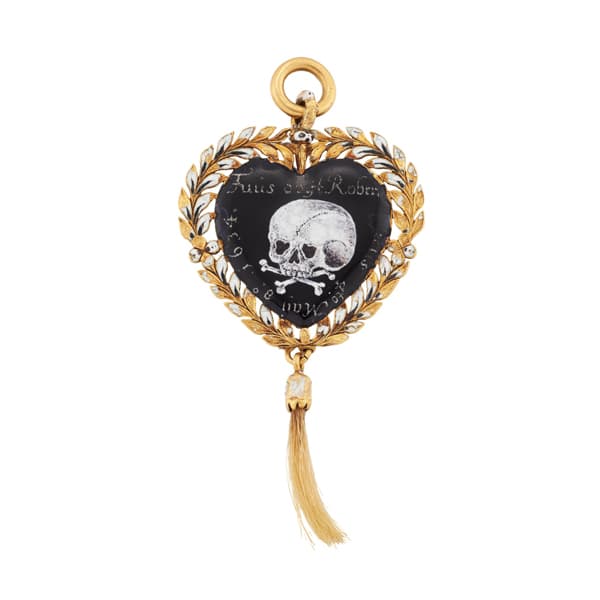
Just as compelling is Martyn Downer’s stand, devoted to a Hamnet-era mourning jewel. The piece was made to commemorate Sir Thomas Aston’s six-year-old son Robert, who died in 1634, and its survival adds emotional texture to the fair’s broader historic spread. Mourning jewels are among the most intimate categories in antique jewelry, because they were created not simply to decorate but to preserve a name, a date and a grief in metal and stones.
Greens of Cheltenham is showing another object with courtly depth, a 16th-century ring that belonged to a knight close to Henry VIII and Queen Anne. Its family history was later obscured after the line became entangled in the Gunpowder Plot of 1605, which gives the ring the rare tension of aristocratic prestige shadowed by political ruin. Pieces like this are the reason collectors still travel for estate jewelry: the setting, the wear and the backstory are inseparable.
Why these historic styles are resonating now
What stands out across the fair is the strength of forms that carry identity rather than just sparkle. Diamond-set insignia, mourning jewels and rings with direct links to courts and households are the categories that feel most resonant, because they combine craftsmanship with narrative clarity. In a market where buyers increasingly want a jewel to do more than flash, these historical objects deliver ornament, authorship and evidence all at once.
That is also where the fair becomes a design source for contemporary buying. The 1900 Golden Fleece insignia shows how colored stones can be used to sharpen a heraldic silhouette. The mourning jewel shows how sentimental jewelry can be made with restraint and precision rather than excess. The 16th-century ring reminds modern buyers that scale is not the only measure of importance; a ring can carry dynastic or political charge even when its form is quiet.
The exhibitors to watch
The mix of exhibitors deepens that conversation. Rosior, the Portuguese jewelry maison, is making its debut at a European fair here, a noteworthy move for a house entering a room dominated by historic specialists and long-established London names. Alongside it are S.J. Phillips, Wartski, Greens of Cheltenham and Sandra Cronan, names that anchor the fair in traditional dealing expertise and connoisseurship.
Wartski is listed by Treasure House Fair as a specialist in fine jewelry, Fabergé, antique silver and objets de vertu, a profile that helps explain why it remains such a magnet for clients who want jewels with imperial or decorative-art pedigrees. S.J. Phillips, founded in 1869, is described by the fair as one of the oldest family-owned antique shops in the world, a lineage that gives its presence at Treasure House particular weight. In a fair built on vetted material, those names signal not just inventory, but institutional memory.
What to take from the fair
Treasure House Fair is also using jewelry to widen its reach beyond cases and salons. The 2026 edition includes a major exhibition marking 90 years of British Surrealism, a reminder that the fair sees itself as a cross-disciplinary event where design, collecting and art history overlap. For jewelry buyers, that matters because the broader context helps explain why the fair can hold both a 1900 insignia and a 16th-century ring in the same conversation as contemporary design.
The result is a fair that makes a strong case for estate jewelry as one of the most disciplined corners of luxury collecting. The best pieces here are not merely old, they are legible, authenticated and tied to people whose names still command attention. In London, that combination remains the most persuasive form of sparkle.
This article was produced by Prism’s automated news system from verified source data, official records, and press releases, then run through automated quality and moderation checks before publishing. The system is built and supervised by the people who set the standards it runs under. Read our full AI policy.
Did this article answer your question?