UK Valuers Now Required to Screen All Diamonds for Lab-Grown Origins
UK valuers must now screen every diamond before issuing an insurance or sale valuation, as lab-grown stones become impossible to distinguish by eye.

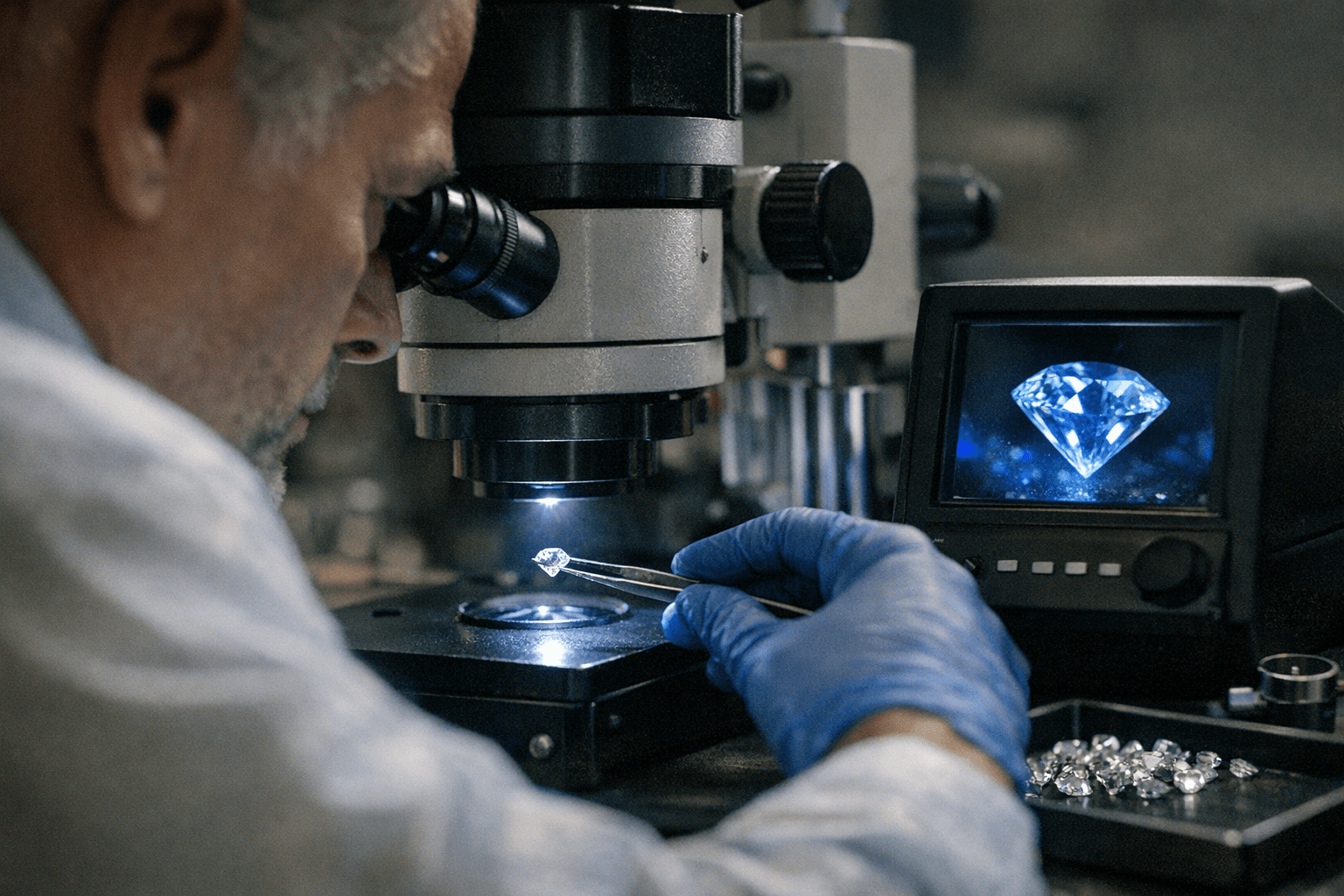
Before you insure a diamond, someone with qualified hands and specialist equipment now needs to confirm it actually formed beneath the earth's surface billions of years ago. That became the new professional standard for UK valuers on 31 March 2026, when the Institute of Registered Valuers updated its guidance to make diamond screening mandatory across all members.
The IRV, the UK's leading authority for jewellery, watch and silverware appraisers, operated under the National Association of Jewellers since its founding in 1987, issued the requirement as laboratory-grown diamonds have made the traditional eye-check obsolete. A stone produced via HPHT (High Pressure High Temperature) or CVD (Chemical Vapour Deposition) is chemically, physically and optically identical to a natural diamond. Without specialist screening equipment, even an experienced valuer cannot tell the difference.
That gap carries real professional and financial consequences. The UK jewellery valuation market is currently unregulated, meaning any company can offer a valuation service without meeting minimum standards. The IRV's new mandate, which covers insurance, probate and sale valuations, draws an enforceable line between its accredited members and the broader, unregulated field.
IRV Chair Sammantha Maclachlan was direct about the shift: "The diamond market has changed fundamentally, and our standards must reflect that reality." She framed the mandate not as a reactive measure but a forward-looking one: "This is about protecting both the valuer and the client, and about leading the profession forward. By taking this step, the IRV is actively shaping the future of valuation standards and not simply responding to it."
The groundwork had already been laid in Birmingham. SafeGuard Valuations, part of the Birmingham Assay Office, had adopted automatic diamond screening as standard practice following the rise of lab-grown stones entering the supply chain. Carla Goodfellow of SafeGuard Valuations put it plainly: "only by using specialist screening equipment can the distinct differentiating indicators be seen between those diamonds grown in a laboratory and those formed billions of years ago in the earth." The IRV's guidance now extends that expectation across the broader professional community.
The IRV has also opened conversations with insurers to ensure the new requirement carries formal weight in policy terms. Some insurance companies already stipulate that valuations must be carried out by a registered IRV member; the ongoing engagement is designed to formalise that recognition more widely, reinforcing the market distinction between compliant and non-compliant valuers.
Internationally, the standard aligns UK practice with a broader industry reckoning. CIBJO, the World Jewellery Confederation, published updated Laboratory-Grown Diamond Guidelines in 2024, requiring explicit disclosure of manufacturing method on all LGD reports. In June 2025, the GIA introduced a new descriptive quality framework for lab-grown diamonds, classifying stones as "premium" or "standard" rather than assigning specific colour and clarity grades.
For IRV members navigating the transition, practical support arrives at the organisation's annual Valuers' Conference on 16 and 17 May 2026, an event the IRV has run for more than 30 years. Live demonstrations of screening equipment will be available alongside updated technical guidance, and the conference will include the presentation of the David Wilkins Award to new members.
Entry to the IRV's Member and Fellow categories already requires valuation, gemmological and diamond grading qualifications, plus a minimum of five years' industry experience, with a mandatory Professional Review every five years. The new screening requirement adds a further technical layer to a credential that, in an unregulated market, now carries more weight than ever.
This article was produced by Prism’s automated news system from verified source data, official records, and press releases, then run through automated quality and moderation checks before publishing. The system is built and supervised by the people who set the standards it runs under. Read our full AI policy.
Did this article answer your question?