Bold engagement rings, from east-west settings to blackened gold gain ground
Bold rings are forcing the wedding band to work harder, with east-west stones, bezels, and blackened gold reshaping what a set looks like.
The center stone is no longer the only decision
A proposal ring now has to do more than sparkle on its own. As couples choose larger, more sculptural silhouettes, the wedding band has become part of the design problem, not an afterthought, and the most interesting sets are the ones that solve that problem visibly.
The shift is easy to see in the numbers. The Knot’s 2024 Jewelry & Engagement Study found that 77% of proposees had some sort of involvement in their ring selection process, which helps explain why so many rings now reflect a shared point of view rather than a single traditional formula. Even so, the classic still holds power: round solitaires made up 28% of all engagement-ring designs in 2024, and 51% of engagement rings had a clear diamond center stone with side stones and or accents. The market is not abandoning tradition so much as stretching it.
Why the band has to adapt
That stretch is changing the band itself. A bold engagement ring with floating diamonds, a bezel setting, or a toi-et-moi layout rarely looks best with a plain straight band pushed up against it. The better solution is often a contour, a gap, or a profile that mirrors the ring’s geometry instead of fighting it.
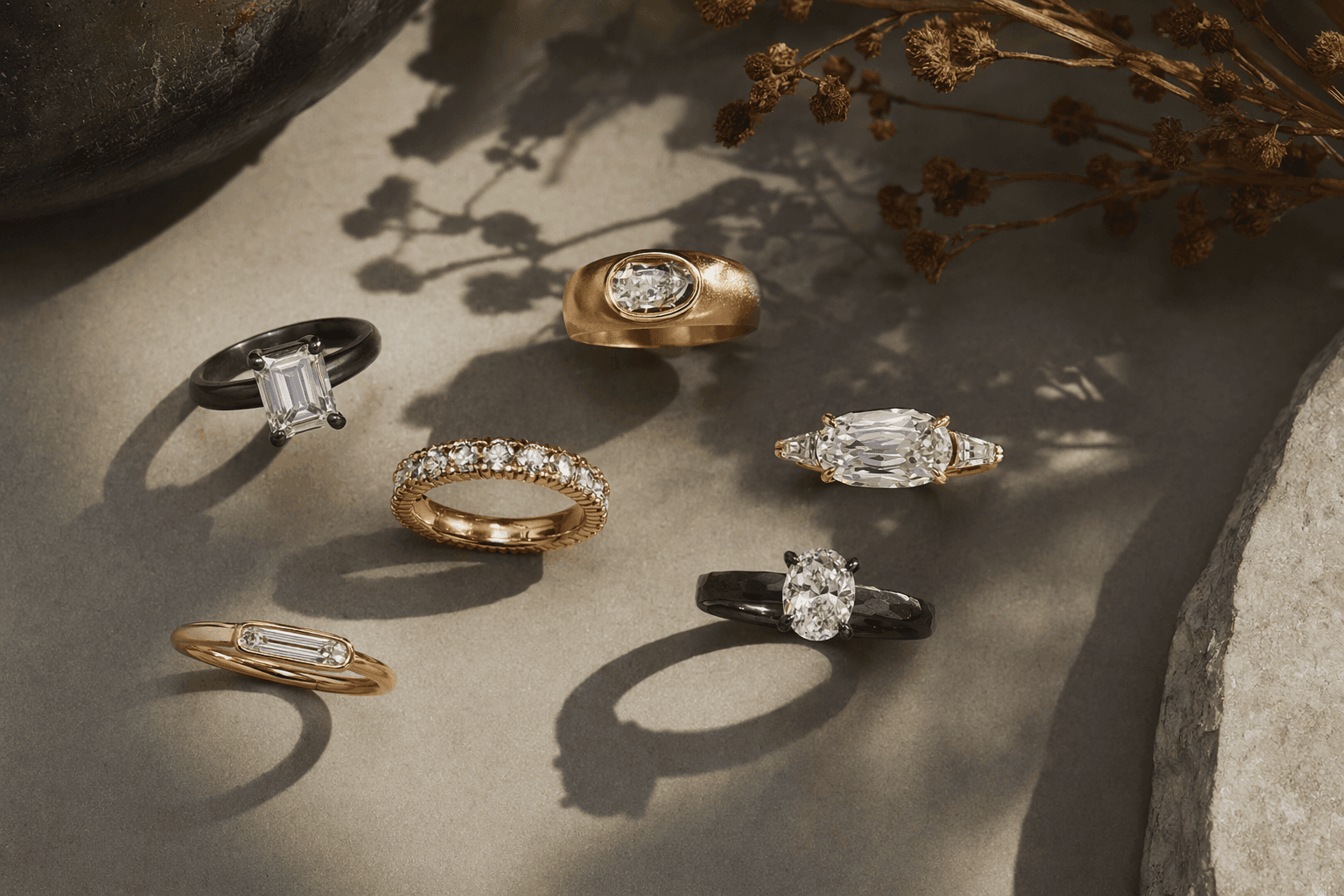
That is where the most practical modern pairings come in. Floating stones tend to call for curved bands that tuck under or around the setting. East-west rings often work best with clean, minimal bands that leave the horizontal stone to read clearly. Toi-et-moi rings, especially the more thoughtful asymmetric versions, look strongest when the band intentionally leaves space or offsets one side, so the set feels designed rather than forced together.
East-west settings changed the silhouette
Among all the recent shifts, east-west settings may have had the biggest visual impact. The Knot defines the style simply as an elongated stone set horizontally across the band, and that horizontal line has changed how the entire ring stack reads on the hand. JCK noted that an east-west orientation can make a gemstone appear larger, which helps explain why the style has spread so quickly across engagement jewelry.
The look also has deeper design roots. L’Officiel traced its modern appeal to a broader move, beginning in the late 2010s, toward rings that feel personal and unique instead of rigidly traditional, while also pointing to Art Deco-era experimentation as part of the style’s lineage. Rachel Boston’s response was telling: as interest rose, the brand added east-west designs to its permanent collection, a sign that this is no longer a novelty category but a lasting part of the engagement-ring vocabulary.
For the band, east-west settings reward restraint. A narrow straight band, a delicately contoured line, or a stacked pair with a little air between the rings lets the stone remain the focal point. When the band tries to compete, the set loses the clean, elongated effect that makes the style feel fresh.
Maximalism is coming with structure
The Knot’s 2025 trend outlook points to a more assertive direction overall: maximalist multi-stone rings, half bezels, marquise shapes, east-west settings, vintage cuts, thoughtful toi-et-mois, blackened gold, architectural designs, and bold color. That list says a lot about where bridal jewelry is going. It is not just bigger. It is more engineered, with settings that frame stones like small pieces of architecture.
JCK’s June 2024 wedding-jewelry panel reached the same conclusion in a different way: personalization was the dominant theme, and panelists made clear that there is no single type of engagement ring anymore. One retailer said that in the last 20 engagement rings sold, only about two were halos, a sharp reminder that the old default halo look is losing ground in some stores. Less-conventional shapes such as oval, pear, marquise, kite, and shield are rising, and those cuts often need bands that are equally considered, whether that means a clean straight line, a split shank, or a band that intentionally leaves negative space.
Materials are part of the message
The metal choice matters as much as the stone layout. JCK found yellow gold especially popular, while New York was seeing renewed demand for platinum and white gold, a split that reflects how regional taste can move in different directions at once. Yellow gold gives bold rings warmth and contrast, especially when paired with blackened gold or vivid center stones, while platinum and white gold keep a look crisp and architectural.
The market is also being reshaped by value and wearability. JCK reported that one retailer was selling eight out of 10 rings as lab-grown diamonds, a number that underscores how quickly buying priorities are changing. For many couples, the draw is not only price but also the chance to redirect budget into a larger stone, a more elaborate setting, or a more customized band solution that can handle daily wear without feeling precious to the point of fragility.
Taste is moving toward rings with a point of view
Fashion is nudging the category too. WWD linked current engagement-ring taste to quiet luxury and the mob wife aesthetic, two very different style references that both favor a strong visual identity. Olivia Landau of The Clear Cut said brides want rings that feel timeless for at least the next five to 10 years, and that is the real test for this new wave of bolder designs: not whether they photograph well, but whether their proportions, metals, and settings can still feel deliberate after the first rush of the proposal.
The rings gaining ground are the ones that know exactly what they are. East-west stones, half bezels, multi-stone compositions, blackened gold, and asymmetric toi-et-moi layouts all ask the wedding band to play a supporting role with precision. The best sets now look less like a solitaire with an accessory and more like a complete design system, which is exactly why the band has become the quiet center of the story.
This article was produced by Prism’s automated news system from verified source data, official records, and press releases, then run through automated quality and moderation checks before publishing. The system is built and supervised by the people who set the standards it runs under. Read our full AI policy.
Did this article answer your question?