Lucille Ball’s stolen 40-carat aquamarine engagement ring, lost in Chicago
Lucille Ball’s 40-carat aquamarine was a love token turned icon, then a Chicago hotel-room theft made it one of Hollywood’s most haunting jewelry mysteries.
A ring that looked nothing like an ordinary engagement ring
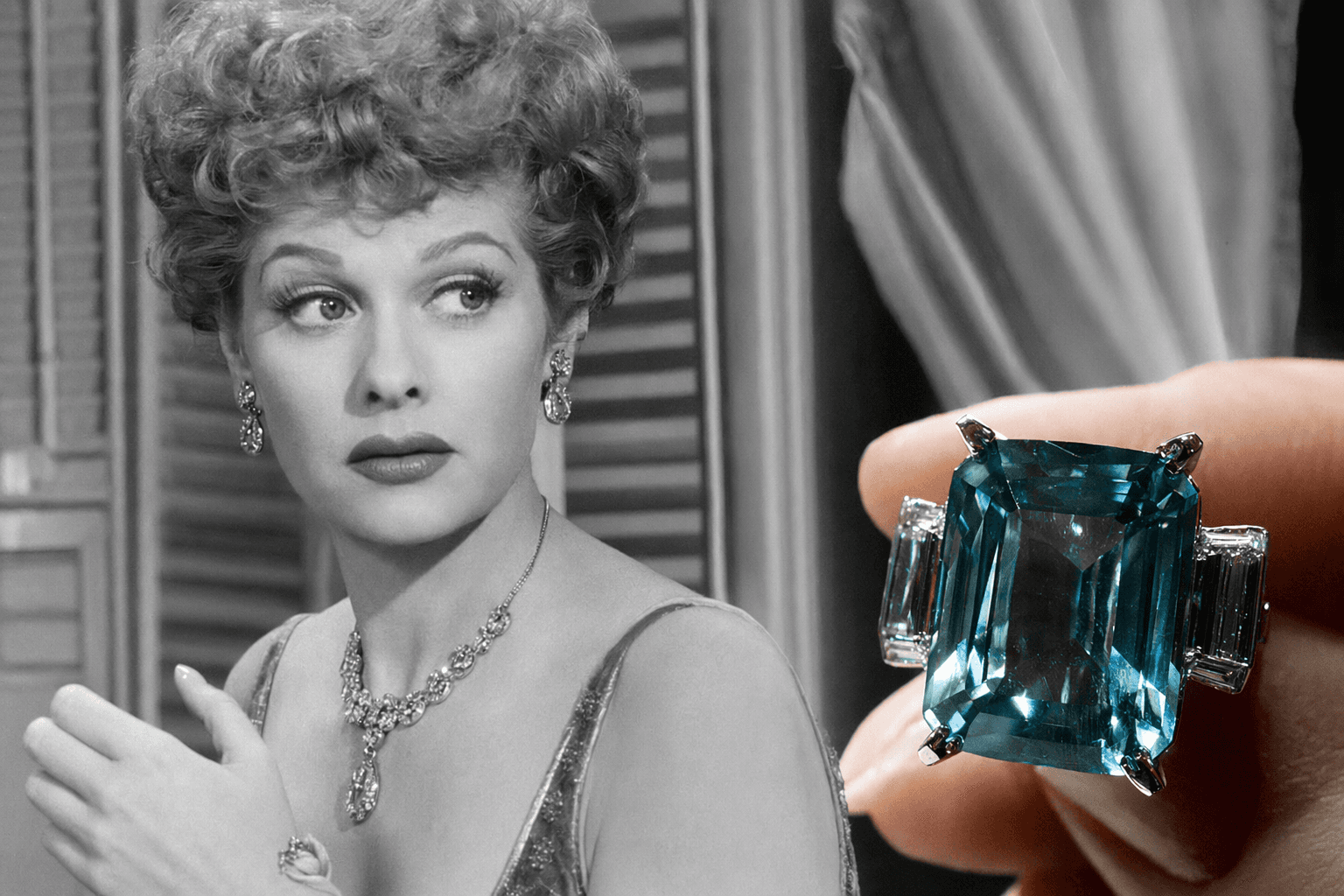
Lucille Ball’s most memorable ring was not a diamond solitaire, but a 40-carat aquamarine that read like a slab of polished winter light on her left hand. Emerald-cut and set in platinum, it had the clean, architectural presence of a cocktail ring and the sentiment of an engagement jewel, a combination that made it instantly unusual and, for that very reason, unforgettable.
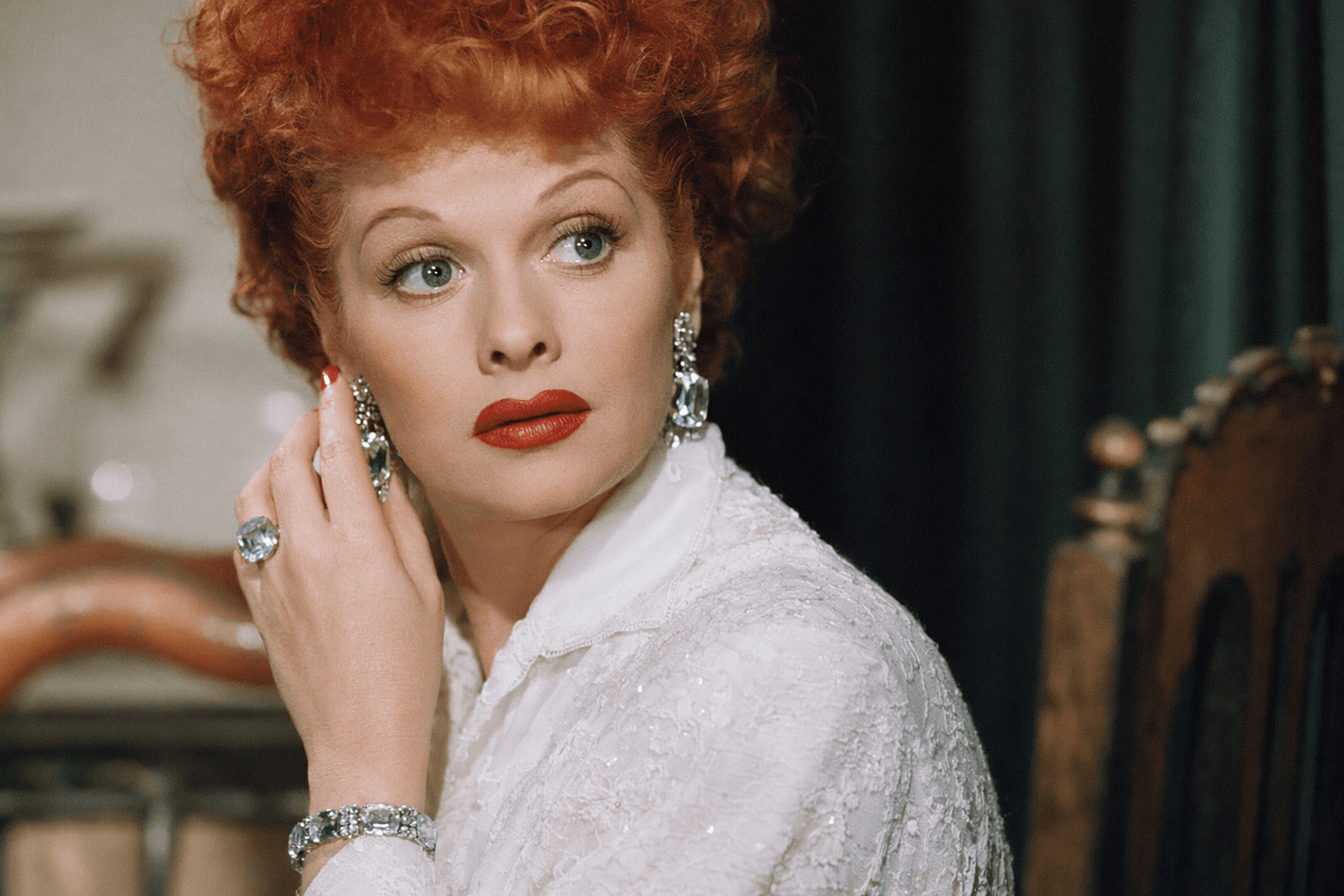
Its scale mattered as much as its color. A stone that large does not whisper; it announces itself, and Ball wore it as a signature piece rather than a discreet token. On her hand, the aquamarine became part of her public image, a jewel so distinct that it was remembered almost as readily as the woman herself.
From a brass wedding ring to a jewel with real presence
The story begins not with the aquamarine, but with improvisation. Ball and Desi Arnaz eloped on November 30, 1940, after meeting on the set of the film *Too Many Girls*. Arnaz had forgotten a wedding ring, so his business manager bought a simple brass ring from Woolworth’s for the ceremony. That humble stand-in is one of the great details of Hollywood romance, because it reveals how little the scene had to do with glamour at first and how quickly the story outgrew its improvised beginnings.
Ball later received a cushion-cut diamond and then the aquamarine ring that became her best-known personal accessory. The sequence matters. It suggests a marriage that moved from practical beginnings to something more polished and conspicuous, as if the ring itself were being edited upward, stone by stone, until it matched the scale of the couple’s fame.
Why the aquamarine felt so right on Lucille Ball
Aquamarine is a gem of clarity and cool color, and in an engagement ring it usually reads as a deliberate choice rather than a default. That was part of the appeal here. In a culture that often expects a diamond to carry the entire emotional burden of a proposal, Ball’s ring offered a different message: individuality first, convention second.
The emerald cut sharpened that message. Unlike a brilliant cut, which is built for sparkle, an emerald cut emphasizes long, open facets and a glassy, mirrored depth. On a stone as large as this one, the effect would have been especially striking, creating a refined, elongated surface that let the blue-green color remain the center of attention. Set in platinum, the ring would have had a crisp, pale frame, a metal choice that suited the gem’s cool tone and reinforced its modern, sculptural character.
That is part of why the ring endured in memory. It was not merely expensive or large. It had a point of view.
A love story worn in public
Ball and Arnaz’s relationship was never a private affair for long. By the time the aquamarine became associated with her, their marriage had become one of the most visible in entertainment, and their names were entering the broader mythology of early television. The ring functioned as a small but potent emblem of that visibility. It sat on her left ring finger, where it was seen, discussed, and remembered as one of the visual signatures of Lucille Ball.
There is a reason jewelry becomes iconic when it is attached to a person with an unmistakable public identity. The object stops being only an object. It becomes shorthand for a life, a romance, and a persona. In Ball’s case, the ring did all three jobs at once, and did them with startling elegance.
The Chicago disappearance that turned it into legend
The ring’s mystique deepened when it disappeared. The theft is generally dated to June 1950, when the aquamarine was reportedly stolen from a Chicago hotel room along with other jewelry. It was never recovered. That fact gives the ring a second life, because the loss froze it in the public imagination at the exact moment when it was already becoming famous.
A ring can be admired for its design, but a stolen ring acquires narrative weight. It becomes a missing object, something people picture rather than simply see. In Ball’s case, the disappearance also sealed the contradiction at the heart of the jewel: it was a deeply personal ring that had already been made public by fame. Once it vanished, it became part memory, part rumor, part unfinished sentence.
Why it still fascinates
The lasting appeal of Lucille Ball’s aquamarine lies in how many stories it holds inside one setting. It is a story of improvisation, beginning with a brass ring from Woolworth’s. It is a story of transformation, moving to a cushion-cut diamond and then to a 40-carat aquamarine in platinum. It is a story of romance, anchored to the elopement with Desi Arnaz after they met on *Too Many Girls*. And it is a story of absence, because the ring’s theft in Chicago made it legendary in the way only a lost jewel can be.
For engagement rings, the lesson is not that bigger is always better. It is that the most compelling rings have a point of view, a shape, and a sense of the person who wears them. Ball’s aquamarine had all three. Even in disappearance, it remained exactly what it had been on her hand: bold, singular, and impossible to forget.
Know something we missed? Have a correction or additional information?
Submit a Tip