Princess Diana's 12-Carat Ceylon Sapphire Ring Shaped Royal Engagement Style Forever
Diana picked a £47,000 catalogue sapphire in 1981 that broke royal tradition; now on Kate Middleton's finger, it's worth an estimated £400,000 and still drives sapphire ring searches.
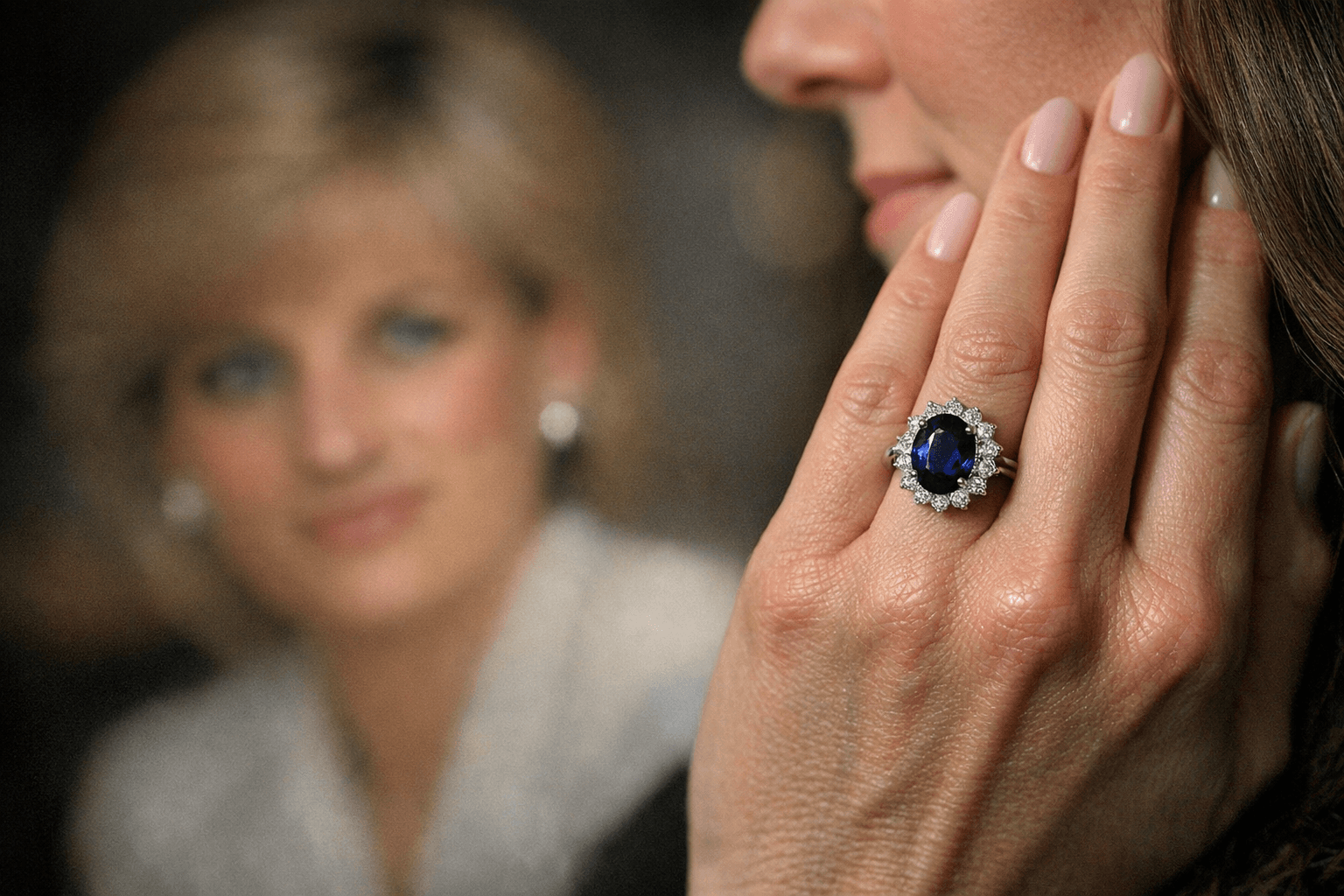
When the FX series *The Crown* brought renewed scrutiny to royal jewels, and when Julien's Auctions announced the largest-ever sale of Princess Diana's wardrobe in 2025, one object kept pulling focus: a 12-carat oval Ceylon sapphire, circled by 14 round diamonds, set in 18-carat white gold, and originally priced at £47,000 from a jeweler's catalogue. It was not commissioned for a princess. It was not one of a kind. That, as it turns out, was precisely the point.
The Ring, Specified
The stone at the center of the world's most recognizable engagement ring is an unheated oval-cut Ceylon blue sapphire weighing 12 carats. Its halo consists of 14 round solitaire diamonds set in an 18-carat white gold band, in the cluster configuration that Garrard had been refining since the Victorian era. Ceylon, the historic name for Sri Lanka, denotes the sapphire's provenance: the island's Precambrian rock formations yield stones prized for their medium-to-deep cornflower blue hue, natural brilliance, and exceptional translucency. This stone is unheated, which in gemological terms means no artificial treatment was used to enhance its color or clarity, a distinction that significantly elevates its value and desirability among collectors. Sara Prentice, Creative Director at Garrard, has described the sapphire's intensity and luster as "astonishingly beautiful."
Garrard, Crown Jeweler
The ring was made by Garrard, the London house founded in 1735 and appointed official Crown Jeweller to the British royal family in 1843, a designation it held until 2007. That appointment gave Garrard custodianship of the Crown Jewels themselves, placing Diana's sapphire ring squarely in a lineage that includes the Cullinan I diamond in the Sovereign's Sceptre. The cluster setting that frames the sapphire is a Garrard signature: a central stone amplified by a radiating crown of diamonds that intensifies both the color and perceived size of the centerpiece. It is a setting with genuine historical roots within the house, not a contemporary styling choice.
A Victorian Blueprint
The design of Diana's ring traces directly to a sapphire and diamond brooch that Prince Albert commissioned for Queen Victoria in 1840. That piece featured a large sapphire encircled by 12 round diamonds set in gold, and Queen Victoria wore it on her wedding day as her "something blue." A Garrard representative confirmed to Marie Claire in 2017 that this brooch, one Queen Elizabeth II wore regularly at formal occasions, was the explicit inspiration when the cluster ring was developed. Prince Charles, familiar with that brooch from his mother's collection, was drawn to the ring in the Garrard catalogue for exactly this reason. The sapphire and diamond cluster design was not an improvisation; it was a deliberate continuation of a royal aesthetic that stretched back nearly 150 years.
The Catalogue Controversy
What distinguished Diana's ring from every royal engagement ring before it was not the stone or the setting but the context in which it was acquired. Prince Charles proposed to the 20-year-old Lady Diana Spencer in February 1981 without a ring, instead inviting her to choose from a Garrard selection afterward. She chose the sapphire cluster from the jeweler's catalogue at a price of £47,000, roughly $60,000 at the time. That made it available, in principle, to any buyer who could meet the price. According to Vogue's editors, some members of the royal family were displeased, not because of the sapphire itself but because a future princess had selected a stock item rather than a bespoke commission. The ring that critics saw as insufficiently exclusive became the most copied engagement ring in history.
What Ceylon Means in Gemological Terms
Ceylon sapphires occupy a specific and coveted category within the sapphire market. The designation refers to origin: stones mined in Sri Lanka, the island nation formerly called Ceylon, which has produced exceptional blue sapphires for centuries. Their color range runs from delicate cornflower blue to deep royal blue, with the finest examples showing vivid saturation, high clarity, and natural luster without enhancement. For a 12-carat unheated stone of Diana's quality, current market pricing for comparable Ceylon sapphires runs between $4,500 and $15,500 per carat at the high end, with exceptional examples exceeding that range significantly. The provenance, the lack of heat treatment, and the size of Diana's stone place it firmly in museum-grade territory.
From Diana to Kate
Following Diana's death in August 1997, her jewelry collection passed to her son Prince Harry. Before proposing to Catherine Middleton in October 2010 during a trip to Kenya, Prince William asked his brother if he could use their mother's sapphire ring. Harry agreed. The couple's engagement was announced publicly on November 16, 2010. Because the ring had been sized for Diana's hand and was slightly too large for Kate's finger, a jeweler added small platinum beads to the interior of the band to ensure a proper fit without altering the original setting. That modification, invisible from the outside, kept the ring's structural integrity intact while making it wearable for a new generation. William's intention, widely understood, was to ensure his mother had a symbolic presence in his marriage.
Value and Influence
The ring that cost £47,000 in 1981 carries a current estimated value of approximately £400,000, a figure that represents a 1,150 percent appreciation over four decades, driven by the stone's intrinsic quality, its unheated status, its documented provenance, and its unmatched cultural biography. That figure reflects a conservative insurance-and-auction estimate; at auction with full provenance documentation, comparable pieces with far less notable histories have fetched multiples of their assessed value. Beyond price, the ring's design directly shaped a generation of engagement ring preferences: sapphire cluster rings surged in popularity throughout the 1980s and saw renewed search interest after William and Kate's 2010 engagement announcement. Garrard formally acknowledged the ring's commercial legacy when it launched the 1735 Collection, a modern line interpreting the cluster aesthetic in sapphires, rubies, emeralds, and aquamarines.
Why the Stone Still Matters
The ring is frequently cited when buyers search for colored-stone engagement rings, and Ceylon sapphires specifically have benefited from its visibility in ways the fine jewelry market has tracked for decades. What the ring demonstrates, more than any trend it generated, is a principle that serious jewelry buyers already understand: provenance and material integrity compound over time. A 12-carat unheated Ceylon sapphire set by the Crown Jeweller, worn by two Princesses of Wales across two marriages spanning four decades, does not simply hold value. It accumulates it. The controversy over its catalogue origins now reads as the most prescient thing about it: Diana chose a piece of genuinely exceptional quality that happened to be accessible, and in doing so, made the finest traditions of British jewelry briefly available to anyone paying attention.
This article was produced by Prism’s automated news system from verified source data, official records, and press releases, then run through automated quality and moderation checks before publishing. The system is built and supervised by the people who set the standards it runs under. Read our full AI policy.
Did this article answer your question?