3D Printing Makes Platinum Jewelry More Accessible and Complex Than Ever
Platinum is gaining a second act in fine jewelry, driven by 3D printing technologies that make its notorious complexity an asset rather than a barrier.
Platinum has never been easy to love from a maker's perspective. Its melting point sits at approximately 1,768°C, its powder behavior in additive systems is notoriously inconsistent, and traditional casting requires specialized tools and expertise that add cost at every step. Considered the noblest element, platinum is 30 times more rare than gold and the most pure precious metal. For all its desirability as a finished object, platinum has long been, in plain terms, a difficult and expensive material to work with. That difficulty is now becoming the point. Advances in metal 3D printing are turning platinum's demanding properties into design opportunities, opening the door to forms that classical techniques simply cannot produce.
Why Platinum, and Why Now
"Precious metals and jewelry have always represented the height of craftsmanship and personal expression," write Charles R. Goulding and Preeti Sulibhavi in their examination of additive manufacturing's role in the platinum revival. From ancient signet rings to Art Deco brooches, platinum and its companion metals have been shaped by centuries of evolving technique. What makes this moment distinct is not just that 3D printing has arrived in the jewelry studio — it has been present in some form for years, mostly in the production of wax and resin patterns for lost-wax casting. The specific novelty here is direct metal printing: building platinum objects layer by layer from metal powder without an intermediate casting step. That capability, as Goulding and Sulibhavi put it, "marks a breakthrough, combining luxury materials with next-generation fabrication."
The timing also has a market dimension. Platinum is currently highly desirable, partly because its price makes it more affordable than gold. With gold trading at historically elevated levels, designers and buyers are looking at platinum with renewed interest, and additive manufacturing is meeting them with a more flexible, less wasteful production path.
The Technical Problem with Printing Platinum
For anyone unfamiliar with the metallurgy, the challenge requires some unpacking. Platinum, prized for its rarity, durability, and lasting shine, has long presented significant challenges for additive manufacturing due to its exceptionally high melting point (around 1,768°C or 3,214°F) and inherent material properties, which make it notoriously difficult to work with using conventional methods. In a laser powder bed fusion system, where a laser selectively melts thin layers of metal powder to build up a part, the high melting temperature demands significantly more energy and precise thermal management. Laser powder bed fusion for precious metals tends to be expensive due to material lost to condensate, and the high reflectivity of platinum means green lasers or special setups are usually required. Binder jetting sidesteps some of the thermal issues by printing a binding agent into a powder bed at room temperature before sintering, but platinum's complex powder behavior introduces its own calibration challenges.
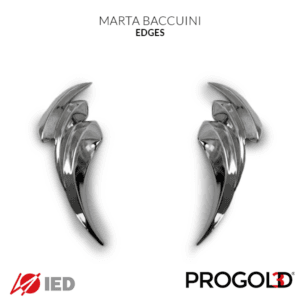
The Tùsaire project, for instance, required months of calibration, redesign, and material science collaboration; through partnerships with ProGold in Italy and research by Platinum Guild International (PGI), these technical hurdles were overcome. That kind of labor-intensive development work is not unique to one project: it reflects the general state of the field, where breakthroughs are hard-won and highly specific to the alloy, machine, and design intent.
Two Technologies Leading the Way
Two additive manufacturing processes are currently the most relevant for platinum jewelry: laser powder bed fusion (LPBF) and binder jet printing. Recent technological advances in both are, as Goulding and Sulibhavi describe, "overcoming these hurdles" that have historically limited direct metal printing in platinum.
LPBF, which uses a high-energy laser to fuse metal powder one layer at a time in a controlled atmosphere, offers exceptional resolution and dense final parts. The Tùsaire collection was manufactured by Progold S.p.A., based in Trissino, Vicenza, Italy, using metal Laser Beam Powder Bed Fusion (PBF-LB) technology. PGI's Director of Innovations, Tai Wong, noted that despite its demanding properties, platinum has real advantages in this process: "Due to platinum's high tenacity, strength and high melting temperature, it enables the highest quality of structural integrity with precise heat control. Its good light absorption and low reflectivity also make platinum a comparatively energy-efficient metal for printing with lasers."
Binder jetting offers a different set of tradeoffs. Platinum is now a customer-qualified material on Desktop Metal's Production System P-1, with a specialty powder developed by Legor; with this qualification, Desktop Metal now has a complete portfolio of materials for direct binder jet 3D printing of jewelry, including stainless steels, sterling silver, titanium gold, composites, and more. Italian company Legor, founded nearly half a century ago with a strong reputation for precious and non-precious metal alloys, has in more recent years positioned itself as a strategic partner for metal additive manufacturing, working with binder jetting hardware suppliers to develop materials and launching its own 3D Metal Hub service. In binder jetting, platinum often requires special tools in traditional production, and binder jet simplifies that process while enabling low-waste production that is eco-friendly and uses only the necessary amount of metal needed to create the design.
These two paths are not interchangeable: LPBF delivers tighter tolerances and is well-suited to complex single pieces, while binder jetting scales more effectively for higher volumes and eliminates many support structure requirements. The choice between them depends on the design, the alloy, and the economics of the run.
What Additive Manufacturing Actually Unlocks
The practical implications for jewelry makers go well beyond engineering novelty. As Goulding and Sulibhavi summarize: "Additive manufacturing significantly reduces material waste, allows for highly personalized designs, and enables jewelry creators to produce objects that would be extremely costly or impossible with classical techniques." Each of those three outcomes is worth examining separately.
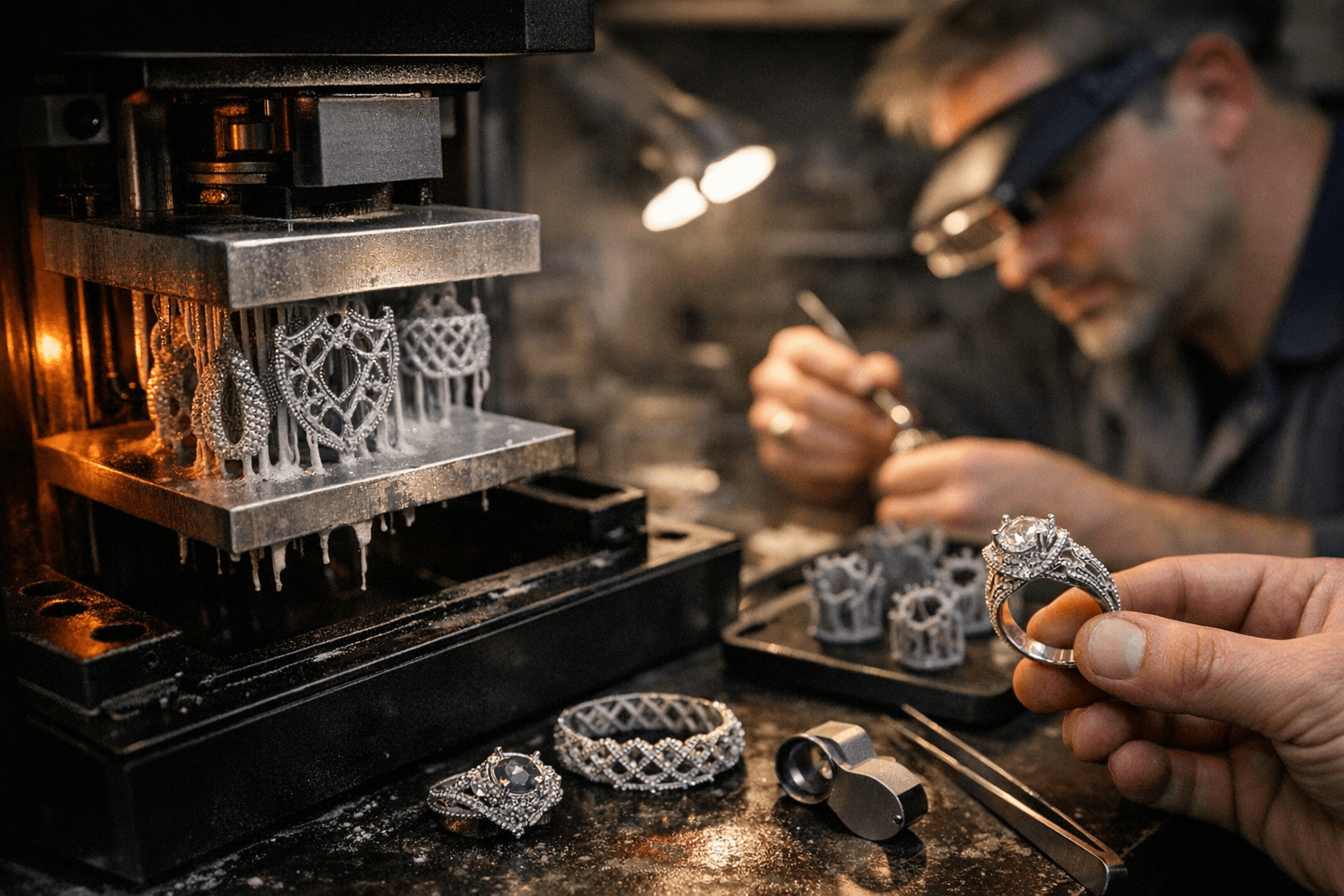
On waste: binder jet 3D printing represents a significant step toward more sustainable production, enabling energy efficiency and reducing the amount of material used; binder jetting uses exactly the amount of material necessary to create an object, drastically reducing waste, and the metal powder not used in the process can be reused, reducing the need for new raw materials and the risks associated with metal extraction.
On personalization: 3D printing enables unprecedented levels of customization, allowing for on-demand adjustments to sizing, integration of personalized design elements, and the creation of unique, bespoke pieces at scale, offering a new level of personalized luxury.
On structural complexity: the technology has enabled the crafting of intricate, unique shapes that would be impossible to achieve by other methods, such as lattices, hollow structures, and detailed textures. The technology catapults platinum into new types of jewelry by enabling the creation of larger silhouettes that were previously impossible because platinum is traditionally a heavier, denser, and more expensive metal.
A Commercial Proof of Concept
The clearest evidence that direct platinum printing has crossed from laboratory to market is the Tùsaire Collection, designed by Maeve Gillies and developed in collaboration with PGI. As the world's first commercially launched platinum-focused collection utilizing direct metal 3D printing, Tùsaire showcases the transformative power of additive manufacturing; unlike most previously seen direct precious metal 3D printed products, which had been mostly experimental or one-off pieces, the collection marks the transition of 3D printed platinum jewelry from experimental novelty to commercial reality.
The pieces are ultralight and hollow, with platinum and titanium that swirls and coils into bold, modern silhouettes; portions of the design are left unpolished, with others being high-polished, to showcase the range of styles the 3D printing technology can produce. The Tùsaire collection retails for $800 to $35,000, a range that places it within reach for serious collectors while also illustrating that printed platinum is not yet a mass-market proposition. It is, however, a demonstrated one.
"This exciting new technology, and my amazing technical collaborators, have allowed me to start to bring to life my dreams of where Platinum can take us," said Gillies. PGI CEO Tim Schlick put the industry stakes plainly: "Additive manufacturing will be very important for the future of jewelry as it unlocks so many new possibilities."
What the Supply Chain Looks Like Now
Industry suppliers are repositioning accordingly. Stuller is the number one supplier of fine jewelry, findings, mountings, tools, packaging, diamonds, and gemstones for today's retail jeweler, and its fabricated metals are manufactured with SCS-certified 100% recycled gold, silver, platinum, and palladium. Alongside its conventional fabricated platinum lines, Stuller offers Inoveo Platinum Grain, a revolutionary alloy designed to redefine industry standards in platinum jewelry production, with benefits including smoother casting and superior quality compared to traditional platinum alloys — the kind of alloy development that feeds directly into the precise feedstock requirements that AM systems demand.
On the powder and printing services side, within the metal binder jetting market, Legor has become a leader in the development and supply of precious and non-precious metal powders, offering a diverse range including silver, bronze, platinum, and gold. That infrastructure, from certified powder to qualified print systems to post-processing finishing, is the unglamorous scaffolding that makes collections like Tùsaire possible.
The Road Ahead
"These breakthroughs are not just engineering feats; they represent a practical shift," Goulding and Sulibhavi write. That framing is accurate, but the shift is still early. The use of direct 3D printing in the jewelry industry remains relatively rare, as most makers prefer to work with the processes they know and have mastered; only for specific designs, where the economic stars align, are jewelry makers turning to 3D printing. Wider adoption will require more accessible business cases, more widely available qualified powders, and continued advances in materials science and workflow optimization that lower barriers to complex platinum forms.
What is already clear is that platinum's historic difficulty, its high melting point and demanding powder behavior, is being reframed. The same properties that made it hard to cast are proving to be assets in laser-based printing: high tenacity, excellent heat control, and low reflectivity. A metal that once demanded the most skilled hands in the workshop is now finding its most ambitious forms in a machine that builds them one micron-thin layer at a time.
This article was produced by Prism’s automated news system from verified source data, official records, and press releases, then run through automated quality and moderation checks before publishing. The system is built and supervised by the people who set the standards it runs under. Read our full AI policy.
Did this article answer your question?