Aluminum Nitride Coatings Boost Silver Jewelry Tarnish Resistance, Study Finds
A new study found that transparent aluminum nitride films just 80–110 nm thick, deposited on 99.9% pure silver at a 1:1 nitrogen-to-argon ratio, resist tarnish while leaving the surface visually unchanged.
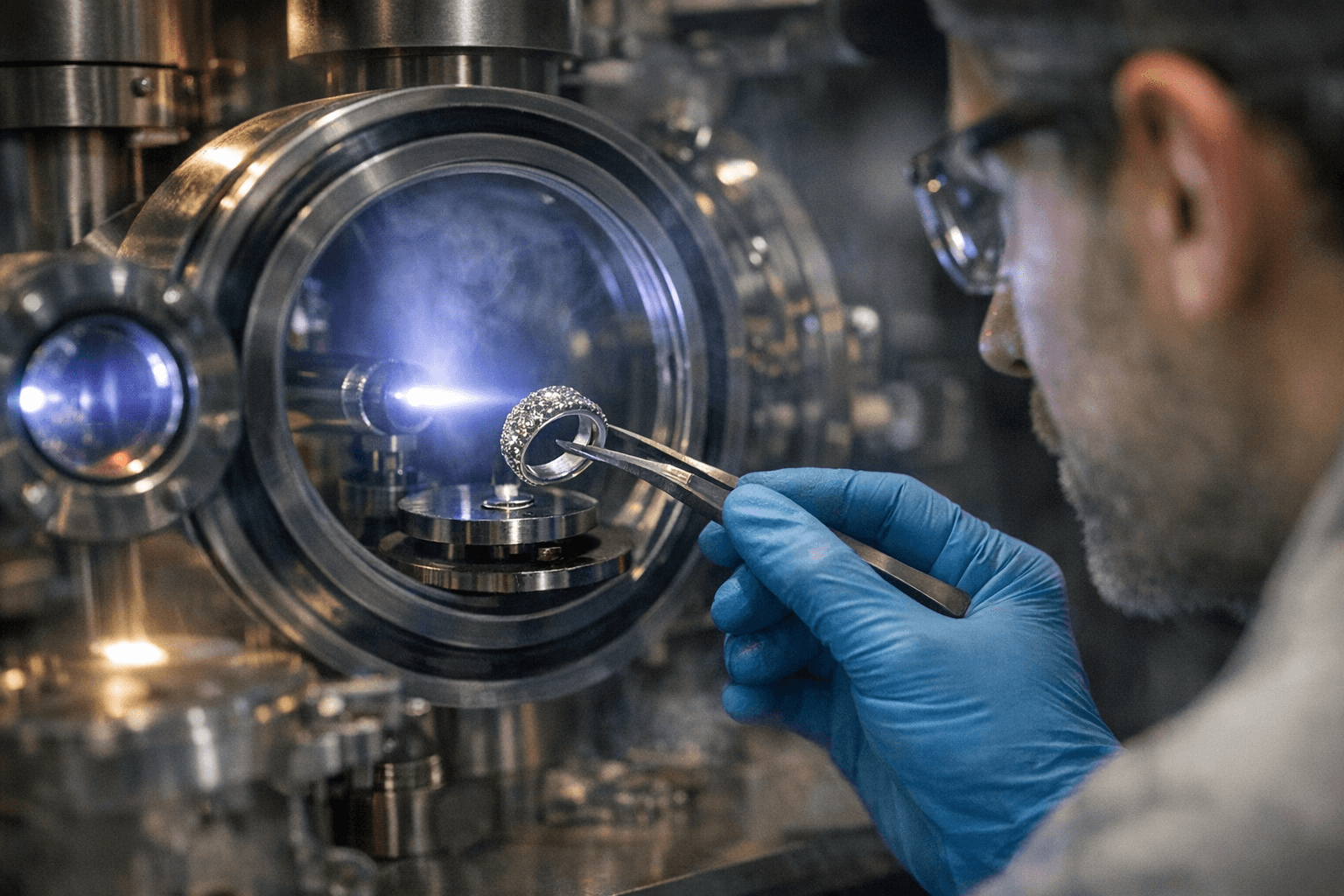
Silver's oldest enemy is atmospheric sulfur. The moment a sterling cuff or a fine-cast pendant meets ambient air, sulfur-containing compounds begin converting its surface to silver sulfide, dimming that luminous sheen into a yellow-gray film. Polishing removes it, temporarily, and then the cycle starts again. A peer-reviewed study published March 19, 2026, in *Thin Solid Films* (Elsevier) by researchers funded through King Mongkut's Institute of Technology Ladkrabang offers a materials-science solution that is, by jewelry standards, almost invisibly thin.
The study deposited a transparent aluminum nitride (AlN) thin film using magnetron sputtering and evaluated it as a protective barrier against silver tarnishing. The appeal of AlN for this application comes down to chemistry: nitride-based coatings are generally preferred for protective applications on silver, and among the nitride family, AlN is particularly attractive due to its wide optical bandgap combined with excellent mechanical and chemical stability.
The choice of DC magnetron sputtering over other deposition routes was deliberate. Physical vapor deposition, particularly magnetron sputtering, represents a practical alternative for protective coatings on silver jewelry; unlike atomic layer deposition (ALD), sputtering does not rely on hazardous chemical precursors, and magnetron sputtering offers strong film-substrate adhesion, high deposition rates, excellent thickness uniformity over large areas, and compatibility with industrial-scale production.
Getting the gas chemistry right proved critical. Sheets of 99.9% pure silver were coated under various nitrogen flow conditions to optimize film composition and performance, and a nitrogen flow rate of 25 standard cubic centimeters per minute (sccm), corresponding to an N₂/Ar gas ratio of approximately 1:1, was identified for forming AlN-rich films, while a film thickness in the range of 80–110 nm was found to be suitable for jewelry protection. That 80–110 nm window matters: it is thin enough to remain optically transparent on silver, yet dense enough to act as a chemical barrier.
Oxygen in the plasma was specifically avoided. Under oxygen-containing plasma conditions, reactive oxygen atoms readily interact with the silver surface, leading to the formation of silver oxides (Ag₂O or AgO); even a thin interfacial oxide layer can induce perceptible color changes and a loss of surface brightness, which are unacceptable for decorative silver applications; as a result, oxygen-containing coatings are generally avoided in sputtering processes intended for tarnish protection of silver surfaces.
The researchers also moved beyond flat test coupons. The practical applicability of AlN coatings was demonstrated by depositing films onto large and intricately designed silver jewelry pieces, highlighting their suitability for industrial-scale and real-world applications. That step distinguishes this work from purely laboratory demonstrations: coating a flat sheet is straightforward; coating a filigree pendant or a cuff with recessed detail requires a process that conforms uniformly to complex geometry.
The competitive landscape for anti-tarnish coatings on silver is crowded. ALD alumina-titania nanolayers have shown strong performance in accelerated H₂S tests, with research showing that the protection given by ALD layers is at least 10 times superior to conventional organic varnishes. Organic lacquers remain the most common commercial solution, but they yellow, crack, and are difficult to apply uniformly to intricate work. Magnetron sputtering offers thickness uniformity over large areas and is widely regarded as a scalable and cost-effective coating strategy for improving tarnish resistance and mechanical durability of silver surfaces.
The study, which draws on 28 indexed references and was funded by one of Thailand's leading technology universities, leaves some questions open. Authors' names, precise quantitative tarnish-resistance metrics, and long-term wear data against skin oils and detergents were not available in the published abstract. Whether AlN sputtering integrates cleanly into existing Thai or broader Asian silver jewelry manufacturing workflows, or what per-piece cost implications might be, will matter enormously to any manufacturer considering adoption. Those are the questions that separate a compelling materials result from a commercially viable one.
This article was produced by Prism’s automated news system from verified source data, official records, and press releases, then run through automated quality and moderation checks before publishing. The system is built and supervised by the people who set the standards it runs under. Read our full AI policy.
Did this article answer your question?