Catherine Allen’s everyday ring began with her grandmother’s diamonds
A grandmother’s diamond became Catherine Allen’s daily ring, and it set the tone for The Gilded Horse: minimal, equestrian jewelry built for real wear.
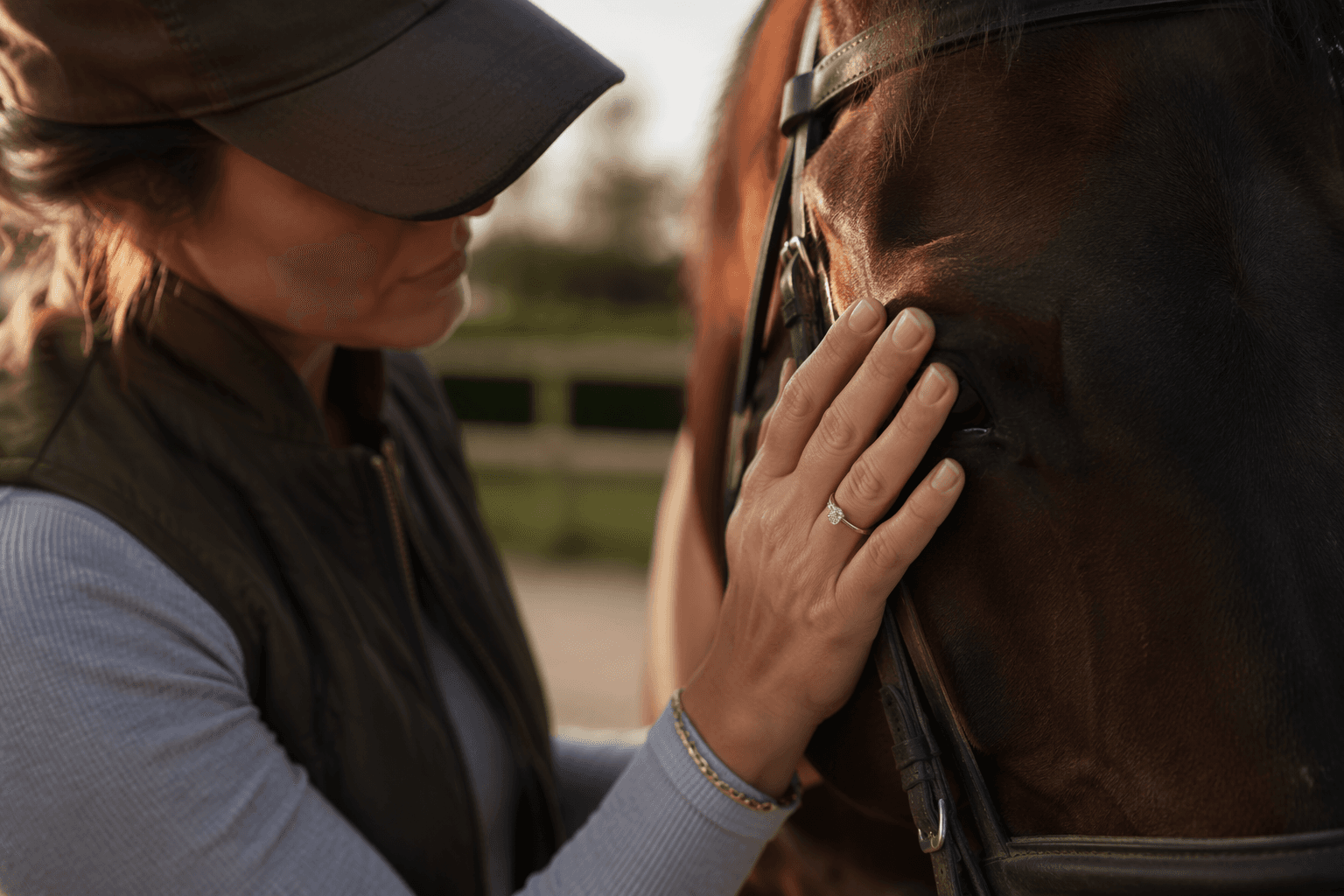
Catherine Allen’s most personal ring is not locked away for special occasions. It began with one of her grandmother’s diamonds, was set into a ring when she was 16, and has stayed in rotation ever since, worn as part of ordinary life rather than guarded as a keepsake. That detail matters, because it explains the sensibility behind The Gilded Horse: jewelry that carries family memory without losing sight of work, errands, the gym, or date night.
A ring that changed how she saw jewelry
Allen’s father had saved her late grandmother’s diamonds for his four daughters, and the birthday reveal became her first real encounter with fine jewelry and craftsmanship. She chose the setting for one of those stones herself, turning inheritance into an object with a clear point of view, not just a sentimental story. The ring was her entry into the mechanics of jewelry, where metal, proportion, and setting shape how a stone actually lives on the hand.
That early lesson still shows in the way she talks about what she wears. Allen says she is not a jewelry maximalist, and her preference runs toward minimal, versatile pieces that can move through the day without fuss. For everyday jewelry, that is the key test: whether a piece can handle repeated wear and still feel considered, not precious in the fragile sense.
Why the brand feels like lived style, not heirloom display
The Gilded Horse came about in 2024, while Allen was on maternity leave with her daughter, and its origin story is rooted in family rather than fantasy. The brand says it was born in Lexington, Kentucky, and that equestrian heritage is part of its identity from the start. That background gives the line a specific visual language, one shaped by horse culture, but softened enough to fit a T-shirt, blazer, or barn jacket.
Its public-facing details are refreshingly concrete. The brand says its jewelry is handcrafted in the USA and made in 14K gold and sterling silver, with collections that include necklaces, earrings, bracelets, and medallions. It also offers free returns within 30 days, which is the kind of practical policy that suits jewelry designed for repeat wear, not one-time display. When a piece is meant to live in your regular rotation, return flexibility matters because fit, length, and scale only become obvious after a few days on the body.
The brand’s own language pushes that idea further, describing some pieces as moving from the barn to the boardroom. That is more than a slogan if the proportions are right. Equestrian jewelry can turn costume-like fast when it leans too hard on horseshoes and novelty motifs, but the pieces Allen is describing seem to work because they keep the reference subtle and the shape wearable.
What to look for in jewelry meant to be worn every day
The Gilded Horse’s collections point to a formula that works for daily wear: clean metal, readable forms, and motifs that stay close to the body. Necklaces, earrings, bracelets, and medallions are easier to integrate into a routine than oversized statement pieces, especially when the design stays lean. The customer testimonials on the brand’s site suggest the same appeal, with buyers responding to jewelry that feels elegant without becoming oversized or flashy.
That balance is where everyday jewelry earns trust. 14K gold brings durability that suits frequent wear, while sterling silver offers a lower-cost, classic alternative that still reads polished. Neither material is unusual, but the combination becomes meaningful when the design avoids overworking them. Allen’s own taste for minimalism helps here, because it keeps the focus on scale, comfort, and repeat use instead of ornament for its own sake.
The brand’s newer Circle Medallion designs sharpen that idea. Medallions sit naturally in an everyday wardrobe because they are flat, easy to layer, and less likely to catch or dominate. In a category full of pieces that promise heirloom status, the more useful question is whether the jewelry can disappear into your schedule without losing character. That is where these designs seem aimed.
Horse heritage as a design language
Allen’s equestrian roots are not treated as decoration alone. They shape the brand’s tone, from Lexington to the horse-centered imagery that gives The Gilded Horse its identity. In 2025, the company extended that world beyond jewelry by partnering with Horse Polo Art Gallery, also known as KaterinaMorgan.art, to turn a 2018 horse photograph into a fine art painting.
The project credited Icelandic artist Thorgrimur Einarsson, who the brand described as born in Reykjavík in 1980. That kind of collaboration shows how the horse motif moves through the brand as an aesthetic system, not just a logo. It also reinforces the sense that Allen’s jewelry story is really about continuity: family objects, equestrian references, and daily habits all feeding the same design instinct.
That is what makes her ring story resonate beyond nostalgia. A grandmother’s diamond can become a daily piece when it is set with restraint and worn with purpose, and that principle carries through The Gilded Horse’s metals, forms, and barn-to-boardroom positioning. The strongest jewelry stories are not the ones that stay sealed in a drawer, but the ones that keep pace with the life around them.
This article was produced by Prism’s automated news system from verified source data, official records, and press releases, then run through automated quality and moderation checks before publishing. The system is built and supervised by the people who set the standards it runs under. Read our full AI policy.
Did this article answer your question?