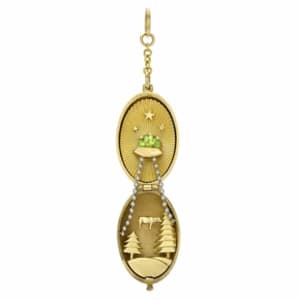
Chanel’s Signes & Symboles collection turns house codes into wearable jewelry
Chanel's Signes & Symboles turns the house’s lion, camellia, comet, and lucky charms into a roadmap for the motifs and colors likely to shape everyday jewelry.

Chanel turns its symbols into a jewelry language
Chanel’s Signes & Symboles collection does not read like a display of excess for its own sake. It feels more like a codebook, translating the maison’s most recognizable emblems into high jewelry that is refined, legible, and, crucially, wearable. The 85-piece collection leans on Gabrielle Chanel’s favorite signs and symbols, then softens the usual high-jewelry spectacle with bold color harmonies and a quieter sense of confidence.
For everyday jewelry readers, that matters because the collection points toward the motifs most likely to move from couture-level fantasy into real wardrobes: camellias, lions, talismans, comets, ribbons, feathers, and medallions. These are not random decorative ideas. They are the visual grammar Chanel keeps returning to, and when a house repeats a symbol this consistently, it usually ends up shaping everything from fine-jewelry pendants to more accessible fashion pieces.
Why La Pausa was the right stage
Chanel unveiled the collection at La Pausa in Roquebrune-Cap-Martin, France, the restored hillside villa above the Mediterranean that Gabrielle Chanel favored. The setting was not just picturesque; it reinforced the collection’s meaning. Frédéric Grangié said the property carries Chanel’s symbolic grammar in its own architecture, with five rectangular windows and arches that recall the Aubazine convent-orphanage, linking the house’s mythology to place, memory, and design.
Grangié also described the collection as a tribute to jewelry and a treasure chest of stories. That framing is telling. Instead of pushing the collection as loud luxury, Chanel presented it with a lower-key mood at a time when the market often rewards noise. The effect is more persuasive than bombastic: the jewelry feels like a private language made visible, not a public dare for attention.
The house motifs most likely to filter down
Chanel’s symbolic vocabulary is broad, but a few emblems stand out as especially ripe for everyday jewelry. The camellia remains one of the most recognizable. Chanel says Gabrielle Chanel plucked it from a dandy’s jacket in 1913, and the flower’s lack of scent and thorns gives it a strange purity, almost graphic in its simplicity. In practice, that makes it ideal for pendants, earrings, brooches, and small rings that read cleanly even at modest scale.
The lion carries a different charge. Chanel links it to courage, power, loyalty, and Gabrielle Chanel’s Leo sign, which gives the motif both personal mythology and instant visual force. In everyday jewelry, that could translate into small sculptural charms, signet-style rings, and medallions that signal strength without needing to be literal. The comet, ribbon, feather, and number 5 round out the house’s symbolic alphabet, offering a path toward more fluid, airy, or lucky-looking pieces rather than heavy ornament.
The strongest trend cue here is not one motif alone but the way Chanel layers them. Expect to see pieces that mix emblem and sentiment, especially in the form of charms, tokens, and reversible designs. That approach already appears in Chance de Chanel, which uses reversible medallions inspired by good-luck charms. For readers shopping beyond high jewelry, that points directly to the growing appeal of jewelry that can be worn one way for polish and another for personal meaning.
Color is doing as much work as the motifs
WWD described the collection as exploding with bold color harmonies, and that detail may matter just as much as the iconography. In Chanel’s hands, symbolism is never purely black-and-white. It is often amplified by saturated stones and graphic contrasts that keep the pieces alive on the body rather than locked in a showcase.
That is where the downstream trend story becomes clearer. Expect the Signes & Symboles effect to show up in color combinations that feel deliberate but not overly precious: emerald green against diamond brightness, warm gold against deep red, or glossy monochrome forms punctuated by one vivid stone. For everyday jewelry, those choices usually appear first in fine-jewelry drops and then in scaled-down fashion pieces, where enamel, colored stones, and mixed-metal finishes carry the same idea at a lower entry point.
The standout stone proves the point
One of the collection’s most striking pieces is the Imprimé Émeraude ring, which centers a 10.44-carat octogonal-cut Colombian no-oil emerald. That detail tells you exactly where Chanel still places its bets: on symbolic design backed by serious gem material. The emerald is not decoration added after the fact; it is the anchor that gives the motif authority.
For buyers, that is the key distinction between meaningful design and empty branding. A house emblem becomes collectible when it is supported by craftsmanship and a stone with real presence. A large Colombian emerald with no oil treatment is not the sort of thing that disappears into trend churn. It carries intrinsic rarity, and when paired with Chanel’s iconography, it becomes both statement and heirloom.
Craftsmanship is the part that keeps the mythology honest
Chanel says its high jewelry begins with an initial sketch from the CHANEL Fine Jewelry Creation Studio and is then handcrafted by artisans at 18 Place Vendôme in Paris. That process matters because it separates a genuine high-jewelry program from mere logo jewelry. The house is not simply repeating a sign; it is interpreting it through handwork, proportion, and gem setting.
Chanel also frames its heritage through Bijoux de Diamants, which it says Gabrielle Chanel created in 1932 and describes as the world’s first high-jewelry collection. Whether you are looking at a major necklace or a smaller medallion, that historical claim helps explain why the brand treats symbols as design architecture rather than embellishment. The motifs are supposed to carry meaning before they carry shine.
What this means for everyday jewelry
The Signes & Symboles collection offers a clear forecast for what will feel current in accessible jewelry. Camellias are likely to keep surfacing as polished floral motifs, but with flatter, more graphic outlines than romantic garden florals. Lions and talismans will continue to feed into signet rings, lucky charms, and medallions that feel personal rather than ornamental. The comet and feather suggest a move toward lighter, more celestial forms, while the ribbon points to soft, ribbon-like curves in bracelets and earrings.
The broader lesson is that Chanel is not only selling high jewelry here. It is reasserting a house language that can travel across categories, from the most exceptional stones to the smaller pieces people wear every day. In a season when Chanel’s fashion side is also entering a new era, the jewelry signals a larger reset: the brand is recasting its symbols as a living style system, and that is exactly how motifs become trends.
This article was produced by Prism’s automated news system from verified source data, official records, and press releases, then run through automated quality and moderation checks before publishing. The system is built and supervised by the people who set the standards it runs under. Read our full AI policy.
Did this article answer your question?