Chopard, Mikimoto and More Shape Everyday Jewelry Trends in March 2026
Chopard's new Happy Hearts tie necklace and Michelle Yeoh's Mikimoto campaign set the tone for what everyday jewelry looks like right now: purposeful, storied, and worth wearing daily.

The jewelry that earns a permanent place in your rotation does two things at once: it carries a story worth knowing and holds up through every hour of a real day. March 2026 delivered two moments that crystallized exactly what that looks like in practice, with Chopard and Mikimoto each releasing work that reframes heritage design as a daily proposition rather than a special-occasion one.
Chopard's Happy Hearts Tie Necklace: Art Deco Utility in Ethical Gold
Chopard timed its latest Happy Hearts launch to March 20, the International Day of Happiness, and the choice of silhouette was deliberate. The new Happy Hearts tie necklace is a sliding heart pendant, a contemporary reinterpretation of a classic design that draws on the geometry and glamour of Art Deco. It arrives in 18-carat ethical gold in both white and rose gold, with colorway options spanning diamonds and mother-of-pearl. The white gold and diamond version is priced at $9,620.
The "ethical gold" designation carries real weight here. Chopard completed its full transition to 100% ethically sourced gold in 2018, certified by the Responsible Jewellery Council and sourced through the Swiss Better Gold Association, among other supply chain partners. That commitment is baked into every piece leaving the Geneva atelier, so the Happy Hearts tie necklace is not simply invoking sustainability as a marketing term; it has the certification trail to back it up. For readers who track provenance as closely as they track design, that distinction matters.
The sliding mechanism also solves a genuine daily-wear problem. Fixed pendants sit where they land. A sliding heart moves with you, adjusting along the chain without requiring a clasp intervention mid-day. It is a small functional detail that makes the piece genuinely more wearable, not just more interesting on a product page. Bella Hadid fronted the campaign, her presence underscoring the house's push to position the collection with a contemporary, fashion-forward audience rather than a strictly fine-jewelry one.
Chopard's Happy Hearts line has always centered on the brand's signature moving diamond technology, where small stones are set to float freely within a transparent case, catching light with every movement. The tie necklace extends that philosophy into the pendant format, giving the piece a kinetic quality that rewards actually wearing it rather than keeping it in a box.
Mikimoto and Michelle Yeoh: Redefining Who Pearls Are For
The more culturally resonant launch of the month came on March 18, when Mikimoto announced Oscar-winning actress Michelle Yeoh as the face of its new global campaign, titled "1893 MIKIMOTO: Time on a String." The campaign title anchors directly to the founding moment: in 1893, Kokichi Mikimoto created the world's first cultured pearl, an achievement that, as the house puts it, was "born from the idea of humans and nature working together in harmony." That founding ambition, to "adorn everyone with pearls," is the explicit through-line of the campaign.
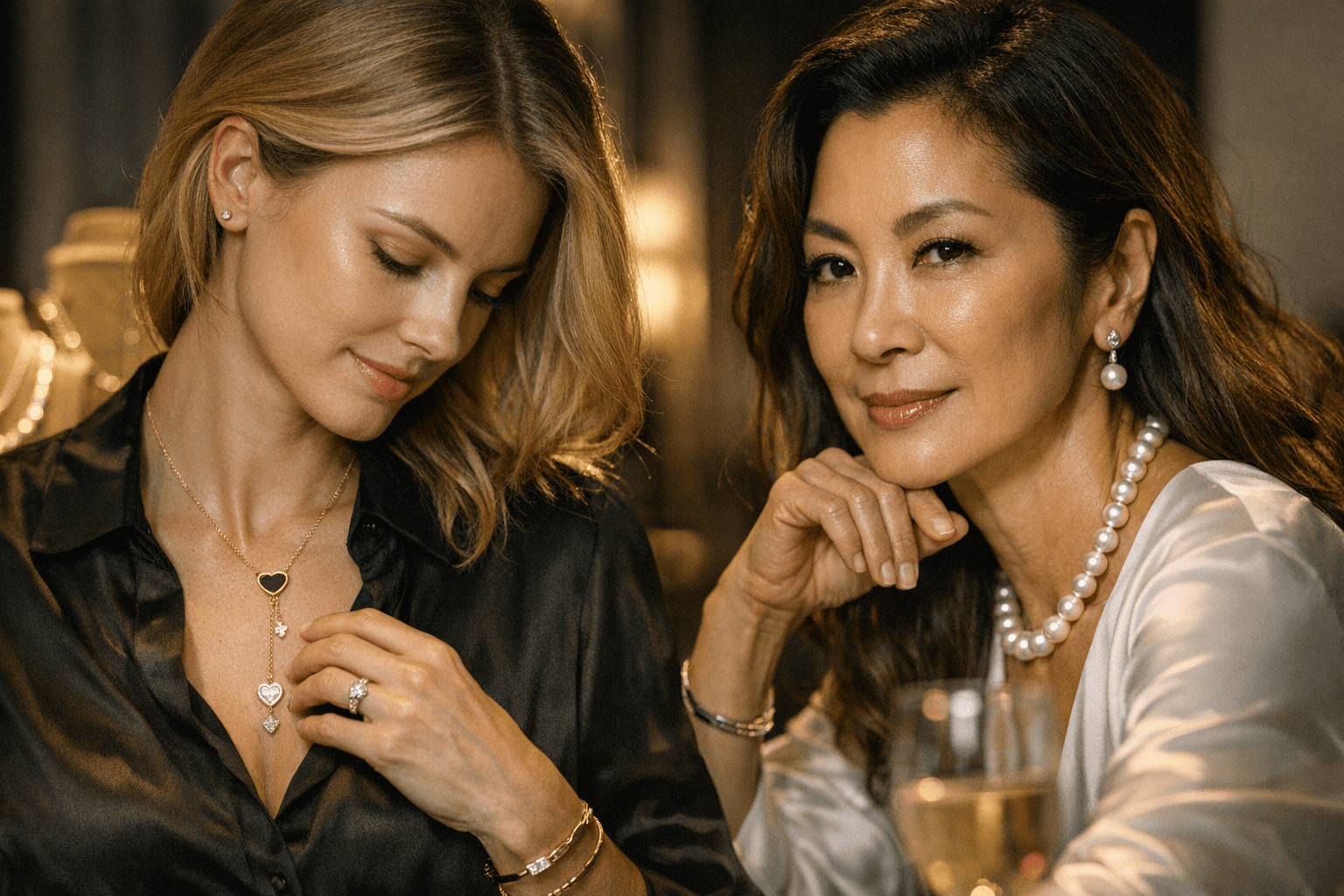
Yeoh's selection is not incidental. She has worn Mikimoto at significant moments throughout her career, so the campaign formalizes a relationship that already existed in public life. Mikimoto describes her as someone who brings "Virtue of Discipline" and "Strength of Purity" to the house's expression of pearls, qualities the brand ties to the pearl's own formation process: slow, pressured, and ultimately luminous. That framing is doing real work. Pearls have spent decades navigating a perception problem, coded as formal or matronly in certain markets, and Yeoh's casting positions them as something else entirely: precise, powerful, and worn by someone who operates at the highest levels of global culture.
The campaign's subtitle, "Time on a String," is worth sitting with. A strand of pearls is literally that: time made wearable, each cultured pearl taking years of careful cultivation before it is harvested, graded, and matched to its neighbors by luster, nacre depth, and diameter. Mikimoto's quality control process is among the most rigorous in the industry; the house rejects the majority of harvested pearls that do not meet its luster and surface standards. What reaches the consumer has been through an extensive selection process that most pearl jewelry buyers never fully appreciate.
For everyday wear, the implications are practical. A well-matched Mikimoto strand or a simple akoya pearl pendant is one of the few fine jewelry pieces that works across a meeting, a dinner, and a weekend errand without adjustment or apology. The nacre that gives a high-quality cultured pearl its glow is also what makes it durable; properly cared for, a Mikimoto piece is a decades-long companion.
Limited Editions as Everyday Anchors
Beyond these two anchors, March also brought a broader pattern worth noting: luxury houses are increasingly treating limited-edition releases not as collector's items to be locked away but as elevated entry points into daily wearing habits. The month's crop of watch and jewelry novelties, tracked across the industry, reflected a consistent appetite for pieces that carry the craft and cachet of a special release while being scaled and styled for actual use.
This is a meaningful shift in how heritage brands are talking to their customers. The limited-edition frame has historically functioned as a scarcity signal, a reason to buy quickly and store carefully. The newer approach treats limited production as a quality marker rather than a preservation directive: fewer pieces made, each one better, and all of them meant to be on your wrist or at your collar rather than in a safe.
The net result, across a month that included Chopard's Art Deco-inflected heart pendants and Mikimoto's pearl reclamation campaign, is a clearer picture of where everyday jewelry is heading. Provenance is becoming non-negotiable, both in the ethical-sourcing sense that Chopard has codified and in the cultural-lineage sense that Mikimoto is broadcasting through Yeoh. The best everyday pieces are no longer just beautiful; they are accountable for where they came from and confident about where they are going.
This article was produced by Prism’s automated news system from verified source data, official records, and press releases, then run through automated quality and moderation checks before publishing. The system is built and supervised by the people who set the standards it runs under. Read our full AI policy.
Did this article answer your question?