Claudia Ley Melds Chinese and Mexican American Heritage Into Silver Jewelry
Ley melts recycled silver shavings over a one-inch purplish-blue flame, turning the metal into jewelry that traces a family line from Canton to Mazatlán to El Paso.
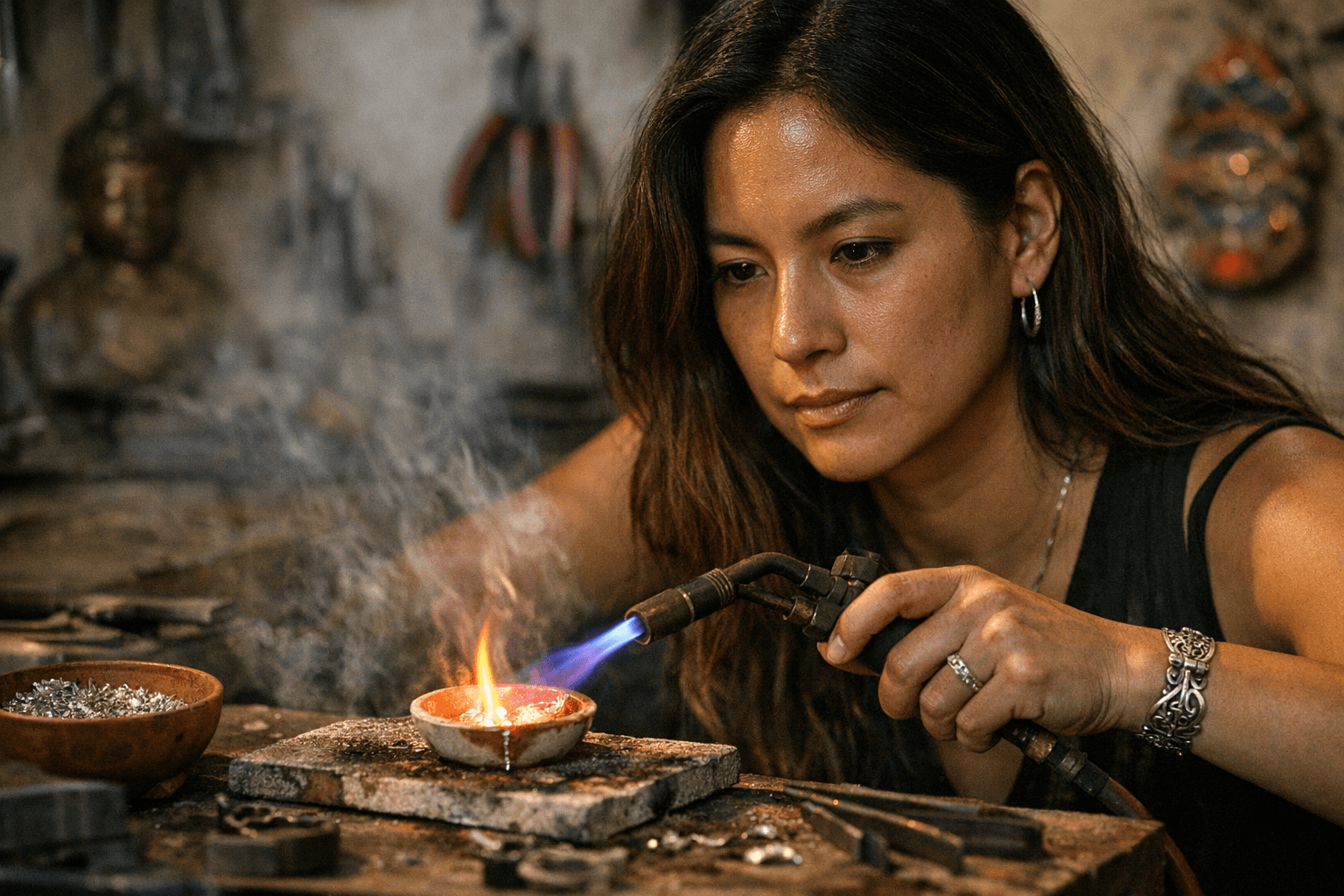
The torch makes a guttural pop as Claudia Ley ignites a flame." In a compact El Paso studio she dials the torch until it is "about an inch long and turns a purplish-blue," then brings the heat to a small bowl of silver shavings she has collected from her production. "Don't try this at home," she joked as the metal begins to yield - a practice she learned from her father, Adalberto Ley Jr., described in the studio as one of the last master jewelers in El Paso.
Ley is a third-generation jeweler who left curating museum art exhibits in early 2025 to concentrate on producing jewelry and to embrace her Mexican American Chinese heritage. Her working process centers on recycled sterling silver - the shavings she melts and recasts are the literal material connection between the family bench and her current designs. The molten silver, Ley says, is the first step in pieces meant to hold memory as much as form.
Her family history reaches back to Woh Lee, born in 1874 in Canton, now Guangzhou, according to Mexican immigration documents kept in the family's archive. Woh Lee "arrived in Mexico as a merchant, but he was left stranded in Mexico after a boat accident off the coast of Mazatlán," a turning point that set the Leys on a transnational course. That narrative sits beside a broader historical frame: the family's story is "heavily influenced by anti-immigrant messaging that Chinese immigrants were taking jobs from U.S. citizens. The sentiment was so strong that it led to the Chinese Exclusion Act of 1882."
Objects in Ley's studio make that lineage visible. A Chinese rice farmer's hat hangs on a peg; the handmade sandals crafted by her grandfather sit on a shelf; a blue-and-pink screen print depicts the Banner Building near San Jacinto Plaza, where her grandfather Adalberto Castañeda Ley I opened his jewelry studio. Outside that building, a sign atop a pole celebrates the Chinese Mexican American community of El Paso - a civic marker Ley keeps in view as she works.
She tends the flame with the same deliberate attention. "She looks closely at the orange-yellow flame. She turns a knob on the side of the torch, dialing it in until it is about an inch long and turns a purplish-blue." As the silver softens the scene changes: "The flame gurgles as it transforms into a turquoise-green as the silver begins to melt and congeal. The silver pops and hisses as the flame melts the metal, the first step in making Ley's jewelry."
Ley's practice sits within a wider El Paso craft ecosystem that includes small retailers and arts organizations focused on regional metalsmithing and turquoise work. Local operations such as Turquoise Ladies emphasize sterling silver and semi-precious stones and list Annie Perez among their founders, while community groups like Las Artistas cultivate opportunities for metalsmiths and multidisciplinary makers including Alejandra Carrillo-Estrada and Davinia Miraval.
By turning family artifacts and recycled silver into wearable pieces, Ley is translating migration documents and studio ephemera into a tactile archive. She left a curatorial life in early 2025 to make that archive public through jewelry - each melted shaving and screen print in the studio a deliberate record of Chinese-Mexican-American continuity in El Paso.
This article was produced by Prism’s automated news system from verified source data, official records, and press releases, then run through automated quality and moderation checks before publishing. The system is built and supervised by the people who set the standards it runs under. Read our full AI policy.
Did this article answer your question?