Couture buyers embrace alternative materials and distinctive jewelry design
Couture’s buying floor pointed to a fresher everyday jewelry language: collars, antique chains, saturated stones, and tougher materials that feel modern, not fragile.

Couture’s clearest message this season was not about more jewelry, but more character. Buyers gravitated toward pieces with edge and texture, from leather collars and interchangeable designs to vintage-inspired links and alternative gemstones, the kind of details that can move from trade-show spectacle into daily rotation without losing their shape.
Why Couture still matters for what people actually wear
COUTURE 2026 took place at Wynn Las Vegas from May 27 to 31, with an opening night event on May 27 from 6:00 PM to 8:00 PM. It is an appointment-based trade event for active jewelry and timepiece buyers only, not a public fair, and that makes the show an unusually useful signal for what independent retailers and designers are likely to stock next.
The scale matters. More than 4,000 top-tier buyers attend from North America and around the world, and about 50% of the exhibiting designers and brands are international. That mix tends to filter out pure novelty and reward ideas that can survive actual retail: pieces that are distinctive enough to stand out, but practical enough to sell to real customers who want jewelry they can wear often.
The strongest shift: alternative materials with a daily-wear edge
One of the most telling directions on the floor was the move toward alternative materials. Steel and titanium appeared in the wider Vegas jewelry-week conversation as part of the market’s broader shift away from gold-heavy sameness, and that matters because these materials bring a different visual language: cleaner, cooler, and less precious in the traditional sense, but often more durable in everyday use.
That toughness is part of the appeal. For readers who want jewelry that can handle a busy week, steel and titanium feel aligned with modern life, especially when they are used in streamlined chains, sculptural cuffs, or mixed-material designs that do not rely on flashy ornament alone. The best versions of this trend are not gimmicky; they are pieces that look intentional on Monday morning and still feel right with evening clothes.
Leather collars also stood out. In everyday terms, they work because they frame the neck with a more tactile, almost tailored presence, especially when paired with a single focal element rather than a crowded cluster of charms. The look has enough attitude to feel current, but the best collars keep the construction simple, which is what makes them wearable instead of costume-like.
Chokers, collars and torques are back, but in sharper forms
Chokers, collars and torques were one of the most consistent stories from the show, and that is no accident. After years of pendants and long, wispy layers dominating the market, buyers seem ready for jewelry that sits higher on the body and makes a cleaner, more decisive statement.
The best part of this revival is how adaptable it can be. A slim torque in metal reads architectural over a T-shirt and polished over a dress. A collar with a single gemstone or a minimal clasp can do the work of a necklace and a neckline detail at once. Even chokers, which can easily tip into heavy-handed territory, feel more relevant when they are pared back and built with careful proportion.
Vintage influence is showing up as construction, not costume
Another major pull was the rise of antique- and vintage-inspired chains. This is not simply nostalgia dressed up as trend language. The interest lies in links with more presence, surface texture, and old-world weight, the kind of construction that suggests something found rather than freshly stamped out.
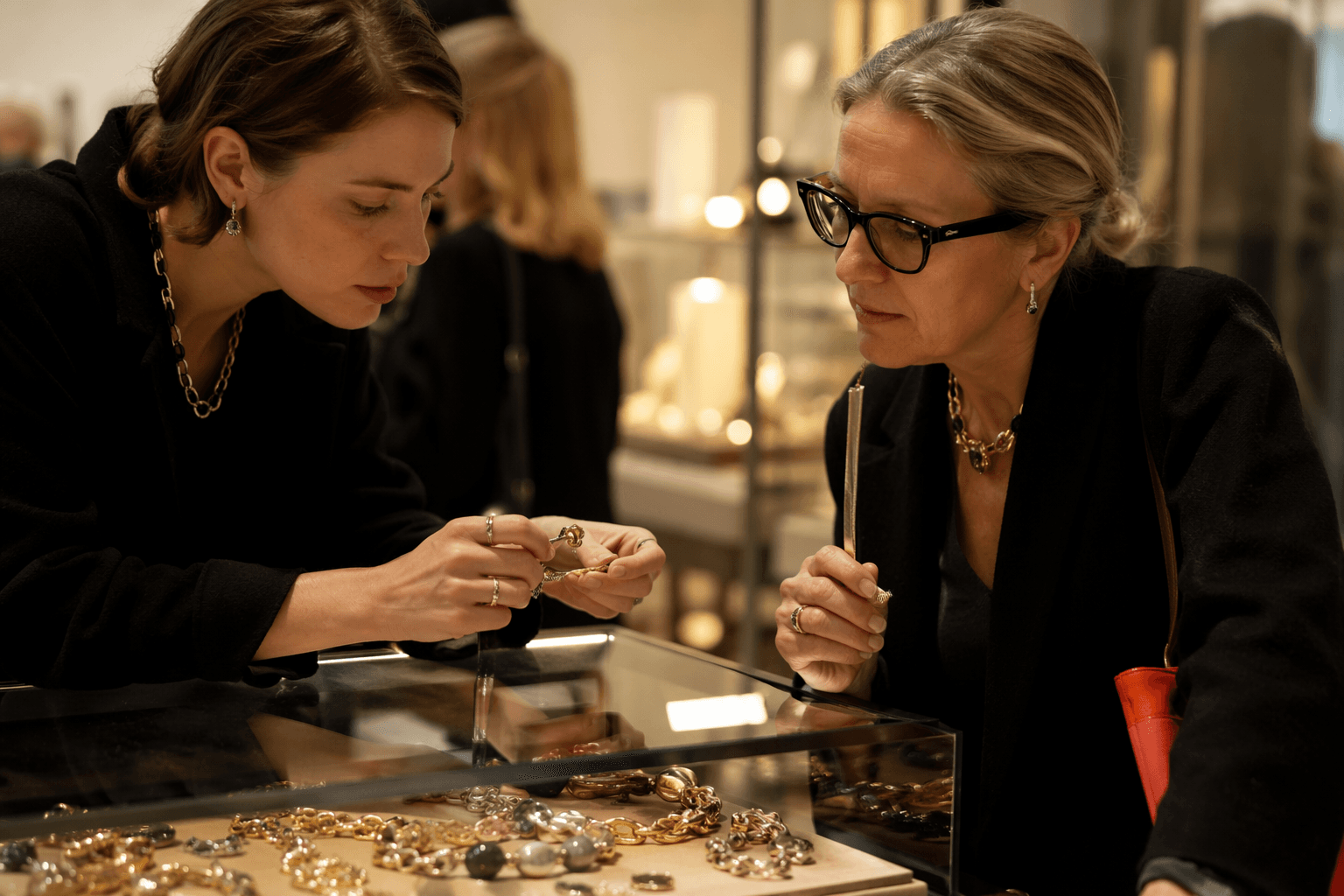
That same sensibility showed up in playful found-object or surrealist designs. These pieces tend to work best when they contain one unexpected element, a clasp that looks borrowed from another object, a charm that seems slightly offbeat, or a shape that feels collected rather than manufactured. For everyday jewelry, that kind of detail offers personality without requiring a full statement look.
Color is becoming more saturated and more specific
The stone story at Couture was just as vivid as the metal story. Saturated colored gemstones were everywhere in the broader conversation, and that shift matters because color is one of the easiest ways for a piece to feel fresh without becoming difficult to wear.
Instead of pale, anonymous accents, the market is moving toward stronger hues and more legible stone choices. That gives jewelry more visual authority, especially in smaller pieces where color has to do the work that size once did. A vivid stone in a clean setting can make a simple ring, pendant or earring feel far more resolved than a busier design loaded with extra ornament.
Alternative gemstones also played an important role. For shoppers, that opens the door to pieces that feel more distinctive, whether the appeal is in unusual color, a less expected texture, or a stone choice that breaks from the default diamonds-and-gold formula. The point is not eccentricity for its own sake; it is giving everyday jewelry a stronger identity.
Interchangeable pieces are the smartest version of versatility
Interchangeable jewelry was another standout idea, and it may be the most practical trend of the bunch. In a market where people want fewer pieces that do more work, modular design solves a real problem: one base, several looks.
The appeal is obvious for everyday wear. A necklace that can change its pendant, a collar that accepts different inserts, or a pair of earrings that can be worn in multiple configurations makes jewelry feel less seasonal and more lived-in. It also shifts the buying logic from novelty to utility, which is exactly where consumers are leaning when they want beauty without excess.
Why the new designers matter
COUTURE also highlighted new debutants in its 2026 Design Atelier, a reminder that experimentation still sits at the center of the show’s identity. Fresh names often move fastest when they are not bound to a house style, and that freedom is part of why Couture remains such a reliable barometer for what comes next.
The encouraging part for readers is that the experiment is becoming easier to wear. The market is not asking people to choose between statement and practicality. It is showing that a leather collar, a steel torque, a saturated gemstone or an antique-style chain can be both distinctive and daily-friendly when the proportions are right.
For anyone building a modern jewelry wardrobe, that is the real takeaway from Couture: the most compelling pieces are no longer the loudest ones in the room, but the ones with enough material honesty, design clarity and tactile detail to stay in rotation long after the trade-floor buzz fades.
This article was produced by Prism’s automated news system from verified source data, official records, and press releases, then run through automated quality and moderation checks before publishing. The system is built and supervised by the people who set the standards it runs under. Read our full AI policy.
Know something we missed? Have a correction or additional information?
Submit a Tip