Ear Cuffs Are Making a Major Comeback in Fine Jewelry
No piercing required: fine jewelry's most versatile ear accessory is back, and this time it spans delicate diamonds to bold statement pieces worth serious investment.

Something shifted in the ear cuff's trajectory around 2013, when the style generated enough buzz to fill multiple editorial pages. Then, as trends do, it receded. Now it's back with the kind of quiet confidence that suggests it isn't leaving again anytime soon.
"It seems inevitable that ear cuffs would make a comeback," wrote Brittany Siminitz in a recent JCK trend piece tracking the resurgence. The appeal is structural: ear cuffs wrap around the outer cartilage or helix without requiring a needle, making them accessible to anyone who owns ears and has a few minutes to spare. As Siminitz put it, "With so many variations on the market, there are endless styling possibilities with ear cuffs, and they require no commitment to piercing by the wearer."
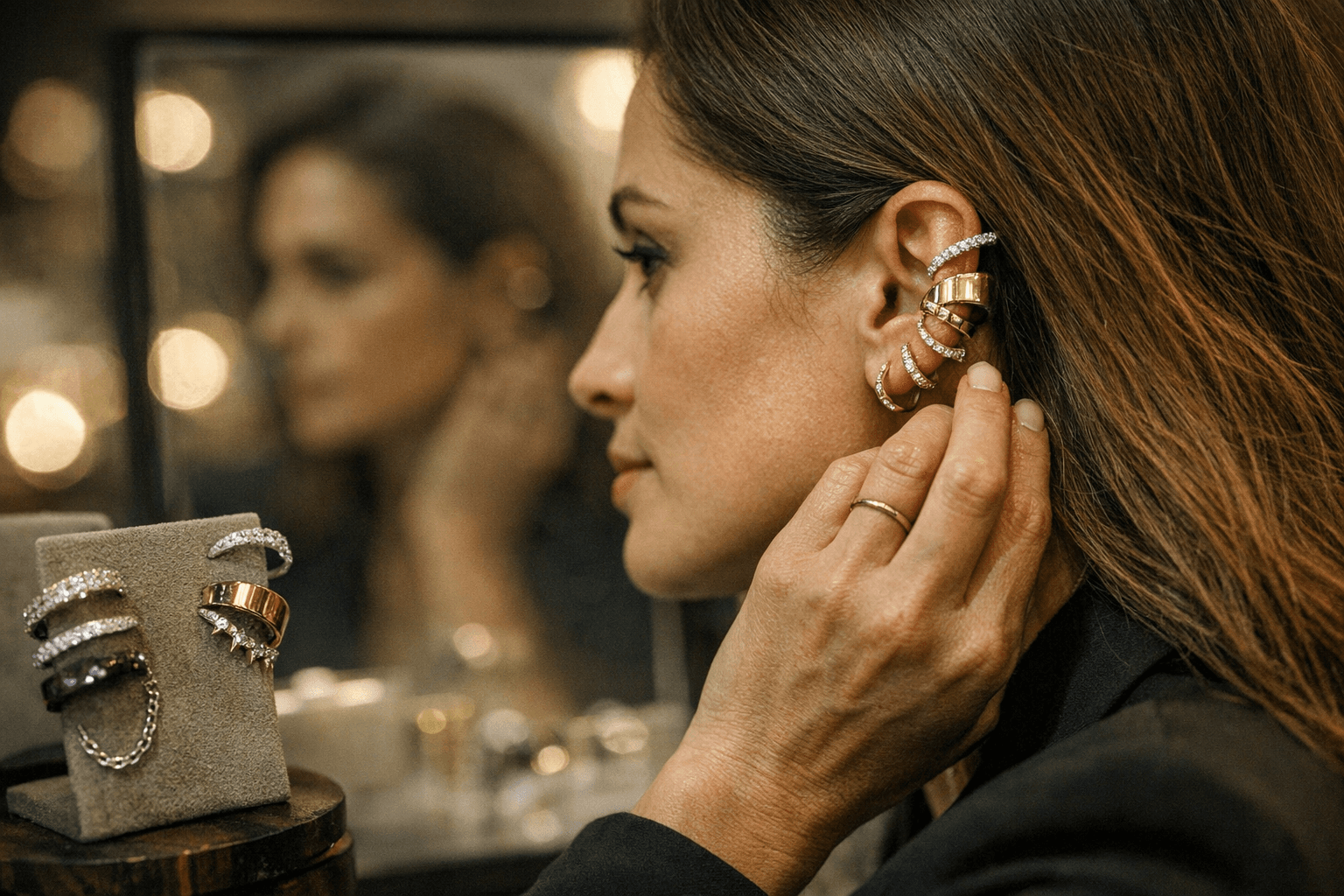
That combination, investment-worthy design paired with zero-commitment wear, is exactly the kind of proposition fine jewelry buyers respond to right now.
Why This Moment Feels Different
The 2013 wave, which Siminitz remembers vividly from JCK's own coverage at the time, leaned heavily toward drama: oversize, architectural, unmistakably there. "The trend was more toward larger, statement-making pieces than delicate ones," she noted. The current revival is broader. Designers are offering both ends of the spectrum, from gossamer single-stone styles to sculptural statement pieces, which means the ear cuff has shed its niche-trend status and is functioning more like a jewelry category with genuine range.
That range matters to buyers. A trend that requires you to commit to one aesthetic has a ceiling. A trend that works equally well styled against a simple lobe stud or worn solo on an otherwise bare ear has staying power.
The Pieces Worth Knowing
Two ear cuffs in this season's market round-up carry full published specifications, and the contrast between them illustrates the category's breadth nicely.
Yeprem's Whisper ear cuff is set in white gold with 1.16 carats total weight in diamonds, priced at $5,800. The name earns its keep: this is the kind of piece that reads as luminous rather than loud, the pavé or scattered diamonds doing quiet, high-impact work against the ear's curve. At nearly $6,000, it sits firmly in fine jewelry territory and asks to be considered alongside rings and necklaces of similar weight.
At a different price point but no less considered, the Jade Trau Crosby ear cuff is crafted in 18k yellow gold with a single 0.18-carat round diamond, priced at $2,850. The warm yellow gold and solitaire diamond placement give it a precision that reads modern without being austere. Jade Trau's work consistently plays with the tension between understated setting and maximum wearability, and the Crosby fits that sensibility.
Beyond these two, the current market round-up includes pieces from a strong cross-section of independent and established designers: the Melissa Kaye Lola ear cuff, the Katkim Anerise ear cuff, the Harwell Godfrey ear cuff, the Robinson Pelham Daystar ear cuff, the Nomis aquamarine ear cuff, the Mariyeh Ghelichkhani spectrum ear cuff, the Noora Shawqi Gifu ear cuff, the Briony Raymond slim Sloan ear cuff, the Stone emerald ear cuff, the Alexandra Beth ear cuff, and the Toi Sparkle mini ear cuff, alongside Isabel ear cuffs. That thirteen-piece spread across independent designers signals genuine market momentum: when labels of this caliber all arrive at the same silhouette in the same season, it isn't coincidence.
The presence of colored stones is notable. The Nomis aquamarine ear cuff and the Stone emerald ear cuff both suggest that designers aren't limiting the form to diamonds and precious metals. Aquamarine's cool blue translucency and emerald's saturated green each bring their own provenance questions worth asking: origin, treatment status, whether certification from GIA or AGL accompanies the stone. As a buyer, it's always reasonable to request documentation on any colored stone regardless of the setting's design appeal.
How to Wear Them
The ear cuff's wearability is central to its appeal. "The ear cuff is one of those easy breezy pieces to throw on and go," Siminitz wrote, "but it looks anything but simple when it's an intricately detailed and exquisite design." That contrast is the point. The mechanics are simple enough that most cuffs can be positioned and adjusted in seconds, sliding onto the helix or outer ear without tools. The visual result, particularly with a diamond-set or sculptural design, is anything but casual.
A few practical considerations:
- Fit varies by ear anatomy. A cuff designed for a standard helix gauge may sit loosely on a thinner cartilage rim. When buying fine jewelry at this price point, ask whether the piece can be sized or adjusted by a jeweler after purchase.
- Stacking is encouraged. Ear cuffs layer well with existing piercings, and the combination of a cuff at the helix with a stud or drop at the lobe creates intentional asymmetry without requiring matched sets.
- Delicate designs demand careful handling. A pavé-set cuff like the Whisper carries small stones in an open setting that can snag on hair. A simple habit of removing it before pulling anything over your head protects the metalwork.
What to Ask Before You Buy
Given that several of the designers featured here work with colored stones and that the ear cuff form often involves fine wirework or tension settings, a few questions are worth raising with any jeweler:
On materials: What is the metal purity, and is the gold alloy nickel-free? For buyers with metal sensitivities, this matters significantly in a piece worn close to skin with no fabric buffer.
On stones: For colored-stone cuffs, is there a treatment disclosure? Aquamarine is commonly heated to improve color; emeralds are frequently clarity-enhanced with resin or oil. Neither treatment is inherently problematic, but both affect value and should be disclosed.
On construction: How is the cuff's tension maintained over time? Fine gold prongs and delicate band structures can fatigue. Ask whether the piece is designed for daily wear or occasional use, and whether your jeweler can check and tighten the setting annually.
The Bigger Picture
Ear cuffs occupy an interesting position in fine jewelry right now because they democratize the category without diluting it. A $2,850 piece from Jade Trau or a $5,800 Yeprem is unambiguously fine jewelry in terms of materials and craft. But the no-piercing requirement removes one of the historical barriers to entry for buyers who have been reluctant to commit to cartilage piercings. The result is a piece that functions as both an everyday accessory and a considered investment.
As summer approaches and the case for lighter, more visible ear jewelry strengthens, the timing of this revival makes complete sense. The more interesting question is whether the current wave will sustain itself beyond a single season or whether, as in 2013, it peaks and retreats. Given how many independent designers have arrived at the ear cuff simultaneously, and given how naturally the form adapts to both minimalist and maximalist aesthetics, the conditions for longevity look considerably better this time around.
This article was produced by Prism’s automated news system from verified source data, official records, and press releases, then run through automated quality and moderation checks before publishing. The system is built and supervised by the people who set the standards it runs under. Read our full AI policy.
Did this article answer your question?