How to Choose Durable, Low-Maintenance Jewelry for Everyday Wear
The jewelry that earns permanent residency on your wrist or ears has one quality in common: it's built for real life, not the velvet box.
The ring that survives gym sessions, dish soap, and a transatlantic flight without fading, bending, or losing its stone is a different animal from the piece you save for Saturday nights. Choosing jewelry for everyday wear is, at its core, an engineering problem dressed in beauty. Once you understand the variables, the decisions become straightforward. The American Gem Society (AGS), which has been setting standards in jewelry education and ethical trade since 1934, frames the question usefully: the right everyday piece starts with material choices, moves through gemstone science, and lands on the craftsmanship details that hold everything together under real-life pressure.
The Metal Question: Karat, Alloy, and Daily Durability
Pure gold, at 24 karats, is too soft to survive a morning commute intact. Everyday jewelry is always an alloy, a blend of gold with silver, copper, zinc, or palladium, and the karat number tells you how much of that blend is actually gold. Fourteen-karat gold contains 58.3% pure gold, with the remaining 41.7% made up of hardening alloys. Eighteen-karat gold pushes to 75% gold content, which gives it a richer, deeper color, but that extra softness means it scratches more readily under the friction of daily life. For most people who work with their hands, exercise regularly, or simply want low-maintenance jewelry, 14k is the practical sweet spot: it resists dents and scratches better, costs meaningfully less per gram, and still reads as unmistakably fine jewelry.
Ten-karat gold sits below both at less than half gold content, which means more reactive alloys in the mix. Those alloys can interact with sweat, perfume, and air over time, causing subtle darkening. It is manageable, but worth knowing before you buy.
White gold deserves a separate note because its maintenance reality surprises many buyers. White gold is yellow gold alloyed with white metals and then coated in rhodium, an ultra-bright, hard metal applied in a layer only a few microns thick. That rhodium plating is what gives white gold its crisp silver-white appearance, but it will wear through with daily friction, eventually revealing the underlying off-white or faintly yellow alloy. Budget for re-plating every one to two years if you wear white gold rings constantly.
Platinum sidesteps that problem entirely. It is naturally white, does not require plating, and is hypoallergenic, a meaningful advantage for people with nickel sensitivities, since many 14k white gold alloys contain nickel. Platinum is denser and more expensive than gold, but it does not shed metal when scratched; instead, it displaces, which means the surface develops a patina rather than losing mass over time.
Sterling silver, stamped 925 (indicating 92.5% silver), is the accessible entry point for everyday wear, though it requires the most active maintenance. Silver oxidizes and tarnishes when exposed to air and moisture, so sterling silver jewelry worn daily needs regular polishing. Vermeil, which is sterling silver with a gold plating of at least 2.5 microns, offers more visual warmth but will show wear at high-friction points, particularly wrists and ring shanks, over months of daily contact.
The Stone Science: Reading the Mohs Scale
The Mohs hardness scale, running from 1 (talc) to 10 (diamond), is the single most useful number to know before buying a stone for a piece you intend to wear every day. The scale measures scratch resistance: a stone rated lower can be scratched by anything above it on the scale, including the quartz found in ordinary dust.
Diamonds register 10 and are the unambiguous choice for daily-wear rings. Sapphires and rubies, both varieties of the mineral corundum, register 9, making them the next best option for stones you want on your finger during everything from cooking to gardening. Their combination of hardness and good toughness (resistance to chipping) is why colored-stone engagement rings centered on sapphires have become one of the most asked-about categories in 2026.
The middle band of the scale, roughly 7 to 8, covers tourmaline, garnet, and topaz. These stones can sustain regular wear in earrings and pendants, where they face less direct impact than a ring does, but they need more careful handling when worn on the hand. Emeralds rank 7.5 to 8 on hardness, but they are notoriously prone to fracture because natural emeralds typically contain inclusions (called a "jardin") that create internal weak points. Hardness and toughness are different properties: a stone can be scratch-resistant and still shatter from impact.
Opals, pearls, and turquoise fall below 7 and are best reserved for pieces that stay out of water and away from hard surfaces. These are evening pieces, not daily drivers.
Settings That Do the Work
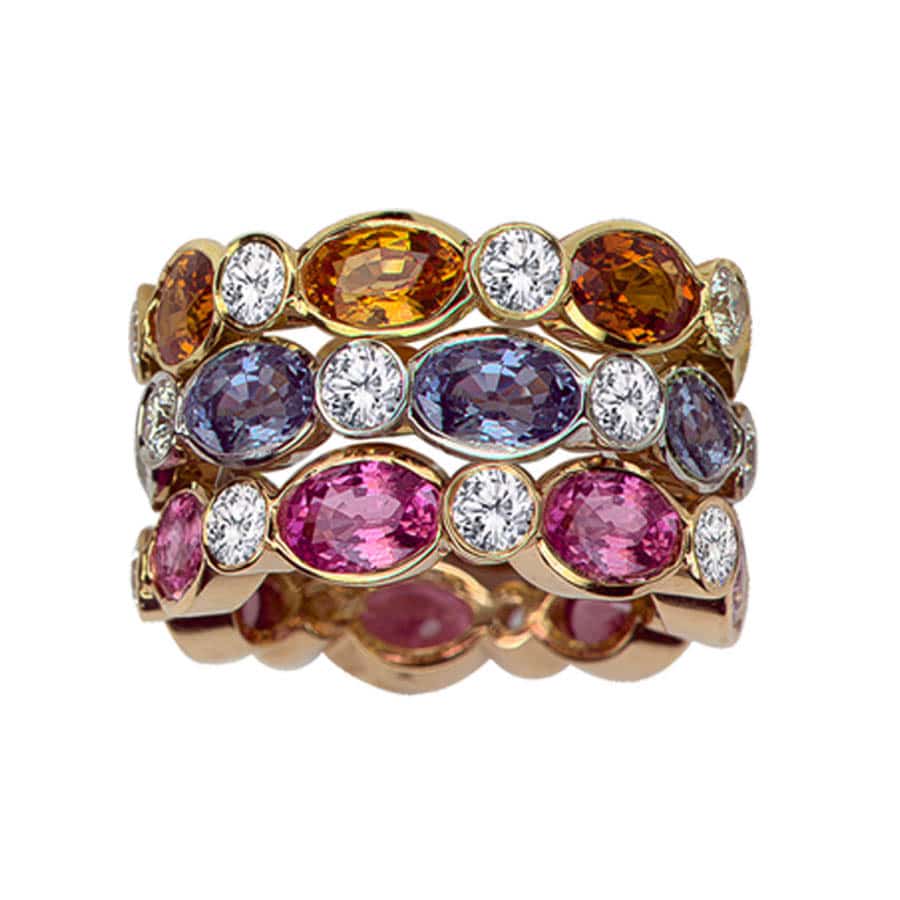
The way a stone is set is as important as the stone itself when it comes to daily durability. A prong setting, in which small claws of metal grip the stone at its girdle, maximizes light return and visual impact but leaves the stone exposed on all sides. Prongs can catch on fabric, bend, and, if one breaks without you noticing, release the stone entirely. A bezel setting, which wraps a continuous rim of metal around the stone's perimeter, is the most protective option for everyday wear: the stone is shielded from lateral impact, and there are no prongs to snag. Channel settings, common in bands, embed stones in a groove between two metal walls, offering good protection for rows of smaller stones.

If you love the look of a prong-set solitaire, a six-prong setting holds a stone more securely than four-prong, and platinum or 18k prongs maintain their grip longer than lower-karat gold, which is softer and more prone to prong wear.
Hallmarks: The Numbers You Should Check Before You Buy
Every piece of legitimate fine jewelry carries a hallmark, and knowing what to look for saves you from buying gold-plated brass at gold prices. In the United States, the Federal Trade Commission requires that metal purity claims be accurate; the numbers stamped into jewelry reflect that standard.
- 999 or 24k: pure gold (too soft for most jewelry)
- 750 or 18k: 75% gold
- 585 or 14k: 58.5% gold
- 417 or 10k: 41.7% gold
- 925: sterling silver (92.5% silver)
- PT950 or PT900: platinum (95% or 90% platinum)
For gemstones, certifications from labs like the AGS Laboratories, GIA (Gemological Institute of America), or IGI provide independent verification of a stone's quality grades, origin claims, and, increasingly, whether it is natural or lab-grown. AGS, founded by Robert M. Shipley in 1934 and based in Las Vegas, Nevada, grades diamonds on its own numerical scale and is one of the few labs whose cut grades are considered benchmark standards by the trade. A loose stone sold without any laboratory report is a stone whose qualities you are taking on trust alone.
Lab-Grown Stones: The Low-Maintenance Case
Lab-grown diamonds and sapphires are physically and chemically identical to their mined counterparts: the same hardness, the same refractive index. They carry a lower price point that makes it possible to buy a larger, higher-quality stone for a given budget. For everyday jewelry, lab-grown diamonds offer a practical argument: you can wear a visually significant piece without the anxiety of a high replacement cost if it is lost or damaged. Lab-grown sapphires carry the same logic. What lab-grown stones lack is the provenance narrative of a natural stone, which matters differently to different buyers. Neither choice is objectively better; the honest question is which trade-off fits your priorities.
Evaluating Craftsmanship: What to Look for in Person
Good craftsmanship is visible before you need to ask about it. Prongs should be smooth and even, not jagged or misaligned. Stone seats should hold each stone level and without wobble. Solder joints where components meet should be clean. Inside a ring shank, the metal surface should be polished or at minimum smooth enough to wear comfortably. Rough edges, visible file marks, or stones that rock in their settings are signs of shortcuts that translate to earlier failure under daily wear.
When you talk to a jeweler about long-term durability, the right questions are specific: What is the metal alloy in this piece? Can these prongs be re-tipped if they wear down? How does the stone's toughness compare to its hardness? Does this finish (high-polish, brushed, hammered) show scratches more or less readily? A jeweler who answers these questions concisely and without defensiveness is one who understands what they are selling. That conversation is itself a quality indicator.
Deciding What Works for Your Life
The most durable everyday jewelry is the piece that matches the actual conditions of your day. If your hands are frequently in water, whether from dishes, patient care, or outdoor work, platinum or 14k gold with a bezel-set sapphire or diamond is the combination that will look the same in ten years as it does today. If you want earrings or a pendant for all-day wear with minimal thought, 14k gold with a sapphire, ruby, or diamond will outlast almost anything else. If your skin reacts to metals, platinum or high-karat yellow gold (which contains the least reactive alloy content) are the choices to start with.
The jewelry that earns its permanent place is specific about what it can handle. The more precisely you understand the materials you are buying, the less you will spend replacing pieces that were not built for the life you actually live.
This article was produced by Prism’s automated news system from verified source data, official records, and press releases, then run through automated quality and moderation checks before publishing. The system is built and supervised by the people who set the standards it runs under. Read our full AI policy.
Did this article answer your question?