How to keep your engagement ring sparkling, safe, and well-maintained
A diamond can still lose its setting. Monthly at-home care, a six-month cleaning cycle, and yearly inspections keep the ring safe as well as bright.

The most expensive mistake with an engagement ring is often the quiet one: assuming a diamond is indestructible because it still looks fine. Daily wear can dull the stone, loosen the prongs, and turn a small bit of grime into a bigger repair bill, which is why the safest routine is less about dramatic fixes than about steady maintenance.
Start with the ring you actually wear
An engagement ring lives on the hand, so it meets water, soap, movement, and hard surfaces constantly. Jewelers of America says even a sharp strike on a hard surface can chip a diamond, and washing dishes in a ceramic sink can do the same. That is the uncomfortable truth behind ring care: the stone may be hard, but the setting and the edges of the diamond are still vulnerable.
The American Gem Society recommends removing jewelry before showering, swimming, or engaging in vigorous activities. That advice covers the obvious risks, but it also reflects something more practical. When a ring is worn through daily motion, oils, dirt, and grime build quickly, and a piece that looked brilliant last month can start to look flat much sooner than many owners expect.
Clean it at home, but keep the method gentle
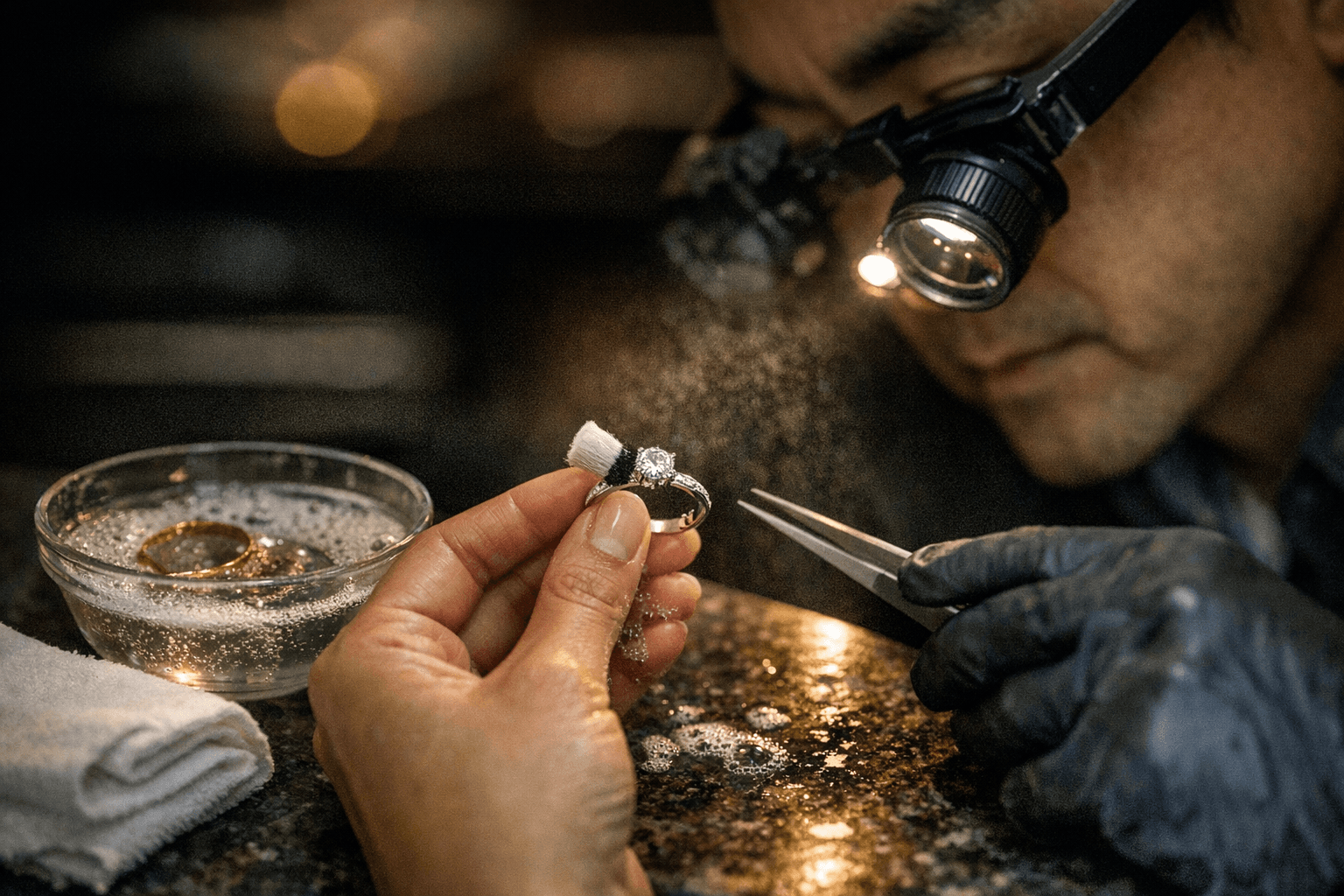
For frequently worn rings, the American Gem Society recommends cleaning about once a month at home. The goal is not a deep restoration, just a careful reset that removes buildup without stressing the metal or the setting. Warm water, mild dish soap, and a soft-bristle toothbrush are the preferred tools, because they clear residue from under the stone and around the prongs without being abrasive.
A simple routine works best:
- Fill a small bowl with warm water and a drop of mild dish soap.
- Let the ring soak briefly to loosen surface grime.
- Use a soft-bristle toothbrush to clean around the setting and under the stone.
- Rinse thoroughly and dry with a soft cloth.
The important part is restraint. Bleach is not safe for jewelry because it damages gold alloys, and the American Gem Society also warns against vinegar, lemon juice, baking soda, and boiling water. Those ingredients sound harmless because they live in ordinary kitchens, but jewelry is not a place for improvisation. Strong chemicals and extreme heat can do more harm than the dirt you are trying to remove.
Know when the ring should come off
Showering and swimming are the easy calls, but the same rule should apply any time the ring is likely to bang against hard surfaces or snag on equipment. Vigorous activities are exactly the kind of setting where prongs get bent, stones get loosened, and a ring starts to change shape before you notice it. The damage does not always arrive as a dramatic break. Sometimes it starts with a slightly crooked stone or a setting that feels less secure on the finger.
Kitchen cleanup deserves special caution. Jewelers of America specifically warns that washing dishes in a ceramic sink can cause chipping, and that is a reminder that one careless knock can matter more than hours of normal wear. If you want the ring to stay intact, the safest habit is simple: take it off before anything that involves slippery hands, hard basins, heavy lifting, or a chance of impact.
Store it like a piece worth protecting
Once the ring is off, do not leave it on a counter, beside a sink, or in a dish where it can be knocked around or misplaced. The American Gem Society advises storing each piece separately in a soft pouch or lined jewelry box. Separation matters because it keeps pieces from rubbing against one another and makes it much less likely that a ring disappears into the clutter of everyday life.
That habit also supports the kind of care that keeps a ring wearable for years rather than months. When you have one fixed place for the ring, you are less tempted to drop it near the faucet, tuck it beside a soap dish, or leave it exposed on a dresser. Good storage is not glamorous, but it is the simplest defense against avoidable loss.
Get the setting checked before it becomes a repair
A ring can look polished and still be in trouble. Jewelers of America says jewelry should be checked by a jeweler at least once a year for loose prongs, worn mountings, and general wear and tear. It also recommends professional cleaning every six months. That rhythm matters because the damage that leads to a missing stone usually starts with wear you cannot see at home.
The American Gem Society gives the same basic advice, recommending regular professional cleanings and inspections. It is also worth remembering how long these organizations have been doing this work. The American Gem Society has been helping consumers buy jewelry since 1934, and Jewelers Mutual brings more than 100 years of jewelry-protection expertise to its consumer guidance. Their consensus is clear: routine inspection is not a luxury, it is part of ownership.
Do not wait for a stone to go missing
The most telling statistic in this category is the one many owners never expect. Jewelers of America says more than half of claims reported by Jewelers Mutual Group are partial losses, which means a stone slipping from a ring is one of the most common jewelry problems people file. That detail changes the way you should think about care. The goal is not just sparkle; it is keeping the stone physically where it belongs.
Engagement rings are often the most expensive piece in a personal jewelry collection, which is why many owners choose dedicated jewelry insurance. Insurance does not replace maintenance, but it does underline the stakes. A ring that is cleaned monthly, removed before water and workouts, stored separately, and checked by a jeweler each year is far less likely to become one of those partial-loss claims. That is the difference between a beautiful object that is merely worn and one that is genuinely protected.
This article was produced by Prism’s automated news system from verified source data, official records, and press releases, then run through automated quality and moderation checks before publishing. The system is built and supervised by the people who set the standards it runs under. Read our full AI policy.
Did this article answer your question?