Jackie Ansell’s Hysteria turns women’s history into symbolic jewelry
Jackie Ansell turns cameos and padlocks into wearable shorthand for women’s history. Hysteria’s $450 to $575 pieces are built for meaning, not disposable trend cycles.
Why symbolic jewelry is winning daily wear
The most compelling jewelry today does more than catch the light. It carries a point of view, a memory, or a small act of defiance, which is exactly why Jackie Ansell’s Hysteria feels so of-the-moment. In a market crowded with trend pieces that can feel interchangeable after a season, Hysteria treats a necklace as a story you can wear to work, to dinner, and through the ordinary choreography of washing hands, opening doors, and living in your clothes.
Ansell’s appeal is not just aesthetic. She pulls from art history, psychology, and her sister’s medical experience to reclaim old myths and motifs, then translates them into jewelry that reads as both decorative and pointed. That mix matters because meaning-heavy jewelry has become a practical dressing tool as much as an emotional one: people want pieces that feel personal enough to keep in rotation, not so precious or fussy that they stay in a box.
A brand built around women’s stories, not empty nostalgia
Hysteria is less interested in recycling antique style than in revising it. The brand frames itself as a reclamation of women’s self-expression and “too muchness,” and that idea runs through everything from its name to its silhouettes. The company’s language is intentionally sharp, citing nineteenth-century etiquette books that told women to “speak gently, laugh softly,” then answering that restraint with jewelry that insists on volume, presence, and contradiction.
That tension is the point. Instead of treating Victorian references as prettified history, Hysteria uses them to ask what women were expected to hide, smooth over, or silence. The result is jewelry that feels symbolic without becoming costume, and that balance is why it lands as everyday wear rather than museum display.
The collection’s defining pieces
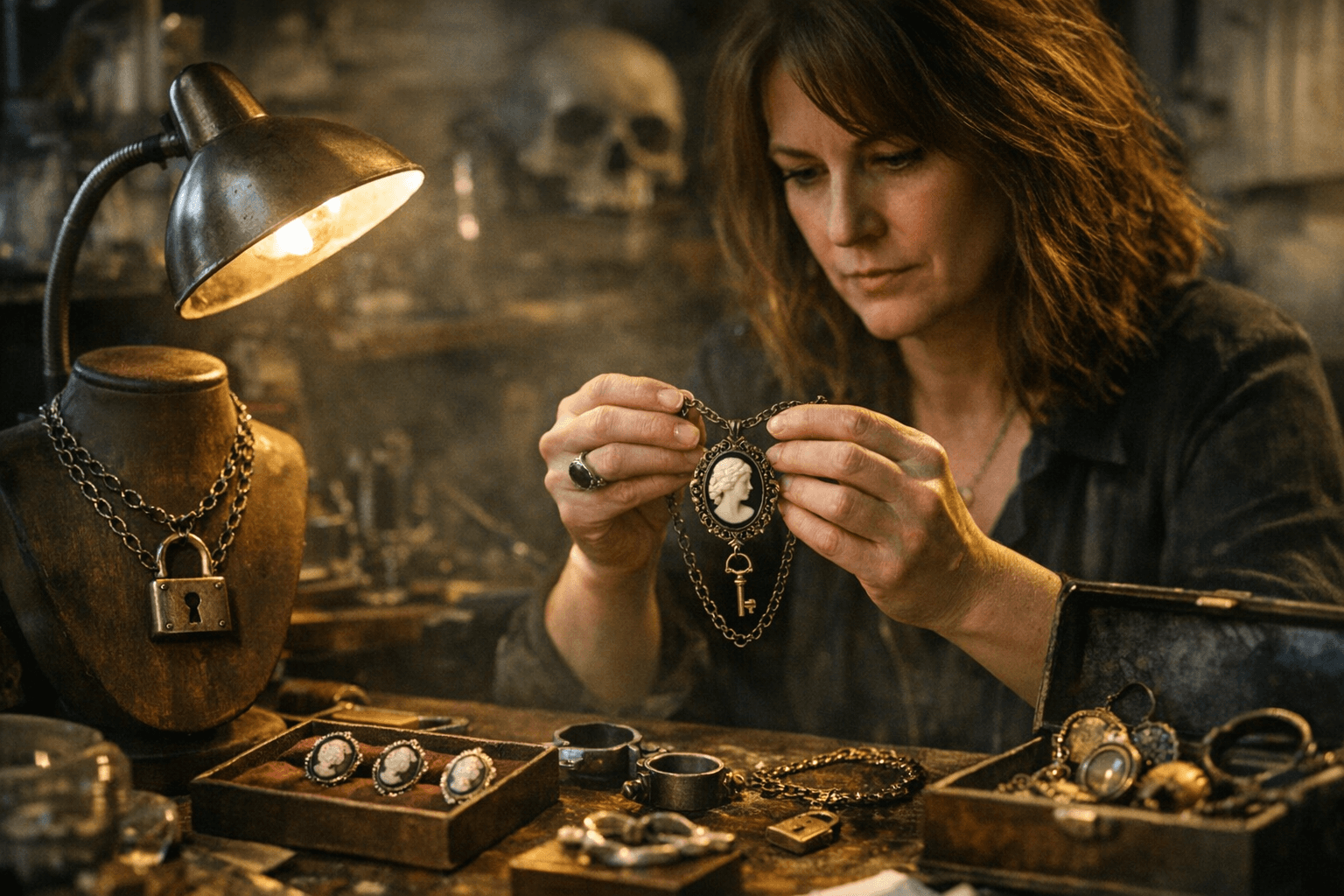
Hysteria officially debuted its first collection, The Awakening, and its website in January 2026, with a planned appearance at Brand Assembly in New York City later that February. The collection’s hero piece is the Shackle of Ophelia necklace, priced at $575, which uses an antique-inspired padlock as a symbol of both constraint and protection. That dual reading is smart: the lock suggests captivity, but it also suggests keeping something safe.
The Cinched Cameo necklace, priced at $450, is the other signature piece and perhaps the more revealing one. Its name nods to corsetry and the pressure placed on women’s bodies, while the cameo itself brings a classical, almost inherited elegance to the message. Together, the two necklaces map the brand’s argument with unusual clarity: beauty can be ornament, but it can also be evidence of the rules women have had to live under.
The charm-holder shape also carries a loaded detail. Hysteria says it takes inspiration from the Greek root of the word hysteria, meaning uterus, which turns a historically weaponized term into a design cue. That choice gives the line a sharper edge than standard “inspired by history” jewelry and makes the pieces feel intentional rather than decorative for decoration’s sake.
Why the cameo feels current again
Cameo jewelry is not a new idea dressed up as one. Its roots stretch back to the Ancient Mediterranean, where cameos often featured mythological figures and portraits carved in relief. Over centuries, they moved through Roman taste, Renaissance collecting, and then the 19th century, when Queen Victoria helped popularize them as status symbols and sentimental keepsakes.
That history is part of why cameo jewelry reads differently now than a generic charm or pendant. A cameo already carries the language of portraiture, inheritance, and self-presentation, so when a contemporary brand like Hysteria reworks it, the piece feels laden before it even gets worn. The Zoe Report has described Ansell and Hysteria as helping breathe new life into antique-inspired cameo jewelry, and that broader revival is easy to understand: cameos offer recognizable form without the overexposed feel of a logo pendant or a mass-market medallion.
What Hysteria says about making, and what that means for the buyer
Hysteria says its demi-fine jewelry is designed in New York and hand-crafted in Rhode Island. It also says its cameo elements are made by female artists in Bali, while its bone-carved stones are ethically produced by skilled female artisans there. That labor story is part of the brand’s identity, and it gives the line a stronger provenance narrative than many mood-board brands manage to provide.
Still, the most useful question for a buyer is not only who made the piece, but how the brand substantiates its claims. Hysteria emphasizes artisan craft and ethical production, yet it does not foreground a third-party certification, so the sourcing story rests on the brand’s own descriptions rather than a formal seal. For readers who care about provenance, that distinction matters. A meaningful motif is more convincing when the material story is as considered as the symbolism.
How to wear symbolic jewelry every day
The strongest everyday pieces are the ones that can handle real life without losing their shape or force. A pendant like the Cinched Cameo works because it can sit close to the body, layer under a collar, and still read clearly against a simple T-shirt or knit. The Shackle of Ophelia has a stronger graphic presence, but that also makes it useful as a single focal point when the rest of the outfit is pared back.
A few practical signs that symbolic jewelry earns its keep:
- The silhouette is compact enough to wear with a blazer, sweater, or plain tank without snagging.
- The motif reads from a distance, so it does not disappear once layered.
- The construction looks sturdy enough for daily skin contact, humidity, and the occasional splash while washing hands or cooking.
- The piece feels personal, not overdesigned, which makes it easier to repeat.
That is where Hysteria is clever. It gives buyers an object with enough narrative weight to feel collectible, but enough clarity to be worn often. In a moment when shoppers are choosing fewer things and asking more of them, that combination of symbolism, craft, and wearability is exactly what makes a piece worth keeping close.
This article was produced by Prism’s automated news system from verified source data, official records, and press releases, then run through automated quality and moderation checks before publishing. The system is built and supervised by the people who set the standards it runs under. Read our full AI policy.
Did this article answer your question?