Oakland jeweler turns shattered car glass into earrings
Shattered car glass becomes floral earrings in Sydney Jones’s Oakland studio, where a pandemic pastime has grown into Odd Commodity Shop.
From break-in debris to ornament
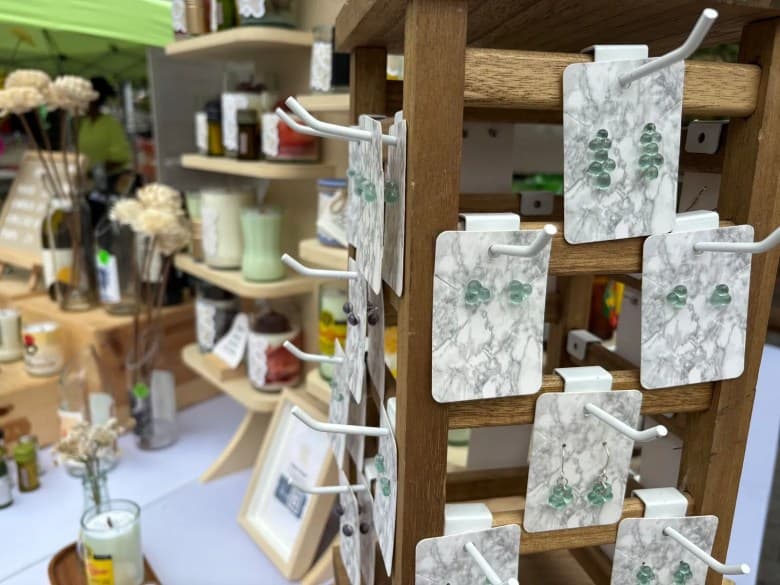
There is nothing delicate about the origin of Sydney Jones’s earrings, and that is exactly the point. In Oakland, where car break-ins have long been a visible nuisance, Jones collects shattered safety glass from bipped cars, sweeps it up with a broom and dustpan, then turns the fragments into rounded, floral-looking jewelry that transforms damage into adornment.
Her business, Odd Commodity Shop, began as a COVID-era experiment and evolved into a full-fledged brand with a distinctly local point of view. What started with leftover resin from architecture-school projects now extends into reclaimed-glass earrings, candles, vases, candle holders, knick-knack containers and other home decor, all framed as handmade upcycled goods from the Bay Area.
How the glass becomes jewelry
Jones’s process is part salvage work, part small-scale alchemy. She gathers the safety glass after break-ins, cleans and sorts it, then melts it in a kiln until the sharp, fractured material softens into something rounded and wearable. The result is jewelry that keeps a trace of its previous life while shedding the violence of the moment that created it.
That matters aesthetically as much as ethically. The finished pieces do not hide their origin in the way many recycled materials do. Instead, the glass is the story: a material associated with urgency and disorder is recast into forms that read as floral, playful and unexpectedly refined. In a jewelry market crowded with polished uniformity, that visible history is the brand’s edge.
What the collection looks like
Odd Commodity Shop’s line includes names that sound almost whimsical, which suits the pieces’ soft, molten look. Bip Drips, Bip Florals, Bip Clusters and Bip Diamonds suggest variety within a single material language, with the glass moved into different silhouettes rather than disguised as something else. The shop’s handmade jewelry is described as crafted from recycled and repurposed materials, from glass bottles to street-found scraps, but the shattered car-window glass remains the signature.
The broader assortment reinforces the same idea across categories. Candles, vases and candle holders sit beside the jewelry, as if the brand is building an entire domestic universe out of rescued matter. Even the candle-making workshops extend the concept: this is not simply a line of objects, but a practice built around reuse, repair and making do with what the city leaves behind.
Why the material story lands now
Jones’s work meets a larger cultural moment in which sustainability has moved from nice-to-have language to a real buying motive, especially when the origin story is visible. Glass is one of the materials tracked separately in U.S. materials-and-waste data, and the Environmental Protection Agency treats it as one of the commonly recycled materials that make up a large share of municipal solid waste. Yet recycling systems remain uneven, and glass is still often under-collected compared with the amount that ends up discarded.
That gap helps explain the appeal of Jones’s approach. The material is familiar, but the route she gives it is unusual: instead of asking consumers to imagine a distant supply chain, she offers a direct line from neighborhood harm to finished object. The jewelry becomes more than upcycling. It becomes a record of place, one that acknowledges Oakland’s real conditions instead of smoothing them into abstraction.
Oakland is part of the design
The city’s public crime data portal tracks incidents by time period and police area, a reminder that car break-ins are not just anecdotal frustrations but part of Oakland’s lived civic landscape. Jones’s work takes that reality seriously without turning it into spectacle. By converting broken window glass into wearable design, she gives the city’s messiest visual cues a second life that is intimate rather than ornamental for ornament’s sake.
That local specificity gives the jewelry a sharper emotional register than generic reclaimed pieces often have. A necklace made from recycled material is one thing; a pair of earrings born from the glass of a broken car window in your own city is another. The transformation does not erase the rupture. It reframes it, asking the wearer to carry evidence of a place, a problem and a solution all at once.
From side project to livelihood
Jones has recently left her day job to focus on Odd Commodity Shop full time, a step that suggests the brand has moved beyond novelty into something more durable. The online shop continues to show sales and workshop dates in the Bay Area, signaling both demand and momentum. For a business rooted in pandemic improvisation, that is a notable shift: the hobby now has the structure of a real design practice.
What makes Jones’s trajectory compelling is not just that she found a way to monetize recycled materials. It is that she built a vocabulary around a specific urban material, one that carries both danger and memory, and made it legible as jewelry. In an era when consumers increasingly want provenance with their purchases, Odd Commodity Shop offers the rare origin story that is both beautiful and plainly true.
This article was produced by Prism’s automated news system from verified source data, official records, and press releases, then run through automated quality and moderation checks before publishing. The system is built and supervised by the people who set the standards it runs under. Read our full AI policy.
Did this article answer your question?