Patek Philippe’s Rare Handcrafts: Geneva Show Highlights Craftsmanship (Watch Week 2026)
Patek's 2026 Rare Handcrafts salon opens April 18 in Geneva with 65 pieces, including the first gem-set dome clock built from 20.75 metres of gold wire and 48 enamel colours.
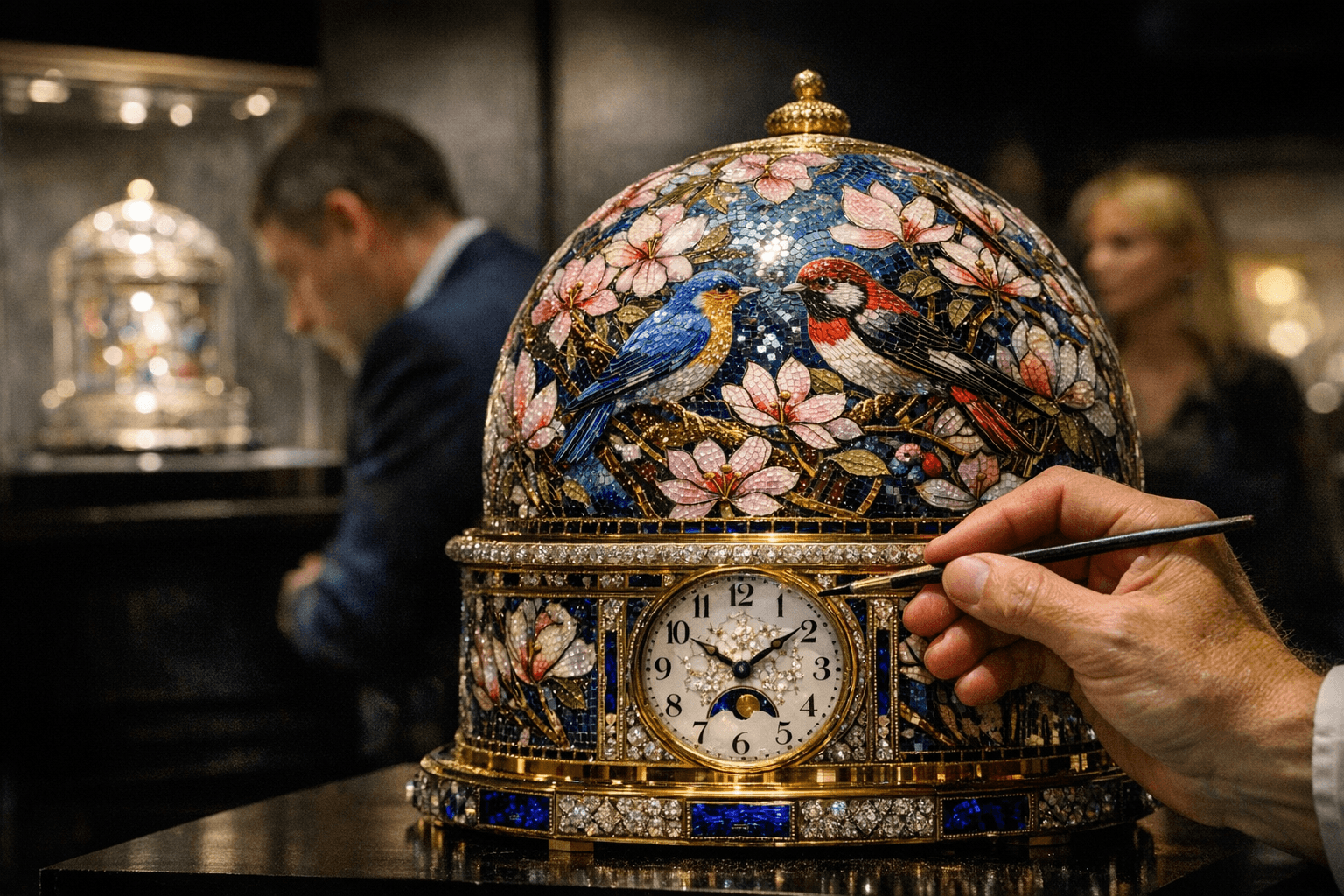
Twenty point seven five metres of gold wire. Forty-eight enamel colours. Eight to ten firings at temperatures between 800 and 820 degrees Celsius. Those are the numbers behind a single dome table clock, the "Macaws," that Patek Philippe unveiled at Watch Week in Geneva as part of its 2026 Rare Handcrafts collection, which opens to the public April 18 at the manufacture's six-story Salons on the Rue du Rhône and runs through May 9.
The collection brings 65 exceptional new creations to Geneva: 23 dome table clocks, 10 pocket watches, and 32 wristwatches, blending centuries-old techniques including Grand Feu cloisonné enamel, grisaille, flinqué, paillonné, feuille enamel, hand engraving, guilloché work, and advanced gem-setting.
The "Macaws" is the first dome table clock Patek Philippe has ever set with precious gemstones. To execute the cloisonné scene depicting scarlet macaws in Amazonian foliage among birds-of-paradise flowers, artisans soldered thin gold wires onto a metal base to form partitions called cloisons, then filled each with vitreous enamel paste and returned the piece to the kiln, repeatedly, until the colour reached depth. The chapter ring glistens with 1,140 snow-set diamonds, and the hour markers are composed of baguette-cut spinels.
The second one-of-a-kind piece, the "Flamenco" pocket watch, carries a yellow gold case, bezel, and bow decorated with hand-engraved floral frieze motifs, while the dial side reveals hand-executed guilloché beneath translucent red flinqué enamel. Applied Breguet numerals and leaf-shaped hands indicate the time, a red spinel cabochon adorns the crown, and the piece is delivered on a gold stand with a plique à jour fan at one end and a black obsidian base.
For anyone who buys jewelry to wear rather than display, these pieces carry a more practical argument than their spectacle suggests. Snow-setting, in which small stones are embedded flush across a metal surface without individual prongs, distributes impact across the metal plane rather than concentrating stress at a single mount point. The guilloché work on the "Flamenco" makes the same case: hand-cut engine-turning compresses and textures the metal surface in a way that machine-rolled finishes do not, creating a substrate that anchors overlying enamel more firmly. It is why enamel on a hand-prepared ground can survive the dozens of kiln firings Patek's artisans require without fracturing.
Patek's gemsetters work entirely by hand on Rare Handcrafts pieces, using snow setting, invisible setting, grain setting, and the manufacture's patented Flamme® setting technique. Each method implies a different tolerance for daily wear, and the questions they raise translate directly to fine jewelry at any price point.
When examining an enameled pendant or ring, ask whether the enamel is applied in a closed-back or open-back setting: closed-back protects the reverse face and extends the enamel's working life considerably. For stone-set pieces, ask whether prong tips were hand-burnished or machine-pressed; burnished prongs hold grip longer and resist catching on fabric. With engraved metalwork, run a fingertip across the surface. Hand engraving carries micro-variability in depth that catches light at different angles, while machine-cut lines are uniform to the point of flatness. And on any bezel-set stone, requesting thicker mounting rails adds measurable structural integrity with almost no visible change in silhouette.
The Rare Handcrafts 2026 exhibition runs April 18 through May 9, daily except Sundays, from 11:00 to 18:00, with last entry at 17:00, at the Patek Philippe Salons at 41 Rue du Rhône in Geneva. The techniques on view represent not a museum of obsolescence but a working vocabulary for evaluating craft, at any price, in any jeweler's case.
Know something we missed? Have a correction or additional information?
Submit a Tip