Scottish Designer Ebba Goring Casts Crocheted Textiles Into Precious Metal Jewels
Scottish jeweller Ebba Goring crochets cotton by hand and casts it into solid gold, creating wearable texture unlike anything else in fine jewelry; her new Regency Collection starts at £390.
Think about what your jewelry goes through in a normal week: handwashing, cooking, the gym, humidity, and the slow accumulation of daily contact with skin and fabric. Most fine jewelry is not built for that reality. Ebba Goring's is. The Scottish designer makes pieces that read as impossibly delicate, all woven lattice and textile memory frozen in metal, yet she insists they are designed to outlast you. "Although the pieces may look delicate," Goring has said, "they're designed with longevity in mind: to be worn, enjoyed, and passed on."
That is a remarkable claim for a jewellery practice rooted in crocheted cotton. And the fact that it holds up, technically and aesthetically, is what makes Goring one of the most genuinely distinctive voices working in British fine jewellery today. Her new Regency Collection, the first she has released in six years, is the fullest expression yet of a technique she has been developing since she graduated from Duncan of Jordanstone College of Art and Design in Dundee in 2009 with a BDes (Hons) in Jewellery and Metal Design.
The Technique: Cotton Becomes Cast Metal
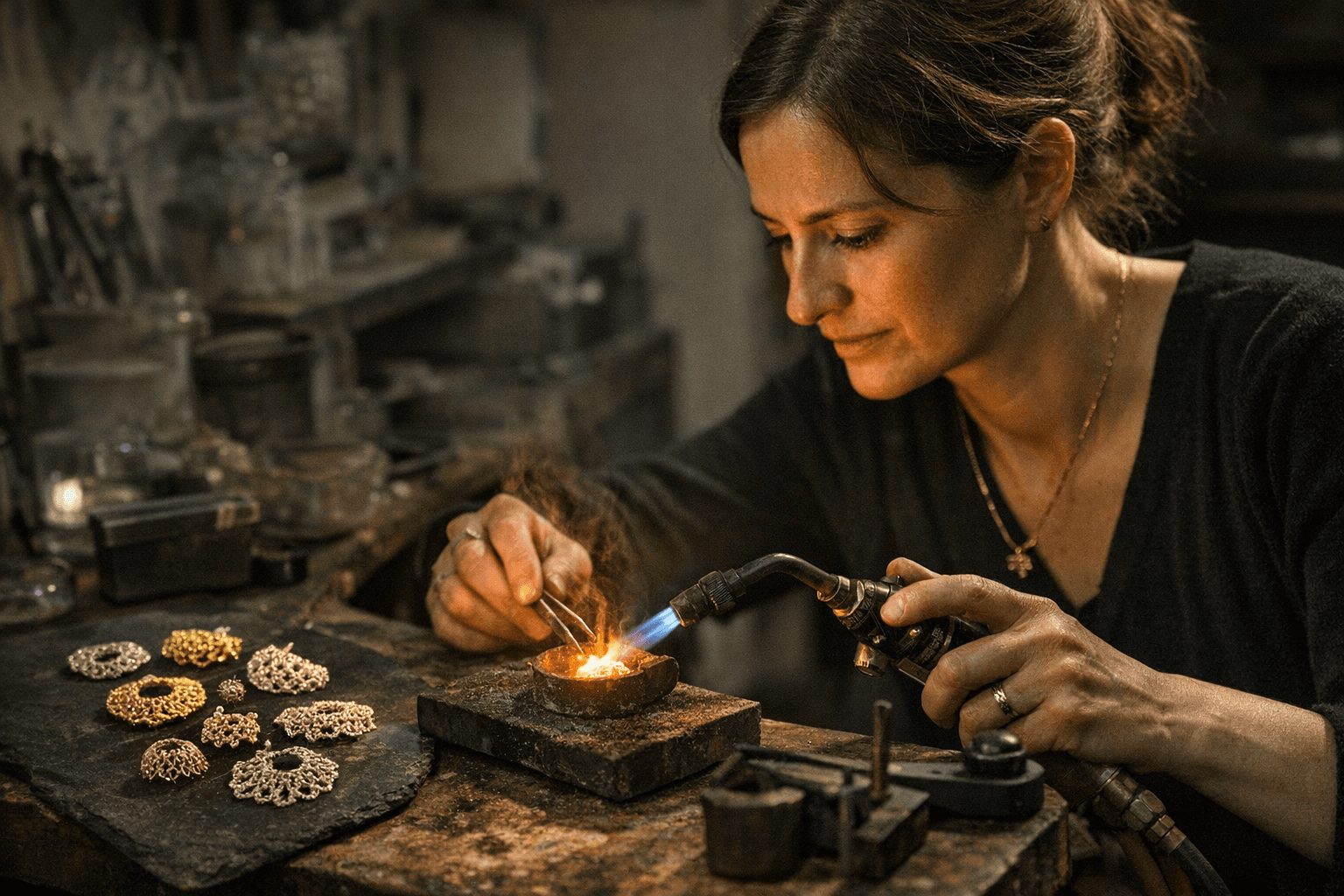
The process that defines Goring's practice begins not at the bench but at a crochet hook. She works with hand-stitched or crocheted cotton thread, building forms she will later sacrifice to fire. Sometimes she constructs a wire armature or a CAD scaffold to stitch over; at other times she crochets directly onto wax. "I'll often make a few versions, testing different scales or thread thicknesses, until I'm happy with the final form," she has explained. "From there, the piece is cold-molded, and a wax is produced from that mold. That wax is what I use for lost-wax casting, transforming it into metal. Sometimes I'll skip CAD altogether and carve directly into wax, then stitch onto that: it depends on the piece."
The lost-wax method she uses, known by its French name cire perdue, is one of the oldest manufacturing processes in human history, dating back between 5,000 and 6,000 years to ancient Egypt, Mesopotamia, and the Indus Valley. What Goring has done is thread an ancient casting tradition through a distinctly domestic craft. After casting, pieces are cleaned, assembled, and hand-fabricated in the studio; hinges and fittings are made by Goring herself. Then comes finishing: stone setting, or the nano-ceramic color plating that gives the Regency pieces their saturated hues. Developing a new design can take weeks to months; bespoke commissions run six to eight weeks from consultation to completion.
The Regency Collection: Saturated Color in Woven Metal
The Regency Collection marks Goring's return to the bench after a multi-year period directing The Incorporation of Goldsmiths, the historic Edinburgh precious metals body she led before stepping back into full-time making. The pieces read like richly colored historical embroidery rendered permanent: the visual reference to textile craft is deliberate, and the nano-ceramic plating amplifies it by layering vivid color directly onto the woven metal surface.
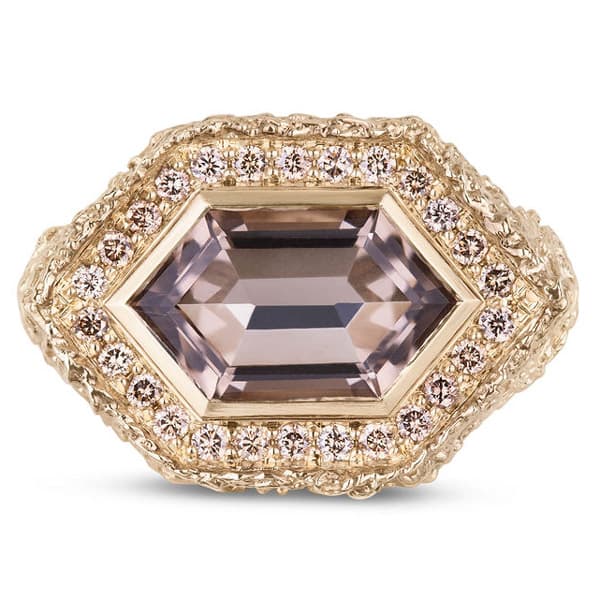
Five semi-precious gemstones anchor the palette: garnet, amethyst, iolite, smoky quartz, and rock crystal. The entry point is a Regency Pendant in silver with peach ceramic and rock crystal at £390, a wearable introduction to the aesthetic that works as a standalone piece or layered. At the top of the range, the Regency long lattice earrings in 18k yellow gold and sterling silver with lilac ceramic and amethyst reach £2,500, reflecting the material complexity and stone quality involved. The Stitch Ring in 9ct yellow gold with a 2.5 ct. oval garnet retails at £1,700, and the diamond-set Ingrid Knit Ring in gold starts from £1,360. Across the range, the woven metal framework is not decorative in the usual sense; it is the structure.
Responsible Sourcing: Following the Metal's Trail
Goring works with recycled and Fair Trade gold and previously held membership in the Fairtrade Goldsmith Scheme, a certification framework that traces gold back to small-scale mining communities operating under verified labour and environmental standards. Her former role as Director of The Incorporation of Goldsmiths, which exists specifically to promote ethical gold and silversmithing in Scotland, means her commitment to provenance is not incidental. It is the intellectual context in which she has spent much of her professional life.
For buyers, this matters more than it once did. Fair Trade gold carries a premium over spot price that flows directly to certified mining cooperatives; recycled gold avoids new extraction entirely. Neither claim is universal in fine jewellery, and the fact that Goring built her practice around both before they became marketing language is worth noting.
How to Wear the Look Without It Feeling Costume-y
Goring's saturated gemstone and woven metal aesthetic is striking, but it is not difficult to wear if you apply a few consistent principles.
*Pick one hero color.* The Regency palette offers deep garnet red, purple amethyst, blue-violet iolite, warm smoky quartz, and neutral rock crystal. Choose one and let it govern the piece. Wearing garnet stud earrings with a garnet cocktail ring reads as intentional; stacking all five colors reads as frantic.
*Pair with warm neutrals or deep monochromes.* The woven metal texture is already doing significant visual work. Camel, ivory, charcoal, and navy all recede enough to let the piece land properly. Avoid busy prints alongside statement pieces; save the lattice for clean backgrounds.
*Stack textures, not just metals.* Goring's work layers woven metal against gemstone against ceramic color. When building around it, mix materials that complement without competing: a simple chain, a plain band, or a smooth leather strap reads as deliberate contrast rather than clutter.
*Choose your metal by wardrobe undertone.* Yellow gold lifts warm undertones and pairs naturally with earth-toned palettes, amber, rust, and forest green. Sterling silver and white gold read sharper against cool undertones and suit grey, navy, and blue-based palettes. Goring's mixed-metal pieces, like the Regency lattice earrings combining 18k yellow gold with sterling silver, offer genuine flexibility and are worth considering if your wardrobe spans both.
Gemstone Color Cheat Sheet
- Warm undertones (yellow/peach/olive skin, green-tinted veins): garnet, smoky quartz, rock crystal in yellow gold settings. The Stitch Ring's 2.5 ct. oval garnet in 9ct gold is a natural fit.
- Cool undertones (pink/blue/pale skin, blue or purple veins): amethyst, iolite, rock crystal in silver or white gold. The Regency Pendant in silver with peach ceramic and rock crystal offers an interesting warm-cool contrast that works precisely because the rock crystal remains neutral.
- Neutral undertones (balanced mix, veins appear blue-green): the full Regency palette is open to you. Iolite's blue-violet shifts with light, making it particularly versatile against both warm and cool outfit palettes.
- Outfit-led selection: saturated jewel tones in clothing (cobalt, burgundy, emerald) call for restraint; choose rock crystal or smoky quartz as your stone and let the metal texture carry the piece. Neutral or white outfits can absorb the full saturation of amethyst or garnet without competing.
Repeatable Everyday Formulas
Two combinations flatten the learning curve considerably:
*Studs plus a bold ring.* A pair of simple amethyst or garnet studs in Goring's woven silver setting anchors the ears without demanding attention, freeing the hand to carry a statement piece like the Stitch Ring. The formula works in every setting from desk to dinner because one element is always quiet.
*A pendant plus simple hoops.* The Regency Pendant layered against a plain shirt or fine-knit sweater does the work of a full look on its own. Add plain gold or silver hoops, no texture, no stones, and the pairing reads polished rather than overstated. The hoops echo the metal without duplicating the detail.
The Studio and Bespoke Commissions
Goring's studio occupies a beautifully restored old railway platform building in Burntisland on the Fife Coast, open by appointment. Visitors can see the full collections in person, discuss bespoke commissions including wedding and engagement rings, or bring existing jewellery for remodelling. It is an unusual setting for a fine jeweller: a coastal historic building rather than a city boutique, which suits a practice shaped as much by Scotland's material heritage as by its training institutions.
Her designs also carry the cultural weight of a specific reference point: the Gold Room at the Nordiska Museum in Stockholm, where ancient Viking treasures demonstrate the tension between simple Nordic forms and intricate granulation and filigree. That influence is visible in the Regency Collection's restraint of form combined with density of surface, metal that carries pattern the way fabric does, but endures in a way no textile can.
Her work was included in the Icons of Scottish Jewellery Exhibition held at the Edinburgh Fringe Festival between August 1 and 25, and she continues to exhibit both nationally and internationally. For a designer who spent years administering the infrastructure of Scottish goldsmithing rather than practicing it, the Regency Collection is a pointed statement about where the real work happens: at the bench, with cotton thread and a crochet hook, six weeks before the gold arrives.
Now let me format this properly:Here is the final article:
SUMMARY: Scottish jeweller Ebba Goring crochets cotton by hand and casts it into solid gold, creating wearable texture unlike anything else in fine jewelry; her new Regency Collection starts at £390.
CONTENT:
Think about what your jewelry goes through in a normal week: handwashing, cooking, the gym, humidity, and the slow accumulation of daily contact with skin and fabric. Most fine jewelry is not built for that reality. Ebba Goring's is. The Scottish designer makes pieces that read as impossibly delicate, all woven lattice and textile memory frozen in metal, yet she insists they are designed to outlast you. "Although the pieces may look delicate," Goring has said, "they're designed with longevity in mind: to be worn, enjoyed, and passed on."
That is a remarkable claim for a jewellery practice rooted in crocheted cotton. And the fact that it holds up, technically and aesthetically, is what makes Goring one of the most genuinely distinctive voices working in British fine jewellery today. Her Regency Collection, the first she has released in six years, is the fullest expression yet of a technique she has been developing since she graduated from Duncan of Jordanstone College of Art and Design in Dundee in 2009 with a BDes (Hons) in Jewellery and Metal Design.
The Technique: Cotton Becomes Cast Metal
The process that defines Goring's practice begins not at the bench but at a crochet hook. She works with hand-stitched or crocheted cotton thread, building forms she will later sacrifice to fire. Sometimes she constructs a wire armature or a CAD scaffold to stitch over; at other times she crochets directly onto wax. "I'll often make a few versions, testing different scales or thread thicknesses, until I'm happy with the final form," she has explained. "From there, the piece is cold-molded, and a wax is produced from that mold. That wax is what I use for lost-wax casting, transforming it into metal. Sometimes I'll skip CAD altogether and carve directly into wax, then stitch onto that: it depends on the piece."
The lost-wax method she uses, known by its French name cire perdue, is one of the oldest manufacturing processes in human history, dating back between 5,000 and 6,000 years to ancient Egypt, Mesopotamia, and the Indus Valley. What Goring has done is thread that ancient casting tradition through a distinctly domestic craft. After casting, pieces are cleaned, assembled, and hand-fabricated in the studio; hinges and fittings are made by Goring herself. Then comes finishing: stone setting, or the nano-ceramic color plating that gives the Regency pieces their saturated hues. Developing a new design can take weeks to months; bespoke commissions run six to eight weeks from consultation to completion.
The Regency Collection: Saturated Color in Woven Metal
The Regency Collection marks Goring's return to the bench after a multi-year period directing The Incorporation of Goldsmiths, the historic Edinburgh precious metals body she led before stepping back into full-time making. The pieces read like richly colored historical embroidery rendered permanent: the visual reference to textile craft is deliberate, and the nano-ceramic plating amplifies it by layering vivid color directly onto the woven metal surface.
Five semi-precious gemstones anchor the palette: garnet, amethyst, iolite, smoky quartz, and rock crystal. The entry point is a Regency Pendant in silver with peach ceramic and rock crystal at £390, a wearable introduction to the aesthetic that functions as a standalone piece or layers cleanly with existing jewelry. At the top of the range, the Regency long lattice earrings in 18k yellow gold and sterling silver with lilac ceramic and amethyst reach £2,500, reflecting the material complexity and stone quality involved. The Stitch Ring in 9ct yellow gold with a 2.5 ct. oval garnet retails at £1,700, and the diamond-set Ingrid Knit Ring in gold starts from £1,360. Across the range, the woven metal framework is not decorative in the conventional sense; it is the structure.
Responsible Sourcing: Following the Metal's Trail
Goring works with recycled and Fair Trade gold and previously held membership in the Fairtrade Goldsmith Scheme, a certification framework that traces gold back to small-scale mining communities operating under verified labour and environmental standards. Her former role as Director of The Incorporation of Goldsmiths, which exists specifically to promote ethical gold and silversmithing in Scotland, means her commitment to provenance is not incidental. It is the intellectual context in which she spent much of her professional life.
For buyers, this matters more than it once did. Fair Trade gold carries a premium over spot price that flows directly to certified mining cooperatives; recycled gold avoids new extraction entirely. Neither claim is universal in fine jewellery, and the fact that Goring built her practice around both before they became marketing language is worth noting.
How to Wear the Look Without It Feeling Costume-y
Goring's saturated gemstone and woven metal aesthetic is striking, but it is not difficult to wear if you apply a few consistent principles.
*Pick one hero color.* The Regency palette offers deep garnet red, purple amethyst, blue-violet iolite, warm smoky quartz, and neutral rock crystal. Choose one and let it govern the piece. Wearing garnet stud earrings with a garnet cocktail ring reads as intentional; stacking all five colors reads as frantic.
*Pair with warm neutrals or deep monochromes.* The woven metal texture is already doing significant visual work. Camel, ivory, charcoal, and navy all recede enough to let the piece land properly. Avoid busy prints alongside statement pieces; the lattice needs a clean background to register.
*Stack textures, not just metals.* Goring's work already layers woven metal against gemstone against ceramic color. When building around it, mix materials that complement without competing: a simple chain, a plain band, or a smooth leather strap reads as deliberate contrast rather than clutter.
*Choose your metal by wardrobe undertone.* Yellow gold lifts warm undertones and pairs naturally with earth-toned palettes: amber, rust, and forest green. Sterling silver and white gold read sharper against cool undertones and suit grey, navy, and blue-based palettes. Goring's mixed-metal pieces, like the Regency lattice earrings combining 18k yellow gold with sterling silver, offer genuine flexibility and are worth considering if your wardrobe spans both ends of the spectrum.
Gemstone Color Cheat Sheet by Skin Tone and Outfit Palette
- Warm undertones (yellow, peach, or olive skin; green-tinted veins): garnet and smoky quartz in yellow gold settings are the natural call. The Stitch Ring's 2.5 ct. oval garnet in 9ct gold exemplifies how a deep red stone reads against golden warmth in both skin and setting.
- Cool undertones (pink, blue, or pale skin; blue or purple veins): amethyst and iolite in silver or white gold. The blue-violet shift of iolite under different light makes it particularly well-suited to cool palettes; the Regency Pendant in silver with peach ceramic and rock crystal offers a warm-cool contrast that works because rock crystal remains fundamentally neutral.
- Neutral undertones (balanced mix; veins appear blue-green): the full Regency palette opens up. Iolite's color-shifting quality is particularly valuable here, reading blue against some outfits, violet against others, without committing to either.
- Outfit-led selection: saturated jewel tones in clothing, cobalt, burgundy, or emerald, call for restraint. Choose rock crystal or smoky quartz as your stone and let the woven metal texture carry the moment. White and neutral outfits can absorb the full saturation of amethyst or garnet without competing.
Repeatable Everyday Formulas
Two combinations flatten the learning curve considerably:
*Studs plus a bold ring.* A pair of simple amethyst or garnet studs in Goring's woven silver setting anchors the ears without demanding attention, freeing the hand to carry a statement piece like the Stitch Ring. The formula works from desk to dinner because one element is always quiet enough to let the other breathe.
*A pendant plus simple hoops.* The Regency Pendant layered against a plain shirt or fine-knit sweater does the work of a full look on its own. Add plain gold or silver hoops with no texture and no stones, and the pairing reads polished rather than overstated. The hoops echo the metal's warmth or coolness without duplicating its intricate surface.
The Studio and Bespoke Commissions
Goring's studio occupies a beautifully restored old railway platform building in Burntisland on the Fife Coast, open by appointment. Visitors can see the full collections in person, discuss bespoke commissions including wedding and engagement rings, or bring existing jewellery for remodelling. It is an unusual setting for a fine jeweller: a coastal historic building rather than a city boutique, which suits a practice shaped as much by Scotland's material heritage as by its formal training.
That heritage has a specific international reference point: the Gold Room at Stockholm's Nordiska Museum, where ancient Viking treasures demonstrate the tension between simple Nordic forms and dense granulation and filigree. That influence is visible across the Regency Collection's restraint of form combined with density of surface, metal that carries pattern the way fabric does, but endures in a way no textile can.
Goring's work was included in the Icons of Scottish Jewellery Exhibition held during the Edinburgh Fringe Festival between August 1 and 25, and she continues to exhibit nationally and internationally. For a designer who spent years administering the infrastructure of Scottish goldsmithing rather than practicing it, the Regency Collection is a pointed statement about where the real work happens: at the bench, with cotton thread and a crochet hook, six weeks before the gold arrives.
This article was produced by Prism’s automated news system from verified source data, official records, and press releases, then run through automated quality and moderation checks before publishing. The system is built and supervised by the people who set the standards it runs under. Read our full AI policy.
Did this article answer your question?