Soaring Gold and Silver Prices Are Reshaping the Jewelry Industry
Gold nearly doubled in price in a year, hitting $5,586 an ounce before whipsawing back. Every jeweler, large and small, is now scrambling to adapt.
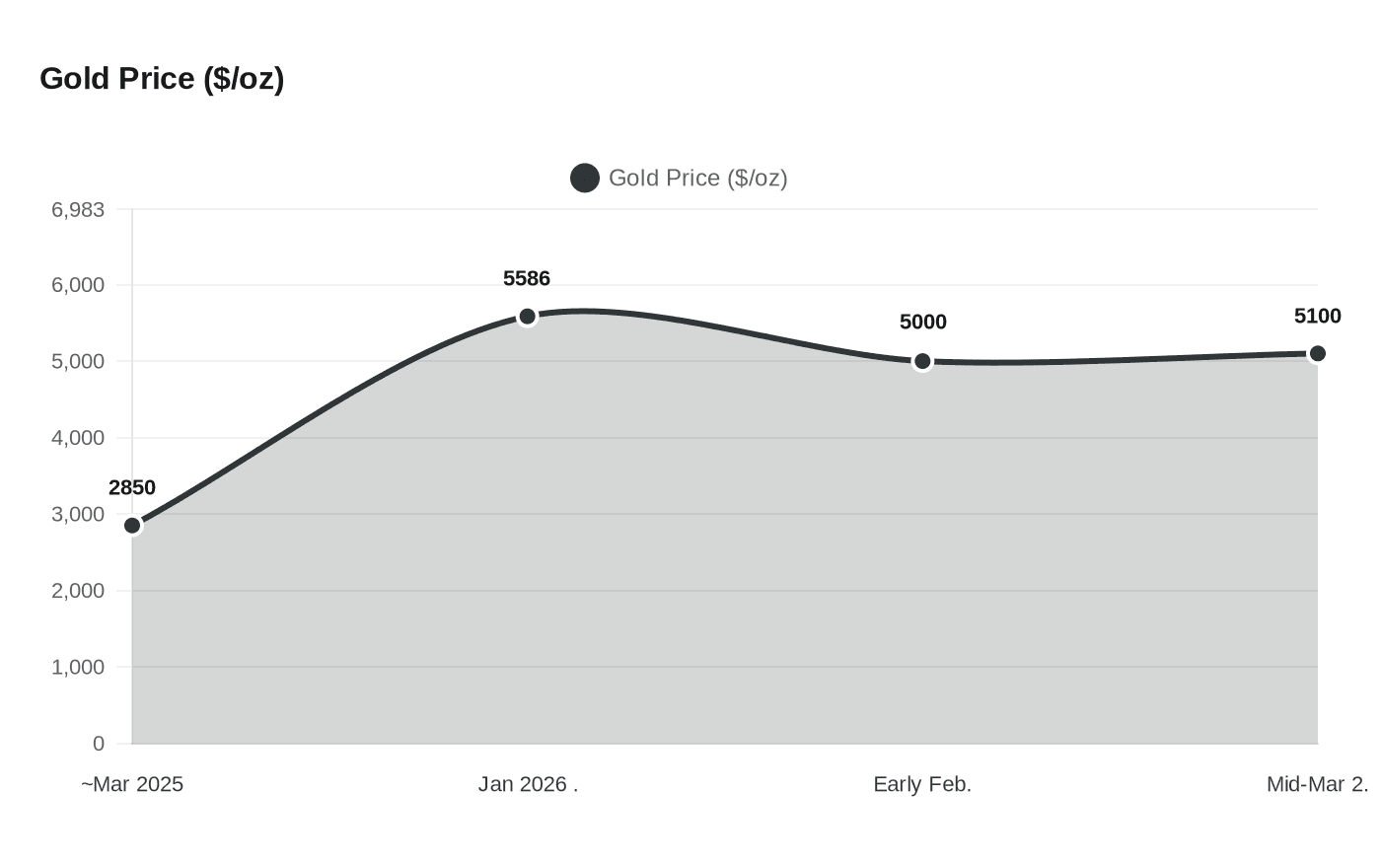
Gold traded around $2,850 per ounce a year ago. That number, unremarkable at the time, now reads like a relic from a more stable era. By late January 2026, the metal had peaked at $5,586 per ounce, nearly doubling in roughly twelve months. It fell below $5,000 in early February, then climbed back to sit around $5,100 as of mid-March. That sequence, compressed into weeks, is not a market cycle. It is a disruption, and it is rewriting the rules for everyone who works with precious metals: the independent designer squinting at a quote from her metal supplier, the national retailer updating price tags faster than her staff can print them, the sourcing manager who can no longer build a stable cost model.
A Price Spike Unlike Any Recent Memory
The speed of this move is what separates it from previous gold rallies. Jim Wyckoff, the senior market analyst for Kitco Metals, where he reports on precious metals and mining, described both gold and silver as experiencing "record-setting daily volatility" in a phone interview in late February. That phrase, "record-setting daily volatility," is the operative one: not elevated, not elevated-for-the-cycle, but record-setting on a daily basis. The speed and magnitude of price fluctuations, as the New York Times reported, have seized headlines in ways that go beyond financial news and land squarely on the desks of designers and buyers.
Gold is not the only material under pressure. Silver has tracked a similarly turbulent path, and both metals shot up again later in February after a brief retreat. For jewelers who work across both, the compounding uncertainty makes it nearly impossible to price a custom piece, hold a consistent retail margin, or plan a seasonal collection with any confidence. A ring priced in October on the basis of one silver quote may be repriced three times before it ships.
What This Means for Jewelry Design
Gold's role in fine jewelry has always been both material and metaphor. The weight of an 18K band, the warmth of yellow gold against skin, the way a bezel setting in solid gold cradles a stone with architectural authority: these are not arbitrary choices. They are the grammar of fine jewelry. When the cost of that grammar doubles, designers face a genuine creative and commercial reckoning.
The extraordinary volatility and record highs in gold and silver are reshaping not only the economics of jewelry but its design language. Jewelers large and small are responding, though the exact contours of those responses vary by scale and market position. An independent designer with limited inventory and tight margins feels the pressure differently than a large retail chain with hedging instruments and bulk purchasing agreements. But across the industry, the confusion is remarkably uniform. For those in fine jewelry, the volatility "has been more than unsettling; it has created a level of confusion few have ever experienced."
That confusion manifests in practical terms. A designer considering a new collection must now decide whether to price pieces at current metal costs, risk absorbing a correction, or hold inventory and gamble on further appreciation. None of those options is comfortable. Each carries risk that would have seemed disproportionate twelve months ago, when gold at $2,850 felt like a perfectly stable foundation for a business.
Sourcing and Retailing Under Pressure
The impact on sourcing is equally acute. Refiners, bullion dealers, and wholesale suppliers are all operating in the same volatile environment, and their pricing reflects it. When a supplier cannot offer a fixed quote for more than a day or two, the conventional practice of building a seasonal line, quoting it to wholesale buyers, and locking in production becomes structurally unreliable. The supply chain, always more fragile than the polished case of a finished piece suggests, is under stress at every link.
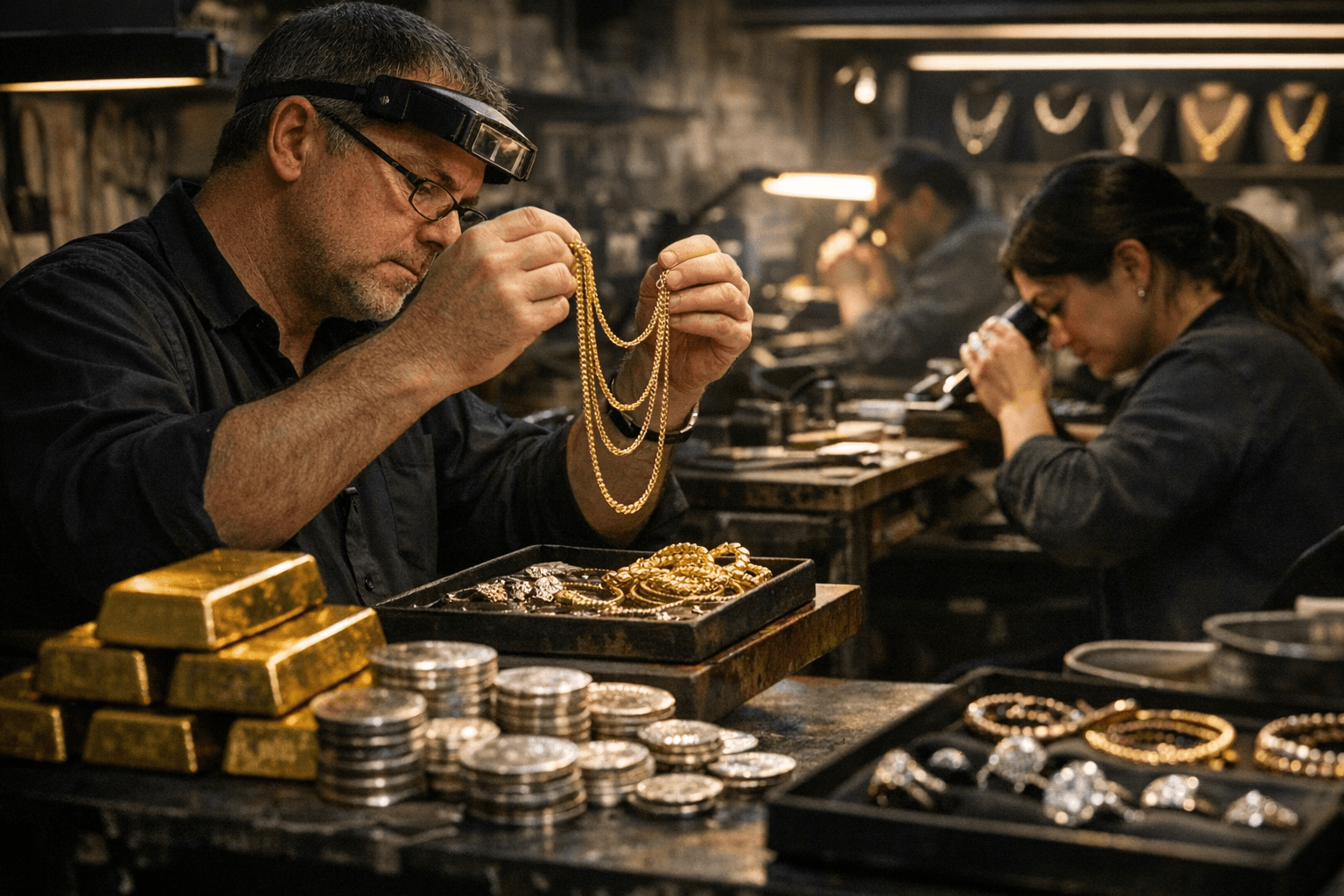
On the retail side, the calculation is no less complicated. A gold necklace that retailed at a certain price point six months ago may now cost significantly more to restock, but raising retail prices risks alienating customers who remember what they paid, or what a similar piece cost at a competitor. Holding prices compresses margins to the point of unsustainability. The tension between those two bad options is playing out across showrooms and e-commerce platforms simultaneously.
Silver, long positioned as the accessible alternative to gold in fine jewelry, is experiencing its own volatility. Its price movement, while not as widely reported as gold's, has been significant enough to affect designers who built their practices on the premise that silver offered a stable, lower-cost material. When silver joins gold in record-setting daily swings, the hierarchy of accessible fine jewelry loses one of its reliable reference points.
The Broader Stakes
The jewelry industry is not a single monolith, and the effects of this price environment are not distributed evenly. A large national retailer has tools, hedging strategies, supplier contracts, and capital reserves, that a one-person studio does not. But the confusion the New York Times describes cuts across size and scale. No segment of the fine jewelry market is insulated from a near-doubling of its primary raw material cost, followed by whipsaw corrections, followed by renewed rallies. The uncertainty itself is corrosive, even when prices stabilize temporarily.
For consumers, the immediate effect is likely to be higher prices on new gold and silver pieces, a reassessment of what constitutes value at a given price point, and possibly renewed interest in the resale and pre-owned market, where pricing is not entirely tied to spot metal rates. A vintage 18K bracelet priced before the rally represents a different kind of value proposition today than it did a year ago.
What the coming months hold depends on whether the forces driving the rally, broadly understood to involve investment demand, macroeconomic uncertainty, and the role of gold as a store of value in turbulent times, continue to apply or begin to ease. Wyckoff's characterization of "record-setting daily volatility" suggests that even those who watch the market most closely are not operating with a clear directional view. For the fine jewelry industry, that is perhaps the most unsettling fact of all: when the people closest to the market cannot predict the next move, those who design, source, and sell the objects that depend on it have no firm ground to stand on.
The pieces that will endure through this period are the ones grounded in craft and intention rather than metal weight alone. A well-designed bezel setting, a considered proportion, a stone chosen with genuine gemological knowledge: these are the elements that hold their value when the spot price of the metal underneath them refuses to hold still.
Know something we missed? Have a correction or additional information?
Submit a Tip