These Jewelry Designers Say 10k Gold Is the Way Forward
Designers are choosing 10k gold for its hardness, not just its price. Here's when it outperforms 14k and 18k on your rings, chains, and daily wear.

Gold peaked at $5,594.82 per ounce on January 29 of this year. For jewelry designers who build pieces meant to be worn every single day, locked onto chains, stacked on fingers, clipped through ears, that number forced a question that had little to do with budget: what is actually the right metal for this job?
The answer, for a growing number of designers and demi-fine brands, is 10k gold. Not as a compromise. As a material decision.
Marla Aaron, whose New York label has long treated jewelry as functional hardware, recently debuted her first piece in the alloy: the Micro Babylock, a rosy, mechanically precise lock priced at $595 and already selling rapidly. "The primary reason for using 10k was its hardness," she told JCK. "I've long been fascinated by Victorian-era mechanical jewelry — not just because it's beautiful, but because it was driven by both curiosity and functionality." The choice was not reactive to the current market moment, either. The Micro Babylock was in development long before gold reached record highs. Aaron drew inspiration from her personal collection of Victorian-era pieces, a period she describes as one of tremendous creativity. "It was a period of tremendous creativity, often involving gold alloys in the 9 to 15k range because of their strength and adaptability; that's why we chose 10k," she said. The timing, however, gave the decision a sharper logic. "That said, in a moment like this, when material costs are what they are, every decision matters more. You have to be smart, intentional, and creative in ways that don't compromise the integrity of the object."
Aaron's framing of the choice is precise: in the Micro Babylock's marketing, she notes that 10k gold "reflects a deliberate return to material intelligence." That phrase is worth unpacking, because it gets at something the fine jewelry world has been slow to say plainly: higher karat gold is not always the better gold for the job you are asking it to do.
What the Karat Numbers Actually Mean
Gold on its own is too soft for wearable jewelry. Pure 24k gold sounds ideal, but pure gold is soft and bends easily. It's not practical for daily-wear jewelry because it can scratch, bend out of shape, and won't hold gemstones securely. That's why jewelers mix pure gold with alloy metals to create pieces that last a lifetime.
10k gold is the least pure but the hardest. With only 41.7% pure gold, it contains more alloy metals, which means it resists scratches and dents better than higher-karat golds. 14k gold means 14 parts pure gold out of 24 total parts, which equals 58.3% pure gold. It offers a middle ground between toughness and richness of color. 18k gold consists of 75% pure gold and 25% alloyed metals, such as copper, silver, zinc, or nickel, with a warmer, deeper yellow tone and a noticeably softer surface that shows wear more quickly under daily conditions.
When you flip a piece over, the hallmarks tell the same story in shorthand. In the U.S., 10k gold is stamped "10K" or with the millesimal fineness mark "417." You may also see "14K" / "585" or "18K" / "750." If a piece carries no hallmark at all, walk away.
10k vs. 14k vs. 18k: The Daily Wear Trade-offs
The comparison that matters for someone who puts their jewelry on in the morning and takes it off before bed, if at all, comes down to four factors.
*Scratch resistance.* The higher alloy content in 10k makes it resistant to scratches, dents, and everyday wear. If you work with your hands or want jewelry that can take a beating, 10k holds up better than higher-karat options. 18k is the softest and will develop a visible patina the fastest. 14k lands in between, durable enough for most daily wear without showing heavy scuffing for years.
*Color and appearance.* 10k gold looks slightly paler than 14k or 18k. The difference is not dramatic, but side by side, you will notice 10k has a lighter, less rich appearance. In rose gold, 10k looks noticeably pinker because of the higher copper content, which is part of why Aaron's Micro Babylock is described as "rosy." If a deep, warm gold tone is important to you, 14k will satisfy it without much sacrifice in durability.
*Tarnish and maintenance.* 10k can tarnish over time, and 14k is much more resistant to tarnishing than 10k. The copper in its alloy can react with sweat, cosmetics, or chlorine. A quick polish with a soft cloth restores the surface, and many wearers find a routine they barely notice. If low maintenance is the priority, the karat tradeoff shifts.
*Skin sensitivity.* The higher proportion of alloy metals in 10k can increase the likelihood of allergic reactions, particularly for individuals sensitive to metals like nickel. While 10k gold offers a cost-effective and durable choice for everyday wear and active lifestyles, potential wearers should consider any metal sensitivities when selecting this option. If you have sensitive skin, ask what the specific alloy composition is before buying, and look for nickel-free formulations, which some brands now offer in bespoke 10k alloys.
Where 10k Is the Smart Buy
Not every piece you own asks the same thing of its metal. Here is where 10k gold earns its place.
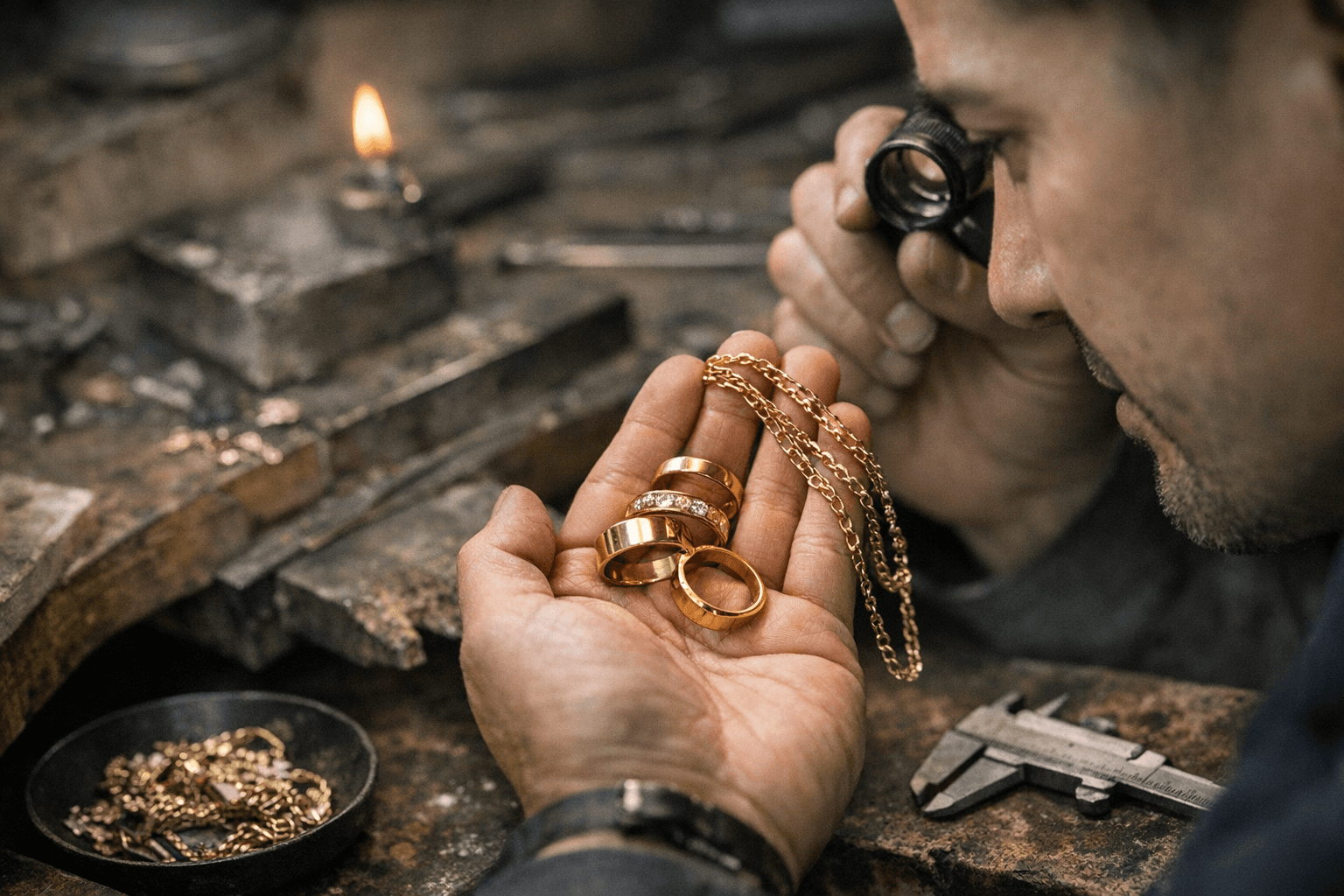
- Everyday rings. The finger is the hardest environment in jewelry: constant contact with water, surfaces, and other objects. If you work with your hands, in landscaping, construction, or sports, 10k is a strong choice for durability. An 18k ring worn during daily life will show its age faster.
- Chains and connectors. Locks, clasps, and chain links undergo constant friction and micro-stress. The Micro Babylock comes out of years of hard-earned expertise, along with a firm refusal to compromise on function, Aaron says. A chain that holds a charm or anchors a layered look needs hardness more than purity.
- Hoops. The hoop is arguably the single most worn piece in most people's rotation. For a piece that clips in every morning and faces everything your day throws at it, 10k is the practical choice for longevity, particularly in smaller, lightweight styles.
- Children's jewelry. 10k is the standard recommendation for kids: durable, affordable, and capable of surviving the indignities of childhood without bending out of shape. The slightly paler color is irrelevant to a nine-year-old.
When is the upgrade to 14k or 18k worth it? For statement pieces worn occasionally, for settings housing significant gemstones where color richness matters to the design, and for anyone who reacts to higher alloy content. 18k gold can be more susceptible to scratches and wear compared to 14k options, but its higher gold content makes it easier for jewelers to re-polish and repair, and it moves more cooperatively under heat and tools.
Your Checkout Checklist
Before you buy, run through this quickly:
- Look for "10K" or "417" stamped on the piece, not just a hang tag claim
- Ask whether the alloy is nickel-free if you have sensitive skin
- For rings and chains you never remove, 10k's hardness is a functional feature, not a downgrade
- For pieces worn a few times a week, or for settings housing significant stones, 14k is the more versatile choice
- If low maintenance and richest color are non-negotiable, 18k is worth the premium
Brands are now going further than simply choosing 10k off the standard menu. Designers are developing bespoke 10k alloys and custom finishes tuned to specific pieces and aesthetics, the same experimental energy, Aaron notes, that drove Victorian metalsmiths to work in exactly this karat range. Ana Luisa, another brand embracing this shift, recently declared: "10k has gone from overlooked to essential, and we've been all in from the start."
Sales of the Micro Babylock are already moving rapidly. "We hoped people would love it as much as we did, and it turns out they do," Aaron says. That response reflects something larger than one brand's launch. 10k gold was never the inferior choice; it was simply misunderstood. When function is the brief and the piece has to survive your actual life, the metal with the most gold content is rarely the right answer. The metal engineered to last is.
This article was produced by Prism’s automated news system from verified source data, official records, and press releases, then run through automated quality and moderation checks before publishing. The system is built and supervised by the people who set the standards it runs under. Read our full AI policy.
Did this article answer your question?