Three GEM Award Nominees Share Their Most Stunning Jewelry Designs
Three designers nominated for tonight's GEM Award bring horse manes, mythic underworlds, and an invictus flower to life in jewels worth examining closely.
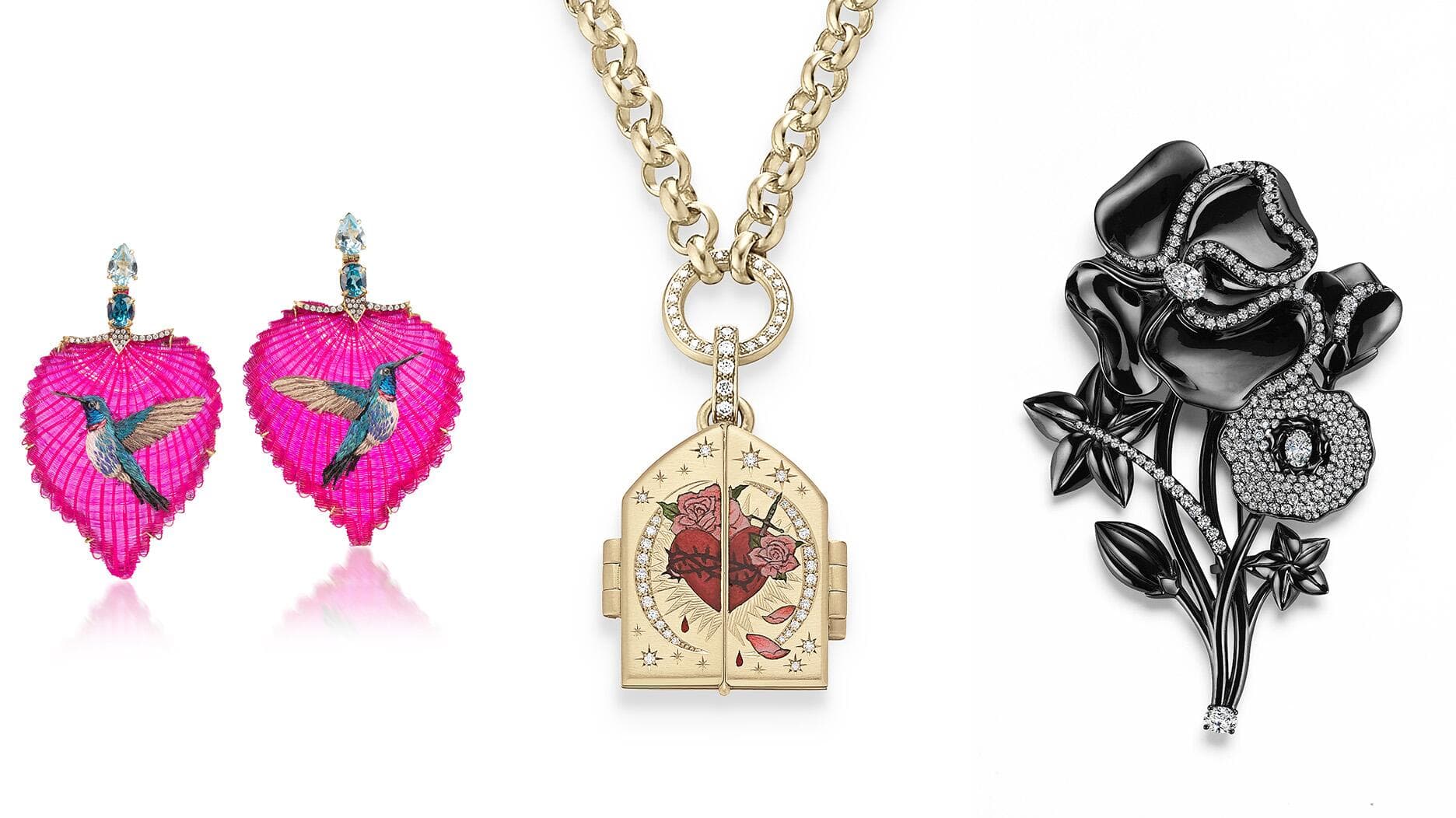
Tonight at Cipriani 42nd Street in New York City, Jewelers of America will announce the winner of the 2026 GEM Award for Jewelry Design. The nominees, Silvia Furmanovich, Cece Fein-Hughes of Cece Jewellery, and Catherine Sarr of Almasika, represent three genuinely distinct design languages. On the morning of the ceremony, National Jeweler spotlighted one piece from each designer as its Pieces of the Week, offering a precise and telling window into what makes each nomination compelling. These three objects, a pair of earrings, a necklace, and a brooch, are worth examining on their own terms.
Silvia Furmanovich: Horse Mane Earrings
Few jewelry designers carry the weight of lineage quite like Silvia Furmanovich. Descended from Italian goldsmiths whose family history reaches back to a great-grandfather who crafted ornaments for the Vatican, Furmanovich launched her namesake brand in São Paulo in 1998 and has spent nearly three decades building one of fine jewelry's most intellectually rigorous studios. She continues to work from her São Paulo atelier with her three sons, a multigenerational continuity that mirrors her reverence for craft traditions at large.
What distinguishes her work materially is the refusal to separate the precious from the natural. Her pieces blend marquetry, lacquer, and miniature painting with bamboo, silk, and wood, all held in conversation with precious gems. It is an approach that treats organic materials not as novelties but as equals to the stones they accompany. The Horse Mane Earrings distill this philosophy into a single object: the fluid, kinetic suggestion of a horse's mane rendered through techniques more often associated with Japanese lacquerwork or Renaissance panel painting than the jewelry counter.
Furmanovich has partnered with artisans worldwide and with institutions including The Metropolitan Museum of Art and the Museum of Fine Arts Houston, and her work appears in museum collections in both New York and Minneapolis. She has earned four Couture Design Awards and received a GEM Award nomination in 2019, making this year's recognition a return visit that feels long overdue. Calling her work "wearable art" risks cliché, but in her case the description is technically accurate: these pieces have earned wall space.
Cece Fein-Hughes: Underworld Triptych Necklace
The title alone signals intent. Cece Fein-Hughes named her Cece Jewellery piece the Underworld Triptych Necklace, and the word "triptych" is doing real work here. A triptych is a structure borrowed from devotional painting, three panels hinged together, traditionally used to tell a story or frame a sacred scene. Applied to a necklace, the format suggests a designer thinking narratively, building a wearable object that unfolds like a story rather than simply adorns.
Fein-Hughes has been nominated for the GEM Award for Jewelry Design alongside two designers with decades of established practice, which is a meaningful statement from the nominating body about where contemporary jewelry is heading. The Underworld Triptych Necklace, with its mythological framing and its three-part architectural structure, positions Cece Jewellery as a brand interested in jewelry as a vehicle for storytelling rather than status signaling. The research available on Fein-Hughes is thinner than one would like, which is itself a reason to pay close attention: the nomination is the industry's argument that the work speaks loudly enough to stand beside much longer careers.
Catherine Sarr: Invictus Flower Brooch
The brooch is one of fine jewelry's most demanding formats. Unlike a ring or necklace, it carries no structural logic from the body. It must justify itself entirely through its own visual authority, holding its place on fabric through presence alone. Catherine Sarr's Invictus Flower Brooch, chosen as the piece representing her Almasika nomination, stakes that claim with a title drawn from the Latin word for unconquered.
Sarr founded Almasika, a name with phonetic roots in the Arabic word for precious, and the brand has built a reputation for geometry and cultural layering. The Invictus Flower Brooch arrives as one of three pieces singled out on one of the most visible days in the jewelry industry calendar, which suggests Sarr and her team chose it deliberately. Like Fein-Hughes, Sarr has not been the subject of extensive published biography in the sources surrounding this nomination, and both designers represent a broader shift in the GEM Awards' willingness to recognize emerging and mid-career voices alongside the most established names in the field.
The Award and What It Means
The GEM Awards, presented by Jewelers of America since their founding, exist to honor individuals and brands whose work raises the visibility and status of fine jewelry and watches. Proceeds from tonight's ceremony at Cipriani 42nd Street directly benefit programs that support Jewelers of America's mission to improve consumer confidence in the industry. The 2026 awards will also honor Mark and Candy Udell of London Jewelers with the Gem Award for Lifetime Achievement, a recognition of a different register entirely, one that measures decades of sustained contribution rather than the sharp, specific achievement of a single nomination cycle.
What the three Jewelry Design nominees share is not a style but a commitment: Furmanovich to material dialogue across cultures, Fein-Hughes to narrative structure as design principle, Sarr to the quiet authority of a well-titled object. The winner will be announced tonight. The pieces, however, already exist as evidence that this year's shortlist was anything but predictable.
This article was produced by Prism’s automated news system from verified source data, official records, and press releases, then run through automated quality and moderation checks before publishing. The system is built and supervised by the people who set the standards it runs under. Read our full AI policy.
Did this article answer your question?