Which Jewelry Can Get Wet and Which Should Stay Dry
Not all gold survives a shower. Your metal, setting, and stone type each cast a deciding vote — here's the verdict for every piece in your rotation.
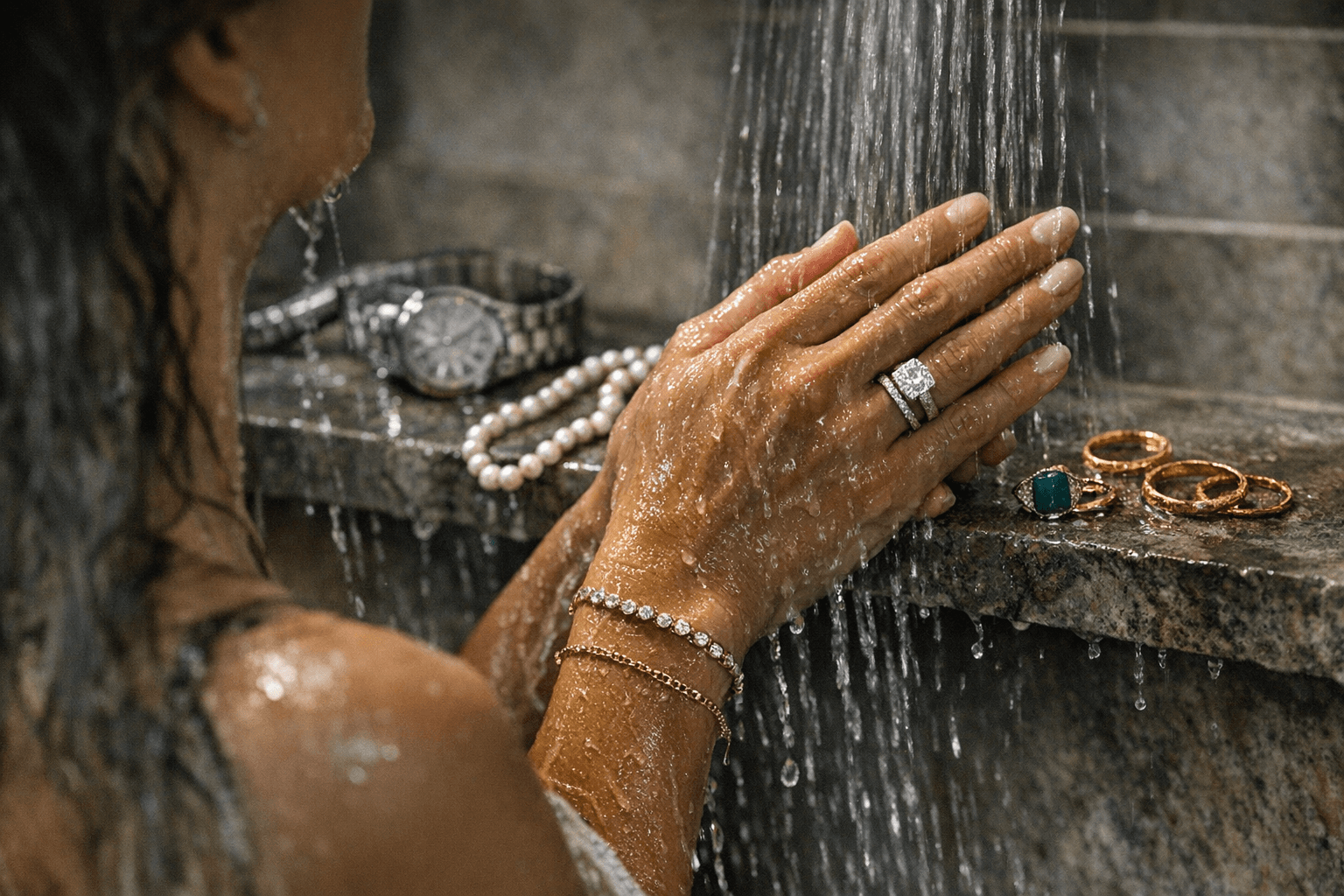
The ring stayed on through handwashing, gym sessions, cooking, and three showers before you noticed it: a dull, faintly filmy surface where there used to be a mirror shine, and one prong that feels, unmistakably, a little loose. Water did that. Or rather, water plus soap plus heat plus time did that. The damage is rarely dramatic. It accumulates the way all quiet damage does: invisibly, incrementally, until one morning the luster is simply gone.
Whether a piece can live through your daily routine depends on three compounding variables: the metal it's made from, the setting that holds any stones in place, and the nature of those stones themselves. Get all three right, and you can shower, swim, and forget about it. Get even one wrong, and you're on a faster timeline to tarnish, loosened gems, and base metal showing through.
Start with the Metal
Solid gold, particularly 14k and above, resists tarnishing and can handle regular water exposure. The same is true of platinum, titanium, and stainless steel: metals like copper, brass, and bronze shouldn't go in the shower, as they can turn skin green, but these four rank as the most reliably water-resistant choices for everyday wear. If you own a solid platinum wedding band or a 14k gold chain with no stones, a daily shower is genuinely not a problem.
Gold filled occupies a middle tier. Gold filled jewelry contains a genuine layer of gold that is mechanically bonded, not electroplated, to a brass core. The gold layer is legally required to be at least 5% of the total weight, which gives it significantly better durability than standard plating and handles water better in the short term. The limitation is that the core remains brass, and over years of exposure, the edges and clasps where gold fill thins will eventually expose it.
Gold vermeil is where the real confusion lives. Gold vermeil consists of a layer of gold applied to a sterling silver base. Just as you wouldn't want to wear sterling silver in the shower due to the risk of tarnishing, gold vermeil is likewise not suitable for the shower. Long-term water exposure can make the layer of gold on chain bracelets and stacking rings wear away, leaving a discolored, less shiny finish compared with its original luster. The rule of thumb: only 18-carat and above gold vermeil is suitable for getting wet at all, and even then, treat it as occasional, not routine.
Standard gold plating offers the least protection of all. Gold plated over brass should be removed before showering: water, heat, and soap accelerate breakdown of the plating and expose the reactive brass base. These are the pieces often identified by the phrase "gold tone" or "gold finish" and a price point under $50. The industry standard advice across every reputable jeweler is to remove them before showering, swimming, and exercising.
Your Setting Makes or Breaks the Stone
Even if your metal is solid gold, the way your stone is held matters. Prong settings, those delicate claws that grip a gemstone from below and hold it up toward the light, are the most vulnerable architecture in any piece of jewelry. Chlorine doesn't damage pure gold itself, but it does react with the alloy metals in 10k, 14k, and 18k pieces, slowly weakening prongs, solder joints, and clasps. This leads to what goldsmiths call "creep": the prongs soften, shift, and eventually fail to hold. Think of chlorine as gradually loosening the glue that holds your jewelry's design together. The changes don't happen overnight; instead, repeated exposure slowly wears down the piece.
Bezel settings, where a thin rim of metal wraps entirely around the stone's girdle, offer more structural protection: there are no exposed tips to weaken. Glued or adhesive settings, common in costume pieces and some fashion jewelry, are simply incompatible with water of any kind. Repeated moisture dissolves adhesives and stones shift, loosen, and fall.
A common misconception: that because a diamond, ruby, or sapphire is chemically resistant to chlorine, pool water is safe. While the stone itself will not be affected by chlorine, the security of the stone is completely dependent on the metal setting that holds it in place. A chemically inert gemstone sitting in a weakened prong is still a gemstone waiting to be lost.
The Stone Itself: Hardness Is Not the Whole Story
On the Mohs hardness scale, a diamond scores 10 and is essentially indestructible in any domestic water context. Sapphires and rubies at Mohs 9, and even emeralds and spinels at 7 to 8, can tolerate a splash. But hardness tells you only about scratch resistance, not about porosity, organic composition, or treatment sensitivity.
Pearls are the most pressing example. Pearls register between 2.5 and 4.5 on the Mohs scale. Due to the way they are created, layer by layer inside a mollusk, they are easily damaged and may dissolve in even mild acids. Chlorine, perfume, and makeup can stain or damage them. The GIA offers a simple protocol: pearl jewelry should be the last thing you put on and the first thing you take off. No perfume, no hairspray, no showers.
Opals can lose moisture in low humidity or when exposed to heat, causing them to crack or craze. On the flip side, long exposure to water can also damage some gems, including amber, azurite, and malachite. Opals contain up to 30% water by composition; the threat isn't dryness alone but rapid, repeated temperature change from a hot shower. Turquoise sits at Mohs 5 to 6 and is highly absorbent. If exposed to liquids like oils, perfumes, or detergents, its color deteriorates. Emeralds, while harder, are almost always treated with cedar oil or resins to fill natural fractures; soap and hot water strip those treatments over time, making fractures visible again.
The Pool and Hot Tub Problem
The shower is one thing. The pool is another entirely. While chlorine in pools and household cleaners is damaging, the addition of high temperatures found in hot tubs dramatically accelerates the corrosive chemical reactions. The kinetic energy provided by heat acts as a catalyst, speeding up the dissolution of alloys and the formation of stress fractures. Research cited by Morin Jewelers found that 14-karat white gold experienced prong failure after just 21 hours of exposure to a heated, chlorine-treated solution, compared to 120 hours at room temperature. A brief soak in a hot tub, in other words, can do more structural damage than a much longer swim in a cold pool. The rule here is categorical: remove everything before you get in.
The Verdict: A Quick-Reference Guide
- Shower-safe: Solid platinum, solid 14k gold and above (no porous or adhesive-set stones), titanium, stainless steel. Rinse after, dry thoroughly.
- Occasional only: Gold filled pieces, 18k+ gold vermeil. Water alone won't immediately ruin them, but even the most natural shower products can leave a filmy residue that builds up in small crevices between gemstones and metals, dulling the finish over time.
- Never: Standard gold plated over brass, sterling silver, any piece with pearls, opals, turquoise, emeralds (oiled), amber, malachite, or any stone in a glued or adhesive setting. Never wear any jewelry in a chlorinated pool or hot tub.
The 60-Second Post-Shower Routine
If you wore a shower-safe piece and want to protect its finish for the long term, this takes less time than it sounds:
1. Rinse the piece under clean, lukewarm tap water to displace any soap film or mineral residue.
2. Pat dry with a soft, lint-free cloth. Don't rub prongs.
3. For gold pieces, use a dry corner of the cloth to buff the surface until it catches light again.
4. Leave the piece on a clean, dry surface for two to three minutes before storing, so no trapped moisture sits in crevices or between the stone and setting.
5. Once a month, check prong tips with a fingernail. If a prong snags, schedule an inspection before the next swim.
The pieces that last decades aren't always the most expensive ones. They're the ones whose owners understood the difference between durable and indestructible, and took 60 seconds after every shower to act on it.
This article was produced by Prism’s automated news system from verified source data, official records, and press releases, then run through automated quality and moderation checks before publishing. The system is built and supervised by the people who set the standards it runs under. Read our full AI policy.
Did this article answer your question?