Alameda County Launches Anti-Smash-and-Grab Initiative to Protect Jewelry Retailers
Alameda County DA Ursula Jones Dickson launched a cross-jurisdictional crackdown on mob-style jewelry heist crews, months after a $1.7M takeover robbery gutted Kumar Jewelers in Fremont.
Alameda County District Attorney Ursula Jones Dickson stood alongside a top Walmart security officer at an East Bay Walmart on April 8 to announce a formalized, multi-jurisdictional initiative targeting the organized smash-and-grab crews that have turned Bay Area jewelry retailers into high-casualty targets. The program brings district attorneys, law enforcement agencies, and retailer security teams into a coordinated structure, from the first arrest through final sentencing.
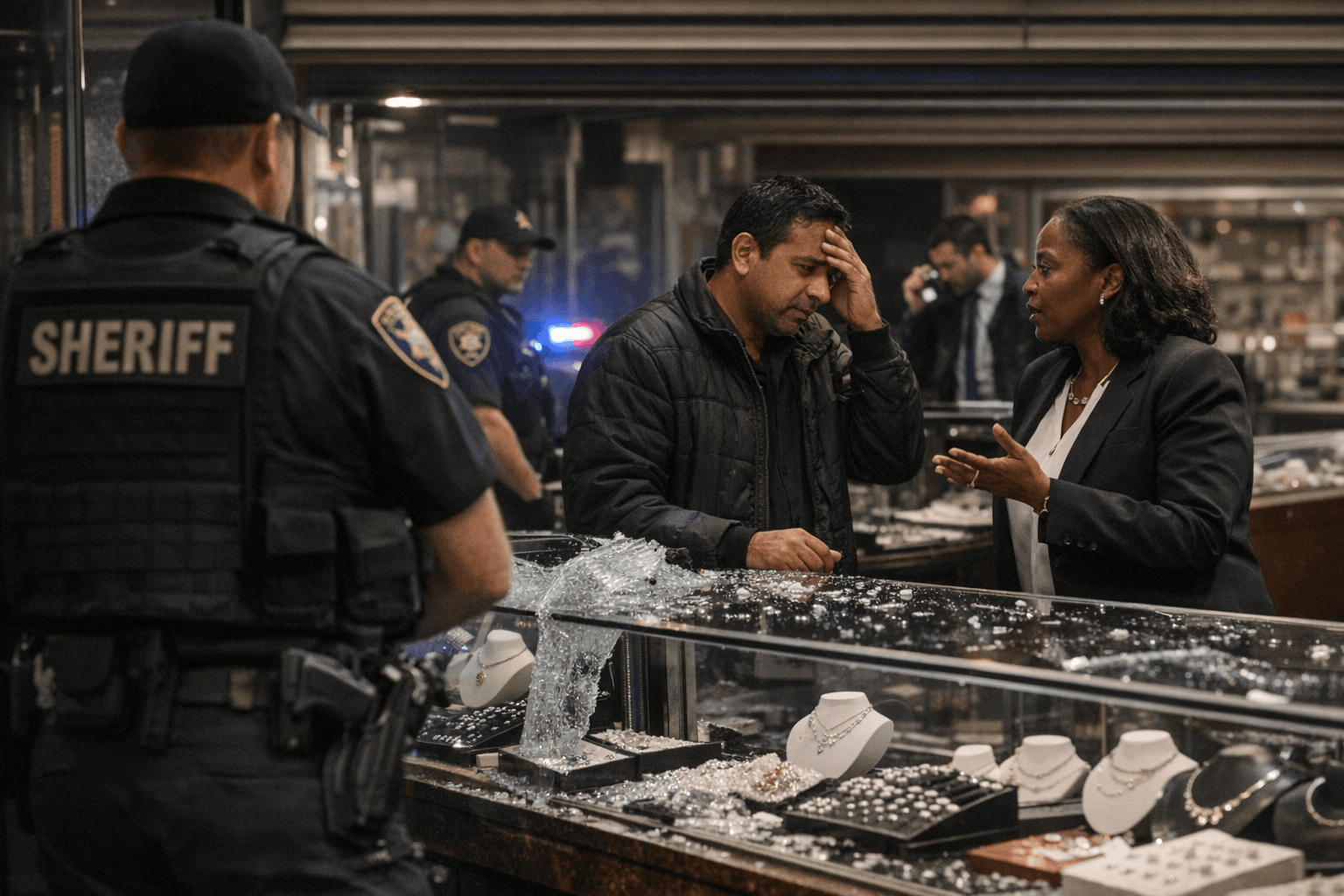
The pressure to act had been building for months. On June 18, 2025, a crew of roughly two dozen masked thieves drove a stolen pickup truck through the front entrance of Kumar Jewelers on Mowry Avenue in Fremont, smashed display cases with hammers and picks, and walked out with $1.7 million in merchandise in just over a minute, taking at least 75 percent of the store's inventory. Federal prosecutors later identified four suspects and linked the same crew to a near-identical heist at Heller Jewelers in San Ramon months later, where approximately 25 masked individuals stormed the City Center location, smashed cases with pickaxes, and fired shots at the glass door to escape. Police tracked getaway cars through Contra Costa County into Alameda County, ultimately detaining multiple suspects in Oakland and Dublin.
The new initiative formalizes what investigators had been improvising. At its core is a vertical prosecution model: the same deputy district attorneys, inspectors, and program specialists handle each organized retail theft case from initial charges through sentencing. That continuity, the DA's office said, eliminates the handoff gaps that allowed crew members to exploit inconsistencies between prosecutors. Defendants charged with acting in concert will also face enhanced sentencing guidelines under the program.
Cross-jurisdictional coordination is the other pillar. The San Ramon robbery had already demonstrated the pattern: suspects from Oakland, getaway cars flagged in Dublin, drone footage from a Contra Costa police department, arrests by Alameda County sheriff's deputies. None of those agencies previously had a shared protocol for pooling that evidence into a single prosecution. The new initiative is designed to close that gap.
Dickson has been personally auditing how the strategy is translating on the ground. "I've done this with Whole Foods; I'm doing it with Macy's," she said, describing her tour of county retailers. "I want to know what's going on throughout the county and whether or not we're seeing any dips in the organized retail theft, if this is decreasing, if what we're doing is working."
That accountability question is precisely what small and independent merchants had been demanding. Local retailers had made clear they were not interested in one-off arrests that left the underlying crews intact and operational across county lines. Edward Escobar of the Coalition for Community Engagement put it plainly after the Heller Jewelers robbery: "This is not about just one store. It's about the safety and survival of entire communities."
California voters passed Proposition 36 in 2024, restoring felony charging authority for repeat theft suspects, but the measure came without dedicated funding. State lawmakers subsequently requested between $250 million and $400 million in annual appropriations to support enforcement. Whether Sacramento delivers that funding will determine how far county-level initiatives like Alameda's can realistically reach.
This article was produced by Prism’s automated news system from verified source data, official records, and press releases, then run through automated quality and moderation checks before publishing. The system is built and supervised by the people who set the standards it runs under. Read our full AI policy.
Did this article answer your question?