Aria Thomas elevates underused gems in Eleux gold designs
Aria Thomas’s Eleux shows how yellow gold looks fresher with pyrite, azurite, turquoise and druzy, proving underused stones can reset gold jewelry’s price and personality.
Underused minerals are giving gold a new accent
Aria Thomas has built Eleux Jewelry around a simple but subversive idea: gold does not need a diamond to look luxurious. In her hands, 18k and 14k yellow gold become a frame for astrophyllite, brown zircon, pyrite-flecked turquoise, azurite druzy and blue sapphires, a palette that feels more geological than bridal and far less predictable than the usual diamond-led script. The result is gold jewelry with texture, depth and a point of view.
That is exactly why Eleux stands out now. The line does not chase minimalism or token sparkle; it treats mineral oddity as the source of beauty. Thomas says the purpose of her work is to “elevate underused stones” and to educate consumers about colored gemstones, and the brand name itself, Eleux, means “elevated luxury.” The phrase is apt because the collection’s luxury lies not in restraint alone, but in knowledge: knowing when a druzy surface should stay rugged, when a cabochon should be polished smooth, and when a stone’s natural imperfections are the very thing that makes it feel special.
A designer shaped by the gem world early
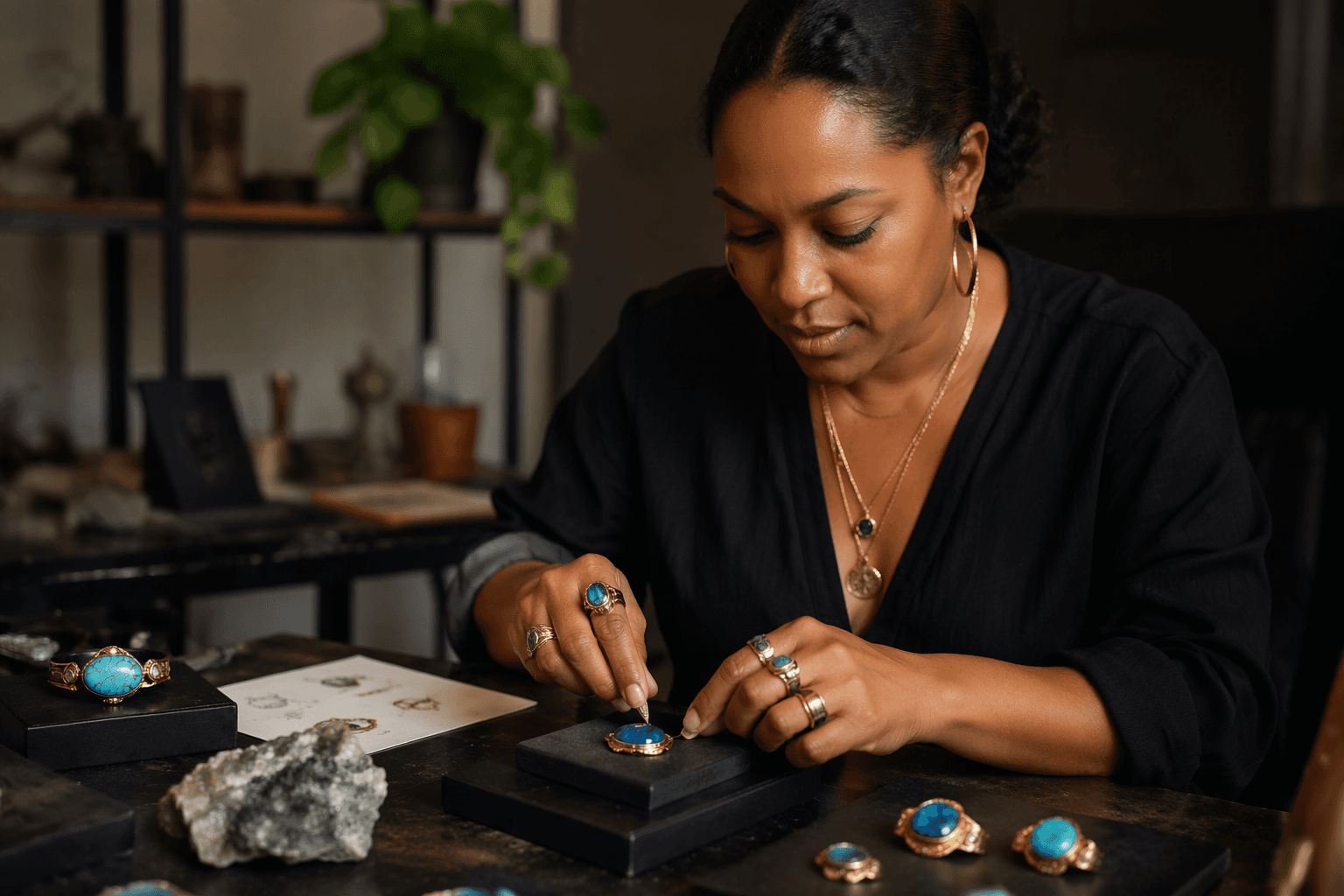
Thomas did not arrive at this language by accident. She attended her first Tucson gem show at age 3, and her parents were hobbyist rockhounds, the kind of upbringing that can make mineral collecting feel as natural as reading a picture book. By middle school, she had already decided to pursue jewelry design, even calling GIA for advice on how to get in. That early confidence still shows in the work: Eleux feels like the output of someone who has spent a lifetime looking closely at stone, not just shopping for it.
Her training gave that instinct technical weight. Thomas studied at Texas Tech University, earning degrees in business and metalsmithing, then continued in Carlsbad, California, at the Gemological Institute of America, where she earned graduate gemology, jewelry design, hand rendering and CAD-technician credentials. That combination matters because her designs depend on both artistic judgment and precision. Underused minerals are difficult to merchandise unless they are set with the kind of clarity that makes their beauty legible, and Thomas seems to understand exactly how to do that.
Eleux’s own company history adds another layer: Thomas created her first handmade jewelry collection at age 10. That long arc explains why the brand feels so assured about its point of view. It is not trying to imitate a heritage house, and it is not pretending every stone needs to behave like a diamond.
Why these gold combinations feel fresh
Gold jewelry can fall into repetition quickly, especially when the metal is paired with the same familiar center stones. Eleux avoids that trap by using minerals with strong visual character. Astrophyllite in the Interstellar earrings brings a celestial, almost meteor-like energy; pyrite in the Blue Sky ring introduces a flash of metallic grit inside turquoise; azurite druzy in the Deep Sea necklace turns surface texture into drama. These are not background stones. They determine the personality of the piece.
There is also a practical design lesson here. Yellow gold amplifies warmth in pyrite and turquoise, while its richness softens the cooler blues of azurite and sapphire. The metal acts less like a neutral setting and more like a color story, one that lets unusual gems read as intentional rather than eccentric. That is a meaningful shift for buyers who want gold jewelry to feel current without becoming disposable.
Price plays into that perception too. Thomas’s pieces are not priced like mass-market gold, but they also are not inflated by a diamond-centric premium. The Interstellar earrings retail for $6,500, the Blue Sky ring for $3,900 and the Deep Sea necklace for $3,200. In each case, the value proposition is tied to design complexity, gemstone selection and the editorial impact of the materials, not simply carat count. For many shoppers, that can make a pair of earrings or a necklace feel more distinctive than a more expensive piece built around a single conventional center stone.
The three pieces that define the line
The Interstellar earrings, in 18k yellow gold, are the most assertive expression of the idea. They feature astrophyllite, brown zircon totaling 1.75 carats and 0.10 carats of diamonds, and they won the Retailer’s Choice Award in Best Celestial Jewelry. The diamonds are present, but they are not the headline. What makes the earrings memorable is the mineral mix, which gives them a cosmic, textural look that feels especially suited to gold with depth and body.
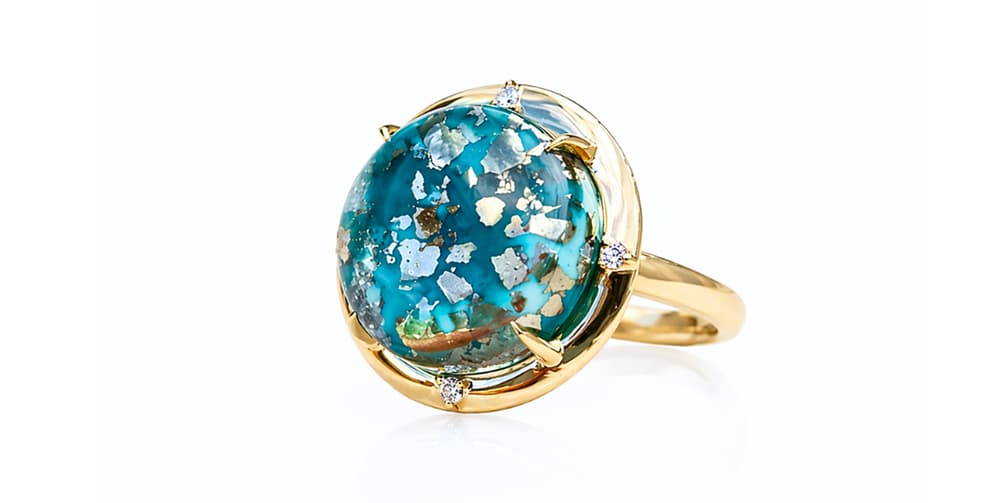
The Blue Sky ring takes a different tack in 14k yellow gold. It centers a round pyrite-flecked turquoise cabochon with 0.05 carats of diamond accents, and the cabochon format matters. A cabochon does not rely on faceting for sparkle, so the stone’s body color and surface character carry the design. Here, the pyrite flecks add movement and visual tension, making the ring feel less polished in the conventional sense and more alive.
The Deep Sea necklace, also in 14k yellow gold, is the most layered of the group. It pairs azurite druzy with blue sapphires totaling 0.30 carats on a 16-inch Figaro-style chain. The Figaro chain lends a familiar gold-jewelry rhythm, but the azurite druzy keeps the piece from slipping into familiarity. That combination of recognizable chain form and uncommon mineral surface is precisely where Eleux finds its edge.
What the award signals about the market
Thomas’s recognition comes through the Cindy Edelstein Award, part of the 11th edition of the INSTORE Design Awards, which drew 229 entries. The competition also introduced a new Small Batch Colored Gemstone category for makers with five or fewer employees, a telling addition in a market where color is clearly gaining ground. INSTORE’s framing suggests colored gemstones were especially strong this year, and that matters because it reflects how buyers and retailers are responding to jewelry that offers more than the default diamond answer.
The Cindy Edelstein Award itself carries its own history. It commemorates Cindy Edelstein, who was described as a fearless leader and passionate designer advocate in the fine jewelry industry. Couture renamed its Human Spirit Award in her honor in 2016 after her unexpected death at age 51, and current nomination criteria emphasize leadership, support for both emerging and established brands, and commitment to the broader community. That makes Thomas a fitting recipient: her work is not only technically accomplished, it pushes the conversation forward by asking consumers to value unfamiliar stones more confidently.
The broader message is hard to miss. Gold jewelry is moving toward personality, not just polish. Designers who pair yellow gold with pyrite, azurite, turquoise and druzy are offering buyers something more specific than sparkle: a piece with geological character, visible craft and a point of view that does not depend on diamonds to feel finished. In a crowded market, that is the kind of distinction that lasts.
This article was produced by Prism’s automated news system from verified source data, official records, and press releases, then run through automated quality and moderation checks before publishing. The system is built and supervised by the people who set the standards it runs under. Read our full AI policy.
Did this article answer your question?