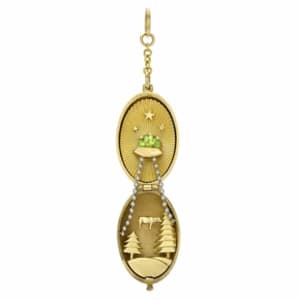
Bulgari to Train Kyrgyz Jewelers in International Gold Production Standards
Bulgari is sending trainers to Bishkek in May to teach gold-jewelry quality standards, in a move that also signals the Italian house's potential entry into the Kyrgyz market.
Bulgari's arrangement to deploy a training delegation to Kyrgyzstan in May traces back to a single January meeting on the floor of one of Europe's most important jewelry trade fairs — and what began as an industry introduction has since expanded into something with significantly higher stakes for both sides.
The groundwork was laid on January 20, 2026, during a working visit by the Chairman of Kyrgyzstan's State Tax Service, Almamet Shykmamatov, to the Vicenzaoro international jewellery exhibition in Vicenza. During the exhibition, Shykmamatov held a series of meetings with representatives of the world's largest players in the jewellery industry, with a key session being his meeting with Eleonora Rizzuto, Bulgari's Director of Sustainable Development and Corporate Social Responsibility. Shykmamatov subsequently announced that Bulgari is preparing to enter the Kyrgyzstani market altogether — making the May workshops less a goodwill gesture and more a market-entry reconnaissance dressed in craft education.
The delegation's curriculum will cover finished-jewelry production, quality controls, and compliance practices: the granular manufacturing discipline that separates export-grade work from purely domestic craft. That knowledge is rooted in what Bulgari has built in northern Italy. The company recently enlarged its Valenza Manifattura to 355,209 square feet, making it the largest single-brand fine jewelry manufacturing site in the world. The facility works exclusively with RJC-certified gold, ensuring every piece begins with traceable, ethically sourced metal.
The workshops arrive alongside a complementary policy shift inside Kyrgyzstan. Under a newly approved framework, precious metals from the State Fund will be sold to local jewelers at a 2% discount from the London Bullion Market Association's daily fixing. The mechanism is designed to increase domestic gold processing, grow jewelry exports, and reduce the share of the gray market for precious metals through a more transparent raw material accounting system. Between subsidized raw materials and Bulgari-caliber finishing standards, Kyrgyzstan is building both ends of a viable supply chain at once.
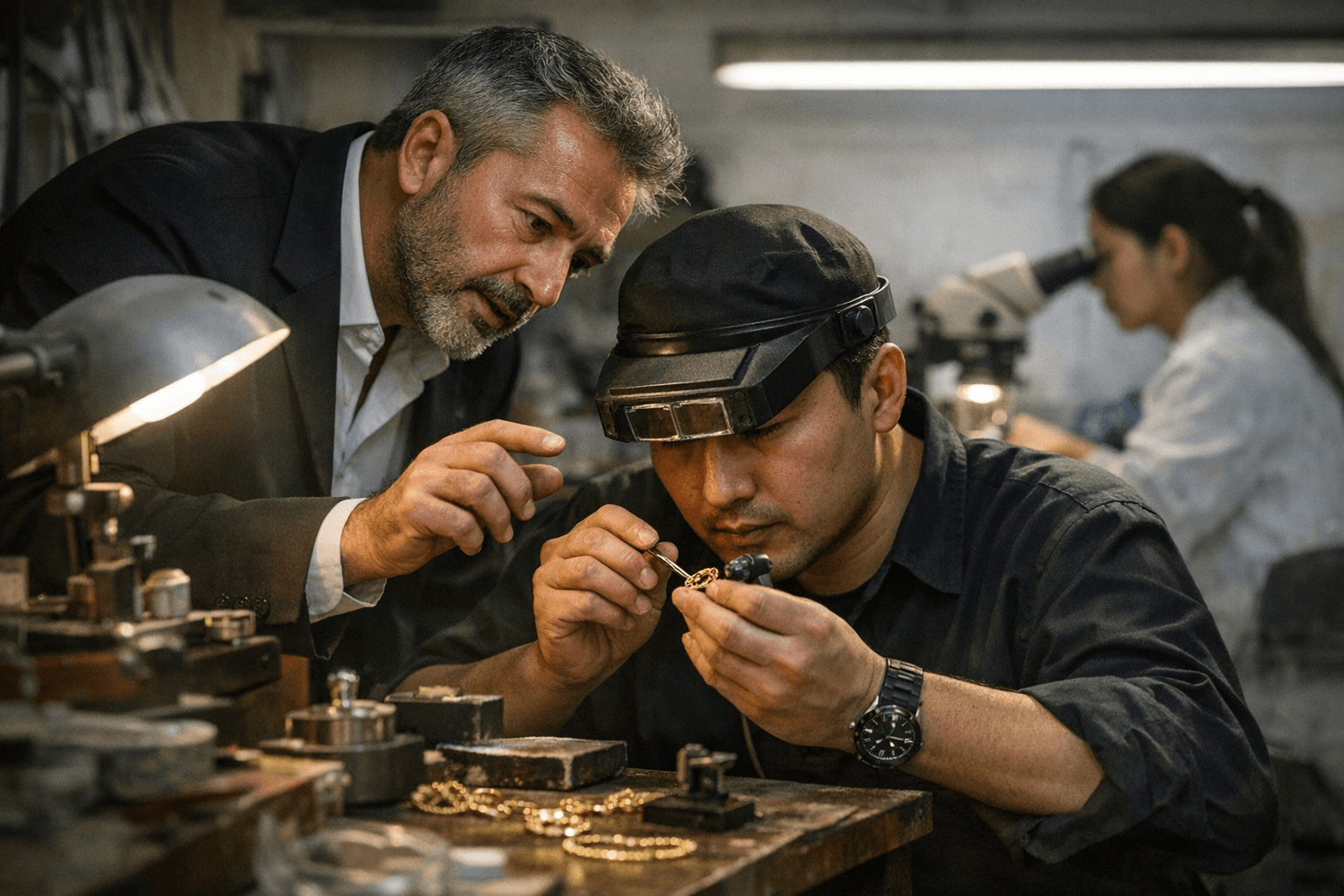
What the May workshops will transfer, in practical terms, are the quality markers that define internationally certified gold jewelry — and they are the same markers any buyer can verify before purchasing. A legitimate gold piece carries a fineness hallmark pressed into a discreet surface: 750 for 18-karat, 585 for 14-karat, 375 for 9-karat in the European convention. That stamp is a legal disclosure of alloy composition, and its presence or absence tells you immediately whether a maker operates within a regulated production framework.
Beyond the hallmark, examine the solder joins where components meet. In quality-controlled production, solder disappears into the surrounding metal with no visible ridge, no pitting, and no discoloration that signals a temperature mismatch or an incompatible alloy. On polished surfaces, light should move evenly and cleanly, without the fine scratches left by buffing a poorly finished piece into a temporary shine. Stone settings are the most revealing test of all: on prong-set stones, each prong should be uniform in height with a rounded tip that holds the girdle without snagging fabric; bezel walls should sit at perfectly even height with no gap where metal meets stone; in pavé work, grains should be consistent in size and rhythmically spaced, the unmistakable signature of a setter who has internalized the process rather than rushing through production quotas.
These benchmarks took Bulgari decades to codify into institutional practice at Valenza. By May, they are scheduled to begin taking root in Bishkek.
This article was produced by Prism’s automated news system from verified source data, official records, and press releases, then run through automated quality and moderation checks before publishing. The system is built and supervised by the people who set the standards it runs under. Read our full AI policy.
Did this article answer your question?