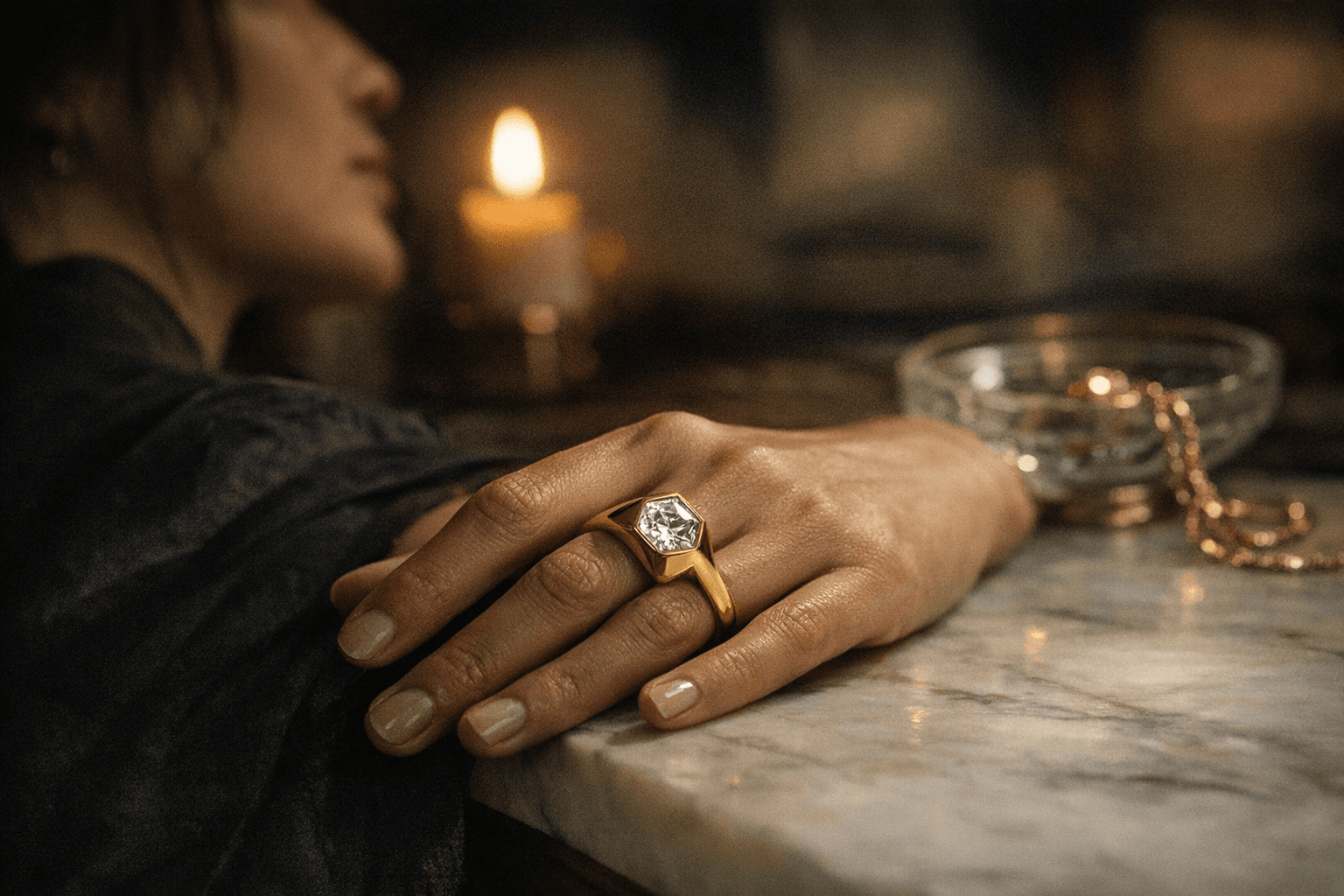
Calms Jewelry’s sculptural gold ring centers a heptagonal lab-grown diamond
A heptagonal lab-grown diamond turns this gold ring into a study in silhouette, wearability, and price perception. The lesson is bigger than one piece: sculptural settings are rewriting the statement ring.
A statement ring is no longer just about size
Calms Jewelry’s Ripple Diamond Ring shows how a statement ring can lead with form as much as with sparkle. The one-of-a-kind piece centers a 1.75-carat IGI-certified lab-grown diamond, cut in a heptagonal step cut, and sets it inside a sculptural band of solid 18K yellow gold that does more than hold the stone in place. It frames the diamond like architecture, turning the setting itself into the headline.
That matters because the modern statement ring is changing. Instead of relying on a large round center stone and a thin shank, designers are building rings with layered gold, unusual geometry, and a more deliberate silhouette. The result can feel quieter at first glance, but often reads more distinctive on the hand, especially when the center stone and the setting are designed as a single composition.
Why the gold setting is the real design story
Calms is a New York City fine jewelry house working in recycled 18K gold and platinum, and the Ripple ring makes that material language visible. The yellow-gold band is not a neutral backdrop. Its curves and layered structure give the piece movement, which softens the sharpness of the heptagonal diamond and keeps the ring from feeling overly rigid.
That balance is the lesson. Unusual geometry can make a ring feel modern, but it also raises practical questions: how high does the stone sit, how much does the band protect the edges, and whether the silhouette feels bold without becoming awkward in daily wear. A sculptural gold setting can solve those problems at once, giving the diamond support while also shaping how the whole ring is perceived.
CAD, casting, and the patience required for custom form
Jennifer O’Brien says the Ripple ring took more than five months to complete, and that timeline is part of the point. The piece went through multiple rounds of refinement, multiple castings, and work with several CAD experts before arriving at its final form. It was developed in New York City’s Diamond District, which still remains one of the few places where such a tightly coordinated process can happen between designer, caster, stone setter, and technical specialist.
That kind of build is expensive for a reason. CAD lets the designer control angles, thickness, and proportion before any metal is poured, but complex forms often reveal weaknesses only after casting. Multiple castings add time and cost, yet they also allow the final ring to preserve both the visual idea and the structural strength needed for regular wear. In a piece like Ripple, that technical labor is part of the value proposition, not just a hidden step behind the scenes.
What a heptagonal step cut changes on the hand
The heptagonal center stone is the feature most likely to stop someone mid-scroll, but its appeal is not only novelty. A step cut emphasizes line, reflection, and shape rather than the high-flash brilliance of a classic round brilliant. With seven sides, the stone pushes the eye outward and gives the ring a slightly more graphic, almost emblem-like presence.
That geometry also affects wearability and price perception. A stone with a distinctive shape can look more custom and therefore more exclusive, even when it is lab-grown. It can also feel more intentional than a standard solitaire because the eye reads the entire object as designed, not merely assembled. The ring’s sharp and soft lines work together here: the diamond supplies definition, while the gold setting prevents the piece from becoming severe.
Why certification matters when the center stone is lab-grown
The Ripple ring’s center stone is IGI-certified, and that detail matters because lab-grown diamonds live or die by disclosure. IGI’s reports identify the gemstone as natural or laboratory-grown and include shape, cutting style, measurements, and a 4Cs assessment, so the buyer knows exactly what kind of stone is being purchased. GIA takes a similarly disclosure-focused approach for laboratory-grown diamonds, using report numbers and laser inscription to identify the stone clearly.
That transparency is especially important in a market where lab-grown diamonds have become increasingly mainstream. A GIA research summary says industry analysts projected in 2024 that laboratory-grown diamonds could account for 20 percent of diamonds on the market by 2025. In other words, lab-grown is no longer a niche category built on novelty alone. It is becoming a major part of diamond jewelry, and certification is what keeps the category legible to buyers.
A ring shaped by the rise of made-to-order fine jewelry
Calms Jewelry offers bespoke engagement rings, heirloom redesign, and private commissions, and the Ripple ring fits squarely within that world. The piece feels less like a mass-market launch and more like a proof of concept for what a smaller, design-driven house can do when custom tools and patient fabrication are part of the brand identity. Calms says its work is designed and crafted in New York City, which reinforces the handmade, local nature of the line.
The JCK coverage also notes that the ring draws partly from ribbed rings of the 1980s. That reference helps explain why the piece feels familiar even while looking new. Ribbing brings texture and rhythm; the heptagonal center stone brings precision. Together they create a ring that nods to vintage form without relying on retro pastiche.
What this means for the next wave of statement rings
The Ripple Diamond Ring suggests that the next generation of statement jewelry will be judged less by carat weight alone and more by how intelligently a piece is built. A ring can feel substantial because of its geometry, because the gold is layered with intention, and because the stone is chosen for shape as much as size. That is a meaningful shift for buyers who want a piece that reads as personal, not generic.
It also changes how price is understood. When a ring requires months of CAD refinement, repeated casting, and a carefully considered setting, the cost is not only in materials. It is in design labor, technical problem-solving, and the precision needed to make an unusual shape wear well. Calms has turned those elements into the point of the ring, and that is where the market is heading: toward sculptural gold jewelry that treats structure, certification, and silhouette as part of the same story.
This article was produced by Prism’s automated news system from verified source data, official records, and press releases, then run through automated quality and moderation checks before publishing. The system is built and supervised by the people who set the standards it runs under. Read our full AI policy.
Did this article answer your question?