Cartier’s gold moon models revisit Apollo 11’s Paris tribute
Cartier's Apollo 11 moon models turn yellow gold into a civic souvenir of the moon landing. White-gold landing gear and hidden microfilm make the tiny LEMs as ingenious as they are ceremonial.

Cartier’s miniature Lunar Excursion Modules are a reminder that gold does more than flatter the wrist or glitter in a case. Here, yellow gold became a vessel for public memory, a material choice that turned Apollo 11 from a fleeting news event into a collectible object with weight, wit, and ceremony. The result was not nostalgia but design with intent: a moon landing translated into precious metal, then handed to the astronauts in Paris as if history itself had been cast and polished.
Gold as a public tribute
The story begins with Le Figaro, whose readers funded the project through a public subscription after the moon landing. Cartier was asked to create three small lunar module replicas for Neil Armstrong, Edwin “Buzz” Aldrin, and Michael Collins, and the presentation took place at the Hôtel de Crillon in Paris on October 8, 1969, during the astronauts’ post-mission goodwill tour. That tour stretched 45 days, crossed 24 countries, and reached 27 cities, which makes the Paris stop feel especially precise: a stopover where diplomacy, celebrity, and craftsmanship converged in one elegant room.
The choice of yellow gold was not incidental. Yellow gold carries warmth, ceremonial force, and a kind of civic optimism that colder metals rarely deliver. For a moment as globally triumphant as Apollo 11, it signaled celebration rather than technical austerity, turning the lunar module into an object of honor rather than a model of machinery. White-gold landing gear sharpened that message by adding contrast and visual clarity, a discreet flash of engineering against the gold body, much like the fine line between ornament and structure in the best high jewelry.
A miniature built like a high-jewelry object
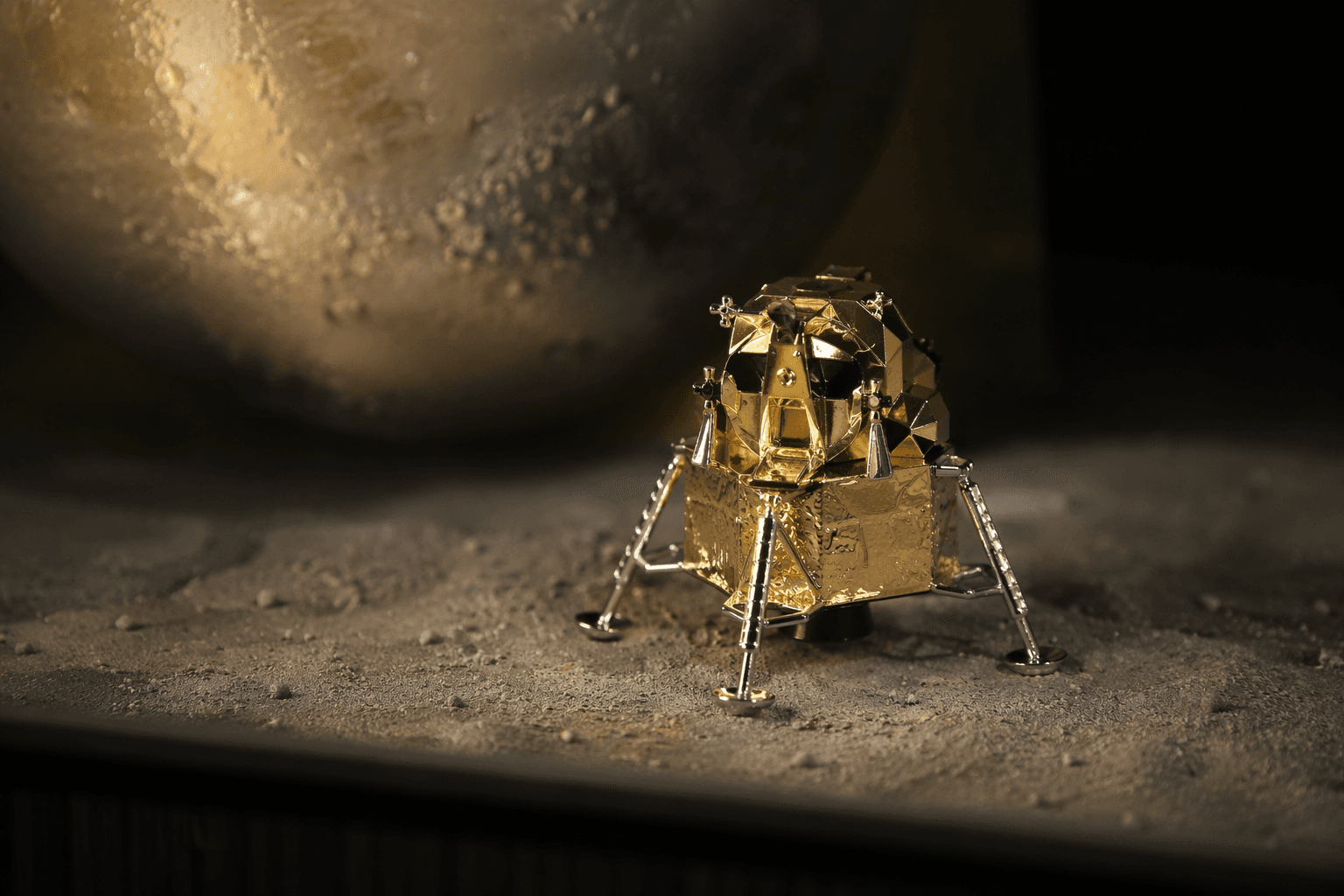
Each model stood about 15 centimeters tall, close enough to feel intimate, large enough to preserve the silhouette of the Lunar Excursion Module. Cartier’s artisans, specialists in objects such as vanity cases and cigarette cases, approached the commission as a piece of precision luxury rather than a novelty. That background matters: the maison’s heritage lies partly in translating function into refined surfaces, and these moon models needed exactly that sensibility to make a spacecraft look at home in precious metal.
The construction layered yellow gold with white-gold landing gear, black lacquer, enamel, and tiny details such as antennas and hatches. Inside each piece, a microfilm listed the names of the subscribers who helped pay for it, while the inscription referenced Le Figaro’s readers. That hidden archive is one of the most sophisticated aspects of the work. It makes the object both jewel and document, a memorial that carries its patrons inside it, the way a serious ring may conceal meaning in its setting or undergallery rather than in its visible face.
For gold jewelry lovers, the lesson is clear: the most compelling pieces often rely on contrast, scale, and restraint. The yellow-gold shell gives the object emotional radiance. The white-gold landing gear prevents it from becoming too sentimental, grounding the fantasy in technical realism. Black lacquer deepens the form, while the microfilm introduces a concept that modern collectors still prize: provenance embedded as part of the design, not appended later as paperwork.
Why only three matters
Only three Cartier Apollo 11 LEM models were made, which immediately raises their status from commemorative objects to rare artworks. Edition size is not just a market talking point here; it is part of the meaning. Three astronauts received three models, and that symmetry reinforces the logic of the commission, an elegant answer to a once-in-a-generation event.
Their later histories only add to the mythology. Neil Armstrong gave his model to the Ohio History Connection in 1973, anchoring one example in the public record of space history. Cartier acquired Michael Collins’s model at auction in 2003, reclaiming one of the pieces into its own archive. That movement between museum, market, and maison is exactly what gives heritage objects their lingering force. They are not valuable simply because they are old. They are valuable because they keep traveling through institutions that recognize them as cultural evidence.
What the revival at The Shed says about gold now
The models are appearing again in Hidden Treasures, 250 Years of Franco-American Luxury Stories at The Shed in New York, where the exhibition runs from May 26 to May 31, 2026. Comité Colbert says the presentation brings together 65 maisons and institutions in dedicated shipping cases, a format that feels especially suited to objects like these, which depend on proximity and controlled light to reveal their detail. Comité Colbert, founded in 1954, has always framed luxury as a cultural conversation, and this exhibition makes that argument concrete by placing Cartier’s moon tribute among a broader story of French craft and transatlantic exchange.
Cyrille Vigneron has described the Apollo 11 commission as one of Cartier’s most unexpected special orders, and the point still holds. Gold becomes most persuasive when it is used to record a moment larger than itself. In this case, yellow gold did not merely imitate the moon; it transformed a brief human achievement into a permanent object, while white-gold details kept the fantasy legible and sharp. That is the enduring appeal of great gold jewelry, whether it is a ring, a cuff, or a lunar module no taller than a hand: it can make history feel touchable without making it small.
This article was produced by Prism’s automated news system from verified source data, official records, and press releases, then run through automated quality and moderation checks before publishing. The system is built and supervised by the people who set the standards it runs under. Read our full AI policy.
Did this article answer your question?