Charles Holl’s Draperie necklace turns gold into fluid fabric
Charles Holl’s 84-gram Draperie necklace shows why articulated gold still feels modern: it wears like silk, yet carries the hallmarks collectors want.
Gold that moves like cloth
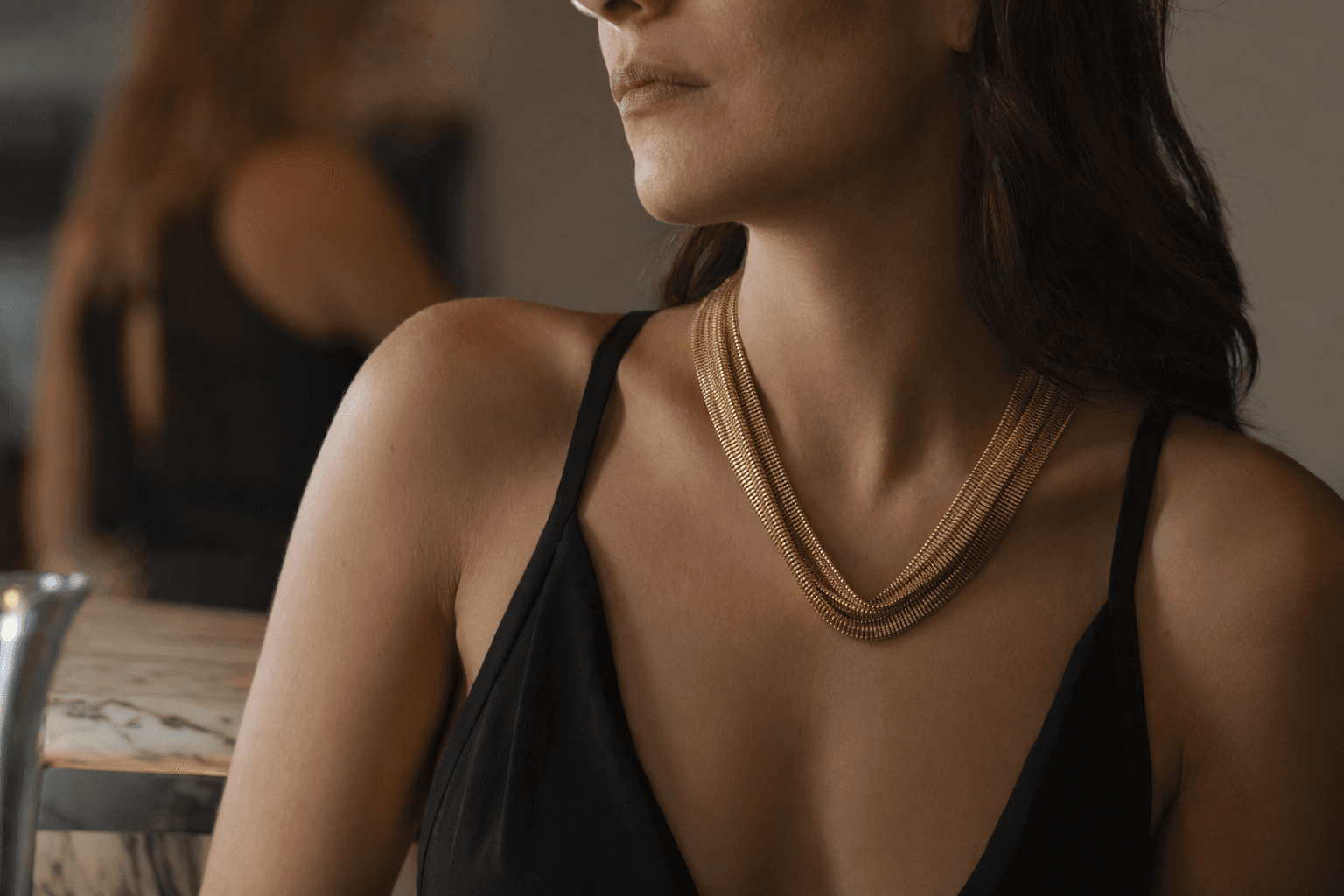
Charles Holl’s Draperie necklace has the kind of physical intelligence collectors notice immediately. It is substantial, at 84 grams, yet the design is built to move with a softness that makes 18ct yellow gold behave less like metal than fabric. Set with 11 round brilliant-cut diamonds totaling an estimated 1.29 carats, the piece turns mid-century engineering into visual ease, which is exactly why it still looks current.
Hancocks London selected the necklace as its Jewel of the Month, and the choice makes sense. The house identifies it as a vintage Draperie necklace in 18ct yellow gold and platinum by Charles Holl, circa 1950s, with French marks and maker’s marks for the maker himself. That combination of hallmarks, materials, and dating is more than inventory language; it is the first clue that this is the kind of estate jewel that rewards close looking rather than brand-name shorthand.
Why the Draperie style still reads modern
The power of this necklace lies in movement. Hancocks describes the construction as alternating quatrefoil panels, a pattern that recalls pleating, joined by circular links so the piece flexes with the malleability of fabric. The central knot is emphasized by a crescent element, which gives the design a focal point without making it rigid or overworked. It is sculptural, but not static.
That is the enduring appeal of mid-century articulated gold. The era drew on haute couture and tried to translate drape, flow, and sheen into jewelry that could hold its shape while still suggesting silk or lamé. When a necklace achieves that balance, it avoids the look of costume and lands in the sweeter spot between ornament and engineering. It feels alive on the body, which is why these pieces still work with a white shirt, a black dress, or a modern tailored jacket.
What Charles Holl did better than most
Charles Holl was not simply a maker of decorative jewels. JCK characterizes him as a technical wizard trusted by Cartier and Van Cleef & Arpels to execute highly complex commissions, and that reputation matters when evaluating a signed estate piece. A jeweler known for precision mounts and gemstone settings brings a different level of authority to articulated gold than a maker who merely follows a style trend.
Hancocks’ director’s notes call Holl a prestigious French jeweler who founded his workshop in 1917, and auction references place his maker’s mark registration on 15 May 1917. Those details anchor the necklace in a documented workshop tradition, not just a period aesthetic. Christie’s notes that Holl was especially revered for handbags, boxes, and works in gold, which helps explain why the Draperie necklace feels so confident in its finish: the maker understood how to give hard material a supple, almost textile-like presence.
Hallmarks, origins, and the paper trail that matters
For buyers, the strongest vintage gold pieces are the ones whose physical charm is matched by a clear provenance trail. This necklace carries French marks and Charles Holl’s maker’s marks, and Hancocks lists Paris as its origin. Sotheby’s places Holl’s workshop at 20 rue des Victoires in Paris and later rue Volney, while other references note that he also opened a New York City workshop in the 1930s. That geographic trail suggests a maker with both European roots and international reach.
The practical lesson is straightforward: when you are assessing an estate necklace, look first for hallmarks, maker’s marks, and any documented workshop history. Those details do not guarantee a bargain, but they do separate a serious signed jewel from an anonymous retro-style necklace. In gold jewelry, the paper trail and the physical craftsmanship should reinforce each other.
How to judge whether a piece earns its price
A necklace like this justifies attention because the value sits in several layers at once. There is the metal, 18ct yellow gold with platinum accents. There are the diamonds, 11 round brilliant cuts totaling an estimated 1.29 carats. There is also the labor required to construct a piece that remains highly flexible despite its weight and complexity.
Collectors should pay particular attention to the following details when comparing similar estate necklaces:
- Length and proportion: At 38.0 cm, or 15 inches, this necklace sits close to the base of the neck, which suits a draped, collar-like composition.
- Weight: At 84 grams, it has real presence. In vintage gold, heft often signals both material value and robust construction.
- Movement: The links should allow the necklace to move naturally, not fight the body. If it feels stiff, the appeal of the design is diminished.
- Surface and finish: Alternating panels, crisp edges, and clean joins matter more than flashy scale. Fine articulated work should look deliberate from every angle.
- Marks: French marks and maker’s marks for Charles Holl are central to authenticity and desirability.
Price in this category is rarely about carat weight alone. The rarity lies in the design intelligence and the maker’s discipline, especially when the jewel bridges sculpture and wearability as convincingly as this one does.
Why buyers still want mid-century articulated gold
The modern appeal of a piece like the Draperie necklace is that it solves a problem many contemporary gold jewels still struggle with: how to feel substantial without looking heavy. The gold is yellow, warm, and visibly luxurious, yet the construction keeps it from reading as blunt or bulky. That is a big reason mid-century articulated necklaces keep resurfacing in serious estate and collector markets.
Hancocks’ earlier Jewel of the Month choices included Van Cleef & Arpels’ gold-and-diamond fringe Cheveux d’Ange necklace, another example of the same couture-minded instinct. The comparison is useful because it shows the period’s larger design language: fringe, pleating, and fluid gold were not decorative gimmicks, but strategies for making hard materials behave like fabric. Pieces from that family remain desirable because they look considered rather than merely ornate.
How to spot a strong comparable today
If you are scanning the estate market for a necklace with similar appeal, the best examples usually share a few traits. They are articulated rather than fixed, signed or clearly attributable, and built from 18ct yellow gold or a comparable high-grade alloy. Many will also include small diamond accents, not as the headline, but as a way to catch light across the folds and links.
The strongest comparable pieces will also feel engineered, not assembled. You want the impression of rhythm in the links, clarity in the motif, and enough flexibility that the necklace settles against the collarbone instead of standing away from it. In mid-century gold, that bodily fit is part of the design, not an afterthought.
Charles Holl’s Draperie necklace endures because it understands that the finest gold jewelry does not simply display wealth. It animates metal, gives structure to softness, and turns technical mastery into something that looks effortless, which is still the hardest trick in jewelry.
This article was produced by Prism’s automated news system from verified source data, official records, and press releases, then run through automated quality and moderation checks before publishing. The system is built and supervised by the people who set the standards it runs under. Read our full AI policy.
Did this article answer your question?