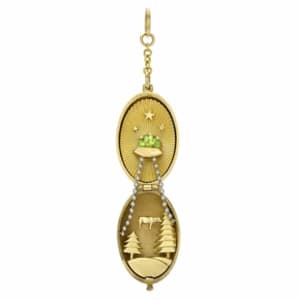
divorce jewelry gains traction as rings are remade for reinvention
Rings are being split, reset, and remade into gold pieces that signal independence, while non-bridal diamond jewelry continues to dwarf the bridal category.

A marriage ending no longer has to mean the end of a ring’s life. Designers are recasting engagement rings and inherited diamonds into yellow-gold pendants, signets, bands, and stackers that feel personal, wearable, and unmistakably self-directed. The shift is emotional, but it is also measurable: non-bridal natural diamond jewelry has become the larger story, and the remake is now one of the clearest ways that story shows up on a hand or at the collarbone.
Reinvented rather than retired
The new appeal of divorce jewelry is that it does not try to pretend the past never happened. Instead, it gives old stones a new purpose, whether that means splitting one ring into two or resetting a family diamond so it reads as daily jewelry rather than a relic. Natural Diamonds describes the category as jewelry chosen or reimagined after a marriage ends, a framing that makes the pieces feel less like consolation prizes and more like marks of independence, renewal, and self-celebration.
Emily Ratajkowski helped push the language into the mainstream when she turned her original engagement ring, a toi et moi design with pear-shaped and princess-cut diamonds totaling about 5 carats, into two separate rings. That kind of transformation matters because it changes the visual meaning of the jewel as much as the emotional one. A single symbolic ring becomes a pair of pieces that can be worn alone, stacked together, or separated into a new style story entirely.
Why yellow gold keeps showing up
The strongest remakes tend to land in yellow gold because the metal softens the mood of a once-loaded stone without dulling it. Gold gives a reset ring warmth and continuity, especially when the original diamond is being moved out of a bridal setting and into something more everyday, like a slim band, a low-profile signet, or a pendant that sits close to the skin. The result is less about erasing history than about giving it a better frame.
That appetite for personal framing fits a larger fine-jewelry shift. The Natural Diamond Council’s 2025 trends report found that non-bridal natural diamond jewelry accounted for 85% of pieces sold and 67% of sales value in 2024, based on more than four million jewelry transactions. In other words, the market has already moved well beyond the engagement ring as its defining category. Divorce jewelry is rising because consumers are increasingly buying and wearing diamonds for themselves, not only for milestones tied to romance.
Designers are building brands around the remake
Sam Hamilton, founder and designer of London-based Sam Ham, sits at the center of this movement. Her work, which spans divorce jewelry and redesigned family heirlooms, shows how a custom remake can hold memory without freezing it in place. The appeal is obvious: rather than leaving an inherited diamond trapped in an old mounting, she reworks it into something with a sharper point of view.
That shift also reflects how clients are shopping now. They are asking for pieces that feel edited and intimate, not overtly ceremonial. The most requested remakes are the ones that can be worn often and layered into an existing collection, which is why pendants, signets, bands, and stackers keep appearing in the conversation. These forms are easier to integrate than a large cocktail ring, and they carry a quieter kind of authority. They say reinvention without announcing the backstory to everyone in the room.
When to preserve the stone and when to start over
The best redesigns are the ones that preserve what is worth keeping. In most cases, that means holding onto the principal diamonds, especially if they already have strong shape, size, or sentimental weight, and rebuilding around them in a setting that suits current wear. Emily Ratajkowski’s ring is a useful model here: the value did not live only in one original mounting, but in the diamonds themselves, which were reorganized into two distinct jewels.
A full reset makes more sense when the old ring no longer matches the life of the person wearing it. If the setting feels too bridal, too ornate, or too fragile for daily use, a cleaner remake can do more for the stone than a minor alteration ever could. Small adjustments work when the original piece still has a shape worth preserving, but a complete redesign is smarter when the goal is to shift a jewel from symbol to signature.
The practical question is whether the old piece can become something you will actually reach for. A diamond that moves from a raised engagement setting into a low-slung gold band, a pendant, or a pinky ring becomes easier to wear and harder to misread. That matters because WWD’s 2026 jewelry coverage also points to bold diamond pinky rings and highly expressive engagement-ring styles as part of the same move toward individuality. The message is consistent: fine jewelry is becoming more personal, more sculptural, and less tied to old script.
A market built for meaning
This is why divorce jewelry is not a niche emotional trend so much as a visible expression of a broader market reset. Consumers are gravitating toward pieces that can carry a story without being trapped by one, and gold is the metal doing much of the heavy lifting. It is warm, adaptable, and strong enough to support a complete change in meaning.
The most compelling remakes do not hide where the stones came from. They honor provenance by keeping the material alive, then use design to change the conversation around it. In that sense, the rise of divorce jewelry is really a story about ownership, not loss: who gets to decide what a diamond means next, and how beautifully that answer can be worn.
This article was produced by Prism’s automated news system from verified source data, official records, and press releases, then run through automated quality and moderation checks before publishing. The system is built and supervised by the people who set the standards it runs under. Read our full AI policy.
Did this article answer your question?