Gold cartilage earrings bring a polished, grown-up ear stack
Cartilage earrings feel most polished in solid gold, where huggies, cuffs and tiny hoops build an ear stack that looks deliberate and wears like fine jewelry.
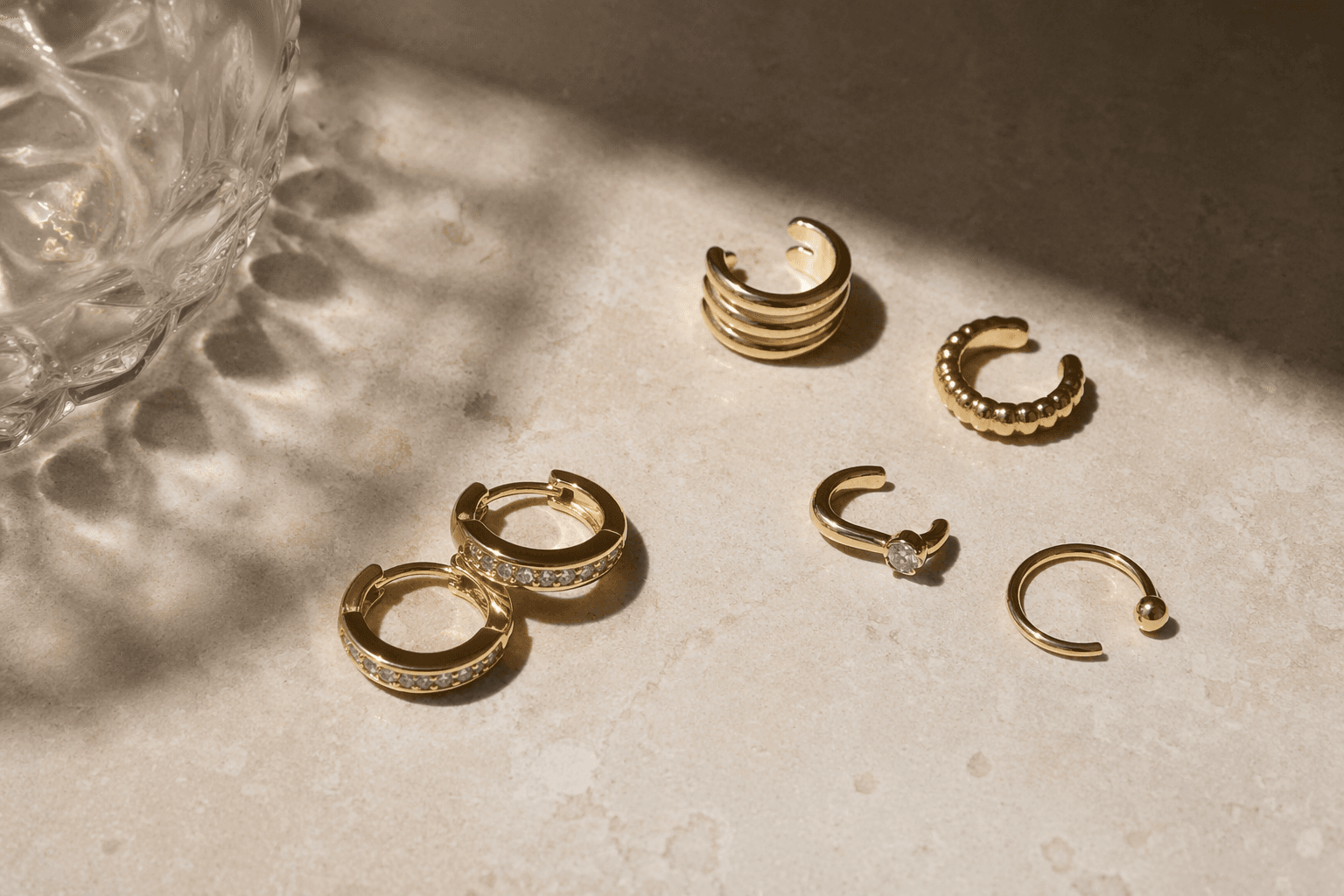
Gold cartilage earrings look most compelling when they stay close to the ear and keep their materials honest. ELLE’s edit leans into solid white and yellow gold, which keeps the category firmly in fine-jewelry territory, and that matters because cartilage is not a casual placement: the Association of Professional Piercers says it may take six months or longer to heal.
Why solid gold makes the stack feel grown-up
The strongest cartilage pieces do not try to shout over the rest of the ear. Huggies, delicate cuffs and tiny hoops create a controlled line of shine that reads polished from the front and tidy from every angle, which is why they work so well as a base layer. Solid white and yellow gold also give the stack a clearer visual grammar than plated metal, especially when the goal is an ear that looks intentional rather than crowded.
That restraint is what makes gold cartilage earrings feel worth investing in. ELLE’s curation points to pieces with a refined finish, including dainty studs and twinkling canary-yellow stones from Australian brand By Lucia, which shows how the look can stay delicate without disappearing. In practice, the best versions do one thing well: they frame the ear, not overwhelm it.
The silhouettes that do the most with the least
Huggies are the easiest place to start because they sit close to the lobe or cartilage and keep the profile compact. Cuffs add the illusion of a pierced look without requiring a new hole, which makes them especially useful if you want visual interest without adding more pressure to a healing ear. Tiny hoops pull the stack together by repeating the same circular shape in a smaller scale, while pavé accents can supply a single flash of light when the rest of the ear stays quiet.
The most versatile stacks usually rely on one anchor and one supporting note. A polished huggie can sit beside a slender cuff, or a tiny hoop can be paired with a dainty stud so the ear has movement without competing focal points. When a single accent carries sparkle, the rest of the stack can stay smooth and sculptural, which is what keeps the look modern rather than overloaded.
How to mix placements without overcrowding the ear
Cartilage earrings cover a wide range of placements, including helix, tragus, daith, conch, rook, snug and anti-tragus piercings. That range is useful because each site changes the way gold reads on the ear: a helix hoop skims the rim, a tragus stud sits close to the face, and a conch piece has more room to make a soft statement in the center of the ear. The trick is not to fill every space, but to let one placement lead and the others echo it.
A balanced stack usually works best when you vary scale, not just quantity. If a thicker gold cuff takes the upper ear, keep the lower half lighter with a tiny hoop or a stud; if a conch piece is the most visible object, let the helix stay minimal. That spacing gives the eye room to move, which is what makes the arrangement feel polished instead of busy.
Everyday wear starts with the healing reality
Cartilage asks for more care than the lobe, and that changes how practical a piece really is. The Association of Professional Piercers, established in 1994 as an international nonprofit focused on health and safety information about body piercing, recommends sterile saline wound wash with 0.9% sodium chloride as the only ingredient for aftercare. It also advises avoiding additives such as moisturizers, antibacterials, contact lens saline, nasal spray or eye drops on a healing piercing.
Daily habits matter just as much as the jewelry itself. Sleeping directly on a healing cartilage piercing can irritate the area and even shift the angle of the piercing, which is why low-profile designs often prove the most wearable. In a gold ear stack, the most practical piece is usually the one that disappears into the routine, smooth enough to sleep around, secure enough to wear all day, and refined enough to look finished with nothing else added.
The long history behind a small circle of gold
Gold earrings have carried meaning far beyond decoration for centuries. The Metropolitan Museum of Art holds gold earrings from ancient Egypt’s New Kingdom, including examples dated to about 1479-1425 B.C. and about 1295-1186 B.C. Those objects make the current cartilage trend look less like a passing style and more like another chapter in a much older language of wealth, status, power and beauty.
That history is part of the appeal of gold in the ear: it has always been small enough to wear every day and significant enough to signal something larger. A well-chosen cartilage earring does the same work now, pairing fine metal, careful placement and restrained sparkle into a stack that feels composed, credible and built to last.
This article was produced by Prism’s automated news system from verified source data, official records, and press releases, then run through automated quality and moderation checks before publishing. The system is built and supervised by the people who set the standards it runs under. Read our full AI policy.
Did this article answer your question?

&w=1920&q=75)