Kris Averi’s Prism Thorn ring turns lab-grown sapphires into wearable armor
Prism Thorn turns lab-grown sapphires into a thorned crown, pairing ROYGBIV color with sharp gold. Kris Averi folds Pride symbolism, recycled-gold claims, and New York craft into one ring.
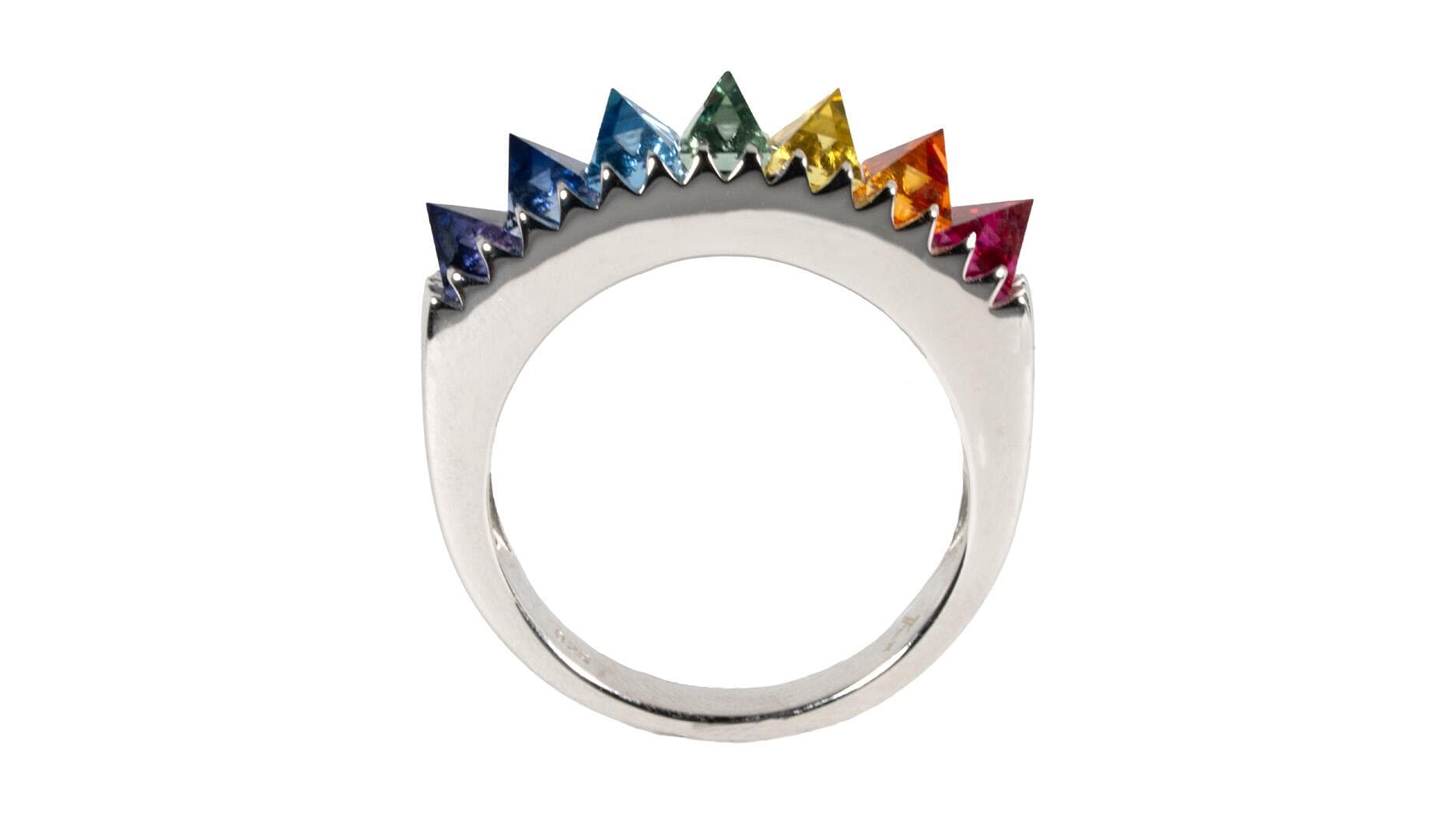
Prism Thorn does not read like a polite accent ring. It looks built to guard the hand, with angular lab-grown sapphires rising in a crown of points and a silhouette that pushes gold jewelry into the language of armor. That sharpness is exactly what makes it feel current: a conversation piece for readers who want a ring to signal identity, not just finish an outfit.
A thorned profile with real presence
Kris Averi offers the ring in 14-karat yellow gold and 14-karat white gold, and the metal choice changes the mood immediately. Yellow gold amplifies the warmth and theatricality of the form, while white gold pushes it toward something colder, sleeker, and more architectural. A black spinel version also exists for anyone who wants the same sculptural outline without the rainbow burst of color.
The most striking iteration is the rainbow version, which uses angel-cut, octahedral lab-grown flame-fusion sapphires arranged in a ROYGBIV colorway. The stones are reverse-set, so the points face upward and the flat faces sit against the setting, creating a crown-like edge that throws light in multiple directions. It is the sort of construction that turns a ring into a surface, almost like a tiny piece of armor plated in color.
Why the cut matters as much as the color
Angel-cut stones are not chosen here for delicacy. Their octahedral geometry gives the ring its faceted, thorned rhythm, and the reverse setting heightens that effect by making the points part of the visual architecture. Kris Averi describes the stones as set face down and point up, and that detail explains why the ring feels more spiked than sparkling.

The design language draws from prisms, pyramids, and the protective power of thorns, which places the ring squarely in the current shift toward sculptural profiles and bold gold forms. In a market crowded with quiet bands and minimal solitaires, Prism Thorn belongs to the growing class of rings that are meant to be noticed from across a room. It is especially resonant for people who wear one strong piece instead of layering many small ones.
The brand story behind the metal
Kris Averi was founded in 2017 under the original name Aetheria Jewel, and the brand still frames its work around inclusive, bespoke fine jewelry and custom pieces meant to honor identity, devotion, and legacy. That positioning matters because Prism Thorn is not simply decorative; it is built to carry symbolism, whether that means Pride color, personal armor, or a more private reading of strength and protection.
The company says it uses recycled gold and ethically sourced materials, and it says its pieces are made in New York City’s Diamond District. Those are important claims in a category where provenance often gets blurred by glossy marketing. The specificity helps, but the strongest sustainability stories in fine jewelry usually pair sourcing language with named materials and place, which Kris Averi does here by putting recycled gold, ethical sourcing, and New York manufacture at the center of the brand’s identity.
Pride Month, and a ring with a public life
Prism Thorn is being highlighted in Pride Month coverage, and a social video tied to the piece says Pride sales are supporting Heritage of Pride through June. That gives the ring a direct civic connection beyond aesthetics, linking the object to a New York institution that supports Pride programming and public visibility. For a piece already built around protective symbolism, that support makes the armor metaphor feel more literal.
The ring also appeared in Pride Month programming beyond product coverage. On June 11, a panel titled “Pride in the Industry: LGBTQ+ Voices in Jewelry” brought together LGBTQ+ leaders across jewelry, luxury, and creative industries in New York City, at Luminary coworking space, 1204 Broadway. Michelle Graff moderated the discussion, and the panel featured Kris Averi alongside Greenwich St. Jewelers co-owner Jennifer Gandia, Only Natural Diamonds contributor Grant Mobley, and former FIT jewelry design department chair Michael Coan.
Who this kind of ring is really for
Prism Thorn fits the broader rise of conversation-piece rings, especially among buyers who want one object to carry the whole look. That audience includes first-time buyers who are moving beyond safe staples, as well as collectors who already know the difference between a pleasant ring and a piece that changes how the hand reads in motion. The sharp geometry and color saturation also make it appealing to people who treat gold jewelry as identity signaling, not just adornment.
The rainbow version leans into visibility and celebration; the black spinel version pulls the same silhouette into something darker and more severe. Either way, the ring lands in the territory where fine jewelry starts behaving like personal emblem. Its value is not only in the lab-grown sapphires or the 14-karat gold, but in the way the whole object turns the hand into a site of statement-making.
This article was produced by Prism’s automated news system from verified source data, official records, and press releases, then run through automated quality and moderation checks before publishing. The system is built and supervised by the people who set the standards it runs under. Read our full AI policy.
Did this article answer your question?