Meta tests AI pendant, signaling a new jewelry wearables category
Meta’s AI pendant would have to earn a place in gold stacks, not just in the wearable-tech aisle, and that is a much harder design test.

The real question is not whether Meta can put artificial intelligence into a pendant. It is whether the thing can sit on skin, under a collar, beside a chain stack, and still read as jewelry people want to wear.
Meta is reportedly testing an AI pendant within the next year, part of a broader wearables strategy that also includes expanded AI glasses and a business subscription called Wearables for Work. The stakes are high: Reuters-cited coverage says Meta wants to sell 10 million wearable devices in the second half of 2026, while Reality Labs reportedly lost $4.03 billion in the first quarter of 2026 on revenue of just $402 million. Meta has already said its Ray-Ban smart glasses sold more than seven million pairs in 2025, and Reuters-cited coverage puts its share of the smart-glasses market at roughly 82 percent through its partnership with EssilorLuxottica.
For gold-jewelry readers, the pendant question starts with proportion. A device like this cannot be too large, or it will break the visual rhythm of layered chains; too small, and it risks disappearing as a piece of adornment while still carrying the burden of a microphone, battery and sensors. Chain length will matter as much as the tech itself. If it sits high at the base of the throat, it will compete with chokers and short curb chains. If it hangs lower, it has a better chance of reading as a modern medallion, especially in polished yellow gold or a matte finish that does not scream gadget.
There is already a template for this kind of hybrid object. Meta acquired Limitless at the end of 2025, and Limitless had already made an AI pendant that could clip to a shirt or be worn as a necklace to record conversations and generate transcripts and summaries. That lineage matters because it suggests Meta is not inventing the form so much as industrializing it, and the design challenge is whether the result looks finished enough to belong among jewelry rather than among accessories that are tolerated for utility.
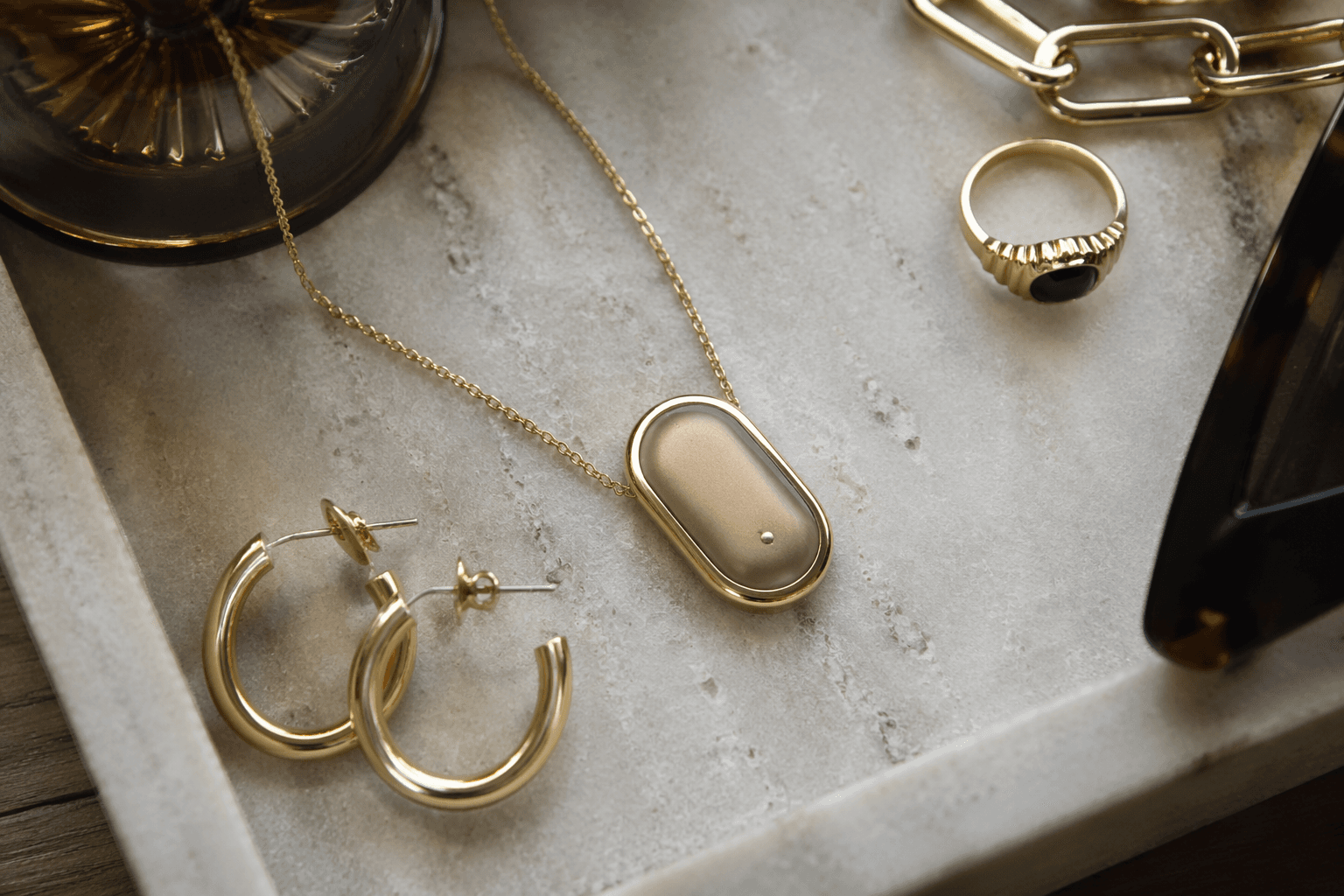
The market has seen how quickly that line can blur. Friend, the AI pendant introduced in August 2024, became more of a conversation starter than a breakout product, with criticism focused on privacy, utility and the unease of always-on microphones. Those objections are not abstract in jewelry terms. A necklace is intimate by definition. It sits close to the body, moves with the wearer, and is seen up close. If the pendant announces itself as surveillance hardware first and adornment second, it will disrupt a gold-necklace stack no matter how clever the software is.
Meta has already shown its appetite for this middle ground. In September 2025, it launched Ray-Ban Display smart glasses in the United States for $799, paired with the Meta Neural Band, an EMG wristband that translates muscle signals into commands. The glasses can check messages, preview photos, see translations and call up Meta AI without a phone in hand. That makes the pendant feel less like a novelty and more like the next step in a deliberate campaign to make AI hardware blend into daily dress. Whether it becomes wearable jewelry or just another device in disguise will depend on one thing: whether Meta can make the object beautiful enough to be styled on purpose.
This article was produced by Prism’s automated news system from verified source data, official records, and press releases, then run through automated quality and moderation checks before publishing. The system is built and supervised by the people who set the standards it runs under. Read our full AI policy.
Know something we missed? Have a correction or additional information?
Submit a Tip