Metal detectorist finds 16th-century gold diamond ring set for auction
A late-16th-century gold cluster ring with eight hogback diamonds and a recovered missing stone will go to auction for up to £20,000.
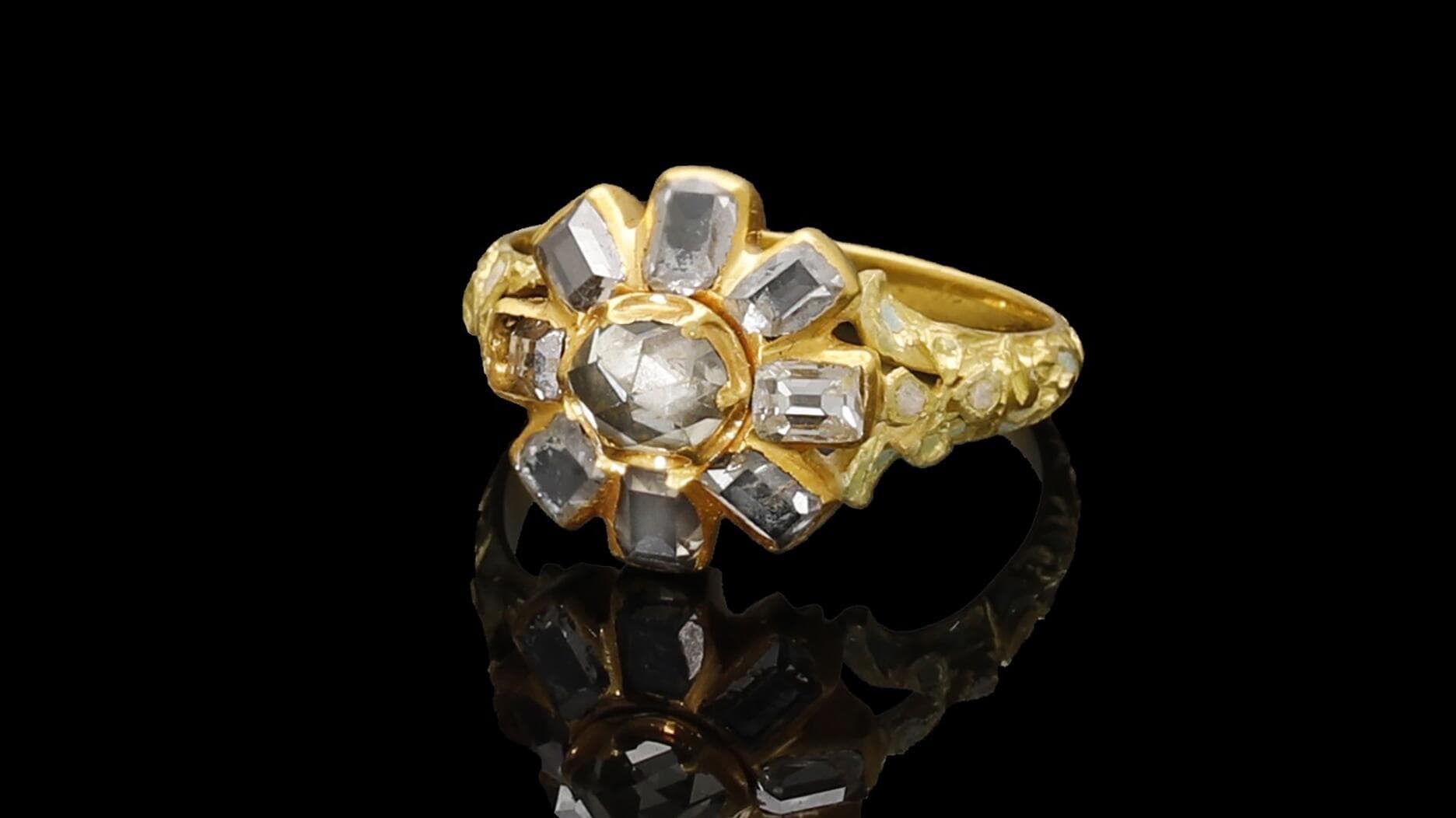
A metal detectorist’s muddy find in Gloucestershire has emerged as a rare survivor from the turn of the 17th century: a gold diamond cluster ring with a flowerhead bezel, eight hogback diamonds and a central rose-cut stone. The ring, now known as the Evesham Diamond Ring, will be offered at Noonans with an estimate of £15,000 to £20,000, a figure that reflects far more than its gold content.
The piece was uncovered in Wormington in November 2024 by Stuart Jones, a 42-year-old from Solihull who works as a welder fabricator at Jaguar Land Rover. Jones had been detecting on his own from about 9:00 a.m. until around 4:00 p.m. when the ring surfaced in the last hour and a half of the day. He called it his “once in a lifetime find.” One diamond came loose as he lifted the ring from the earth, and a second setting was empty. After a club administrator advised him to save the surrounding soil, Jones washed and sieved it at home and recovered the missing stone.

Noonans says the British Museum tested the ring and dated it to the 16th century, while the gold itself tested at 19.2 carats, the historic standard established by Edward I in 1300. The ring is now disclaimed as Treasure, and the proceeds will be shared equally with the landowner. It is lot 106 in Noonans’ Jewellery, Silver & Objects of Vertu sale, with live bidding scheduled for June 23, 2026, at 12:00 BST, and the sale running through June 24.
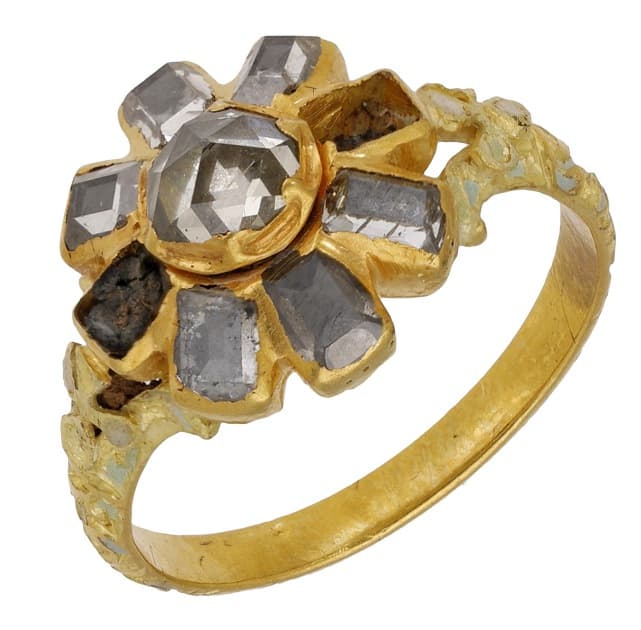
Its construction explains much of its appeal. The flowerhead bezel, a protective rim that gathers the stones into a single cluster rather than setting them on separate prongs, gives the ring a compact, almost botanical silhouette. Frances Noble, Noonans’ head of jewellery, said that early-17th-century baroque taste favored this shift away from solitary stones toward decorative groups arranged in rosettes and other patterns. The underside of the bezel, finished with turquoise and white enamel, shows that the ring was conceived as a complete jewel, not just a display of diamonds.

The setting also hints at the life it once lived. Wormington lies about four miles from Broadway on the London-to-Worcester road, near 16th-century manor houses including Snowshill Manor, a National Trust property once granted by Henry VIII to Catherine Parr in 1543. That geography has fueled speculation that the ring may have belonged to someone of considerable wealth, possibly even royal status. For today’s gold-jewelry buyer, that is the lasting lesson of the Evesham ring: rarity, provenance and workmanship still drive desire, and antique-inspired gold pieces continue to resonate because they carry history in the metal as clearly as in the stones.
This article was produced by Prism’s automated news system from verified source data, official records, and press releases, then run through automated quality and moderation checks before publishing. The system is built and supervised by the people who set the standards it runs under. Read our full AI policy.
Did this article answer your question?