Rawalpindi Man Arrested for Stealing Parents' Gold Jewelry Worth Rs 4.8 Million
A Rawalpindi son allegedly walked out with 10 tolas of his parents' gold worth Rs 4.8 million while they were away, turning a familiar house key into the most dangerous security risk.
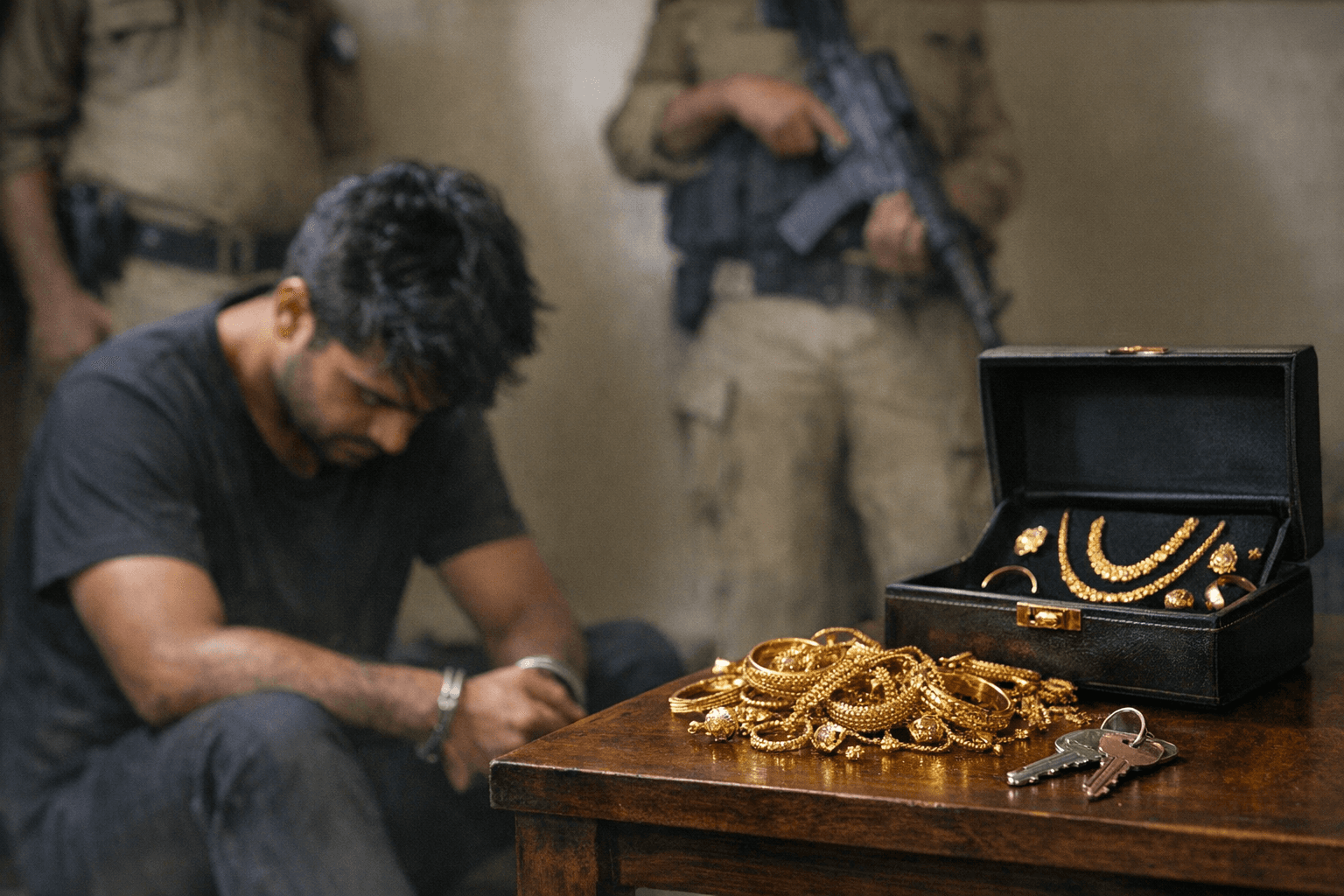
Rawalpindi police arrested a man who allegedly entered his parents' home during their absence and made off with 10 tolas of gold jewelry valued at over Rs 4.8 million. The accused confessed after his arrest, the stolen jewelry was recovered, and he will be presented before court along with the evidence. What sets this case apart from Rawalpindi's recurring gold theft headlines is not the scale but the source: the alleged thief was not an armed dacoit, not a household employee, not a stranger. He was the homeowners' own son.
That detail carries particular weight in a city where gold jewelry functions as both personal adornment and household savings instrument. Pakistani families across income levels hold gold in exactly this form, portable and liquid, which is precisely what makes it vulnerable. At current market rates, 10 tolas of 24-karat gold trades between Rs 477,885 and Rs 502,000 per tola in Pakistan, putting the reported Rs 4.8 million valuation squarely in line with live market prices. Gold prices in Pakistan have risen approximately 1.96% week-on-week in recent trading, meaning a collection that felt adequately modest a month ago now represents a significantly more valuable target.
The Rawalpindi pattern is well-documented. Westridge Police recovered Rs 10 million in gold jewelry and foreign currency within 78 hours after Crime Mapping Officer Kashif Khattak identified a household maid's mother as the suspect. In a separate incident, a gang of 10 armed dacoits held a family at gunpoint and left with 50 tolas of gold jewelry and Rs 4 million in cash. A jewelry shop employee in the city was separately caught stealing gold worth Rs 2.8 million from his own employer. The common thread across these cases is not forced entry at midnight; it is proximity and access.
The lesson for households holding gold, particularly in a rising-price environment, is worth sitting with. The greatest security gap in most homes is not a faulty lock but an unexamined assumption: that people with legitimate access will not exploit it. A basic home gold audit takes roughly 15 minutes. Photograph and document every piece with its approximate weight and description. Store pieces in a dedicated lockbox, not in predictable locations like bedroom almirahs. Limit knowledge of exact storage locations to the minimum necessary. Maintain a simple handwritten inventory, updated whenever pieces are added or worn for an occasion. These are not elaborate precautions; they are the difference between a theft that goes undiscovered for weeks and one that is acted on immediately.
Under Pakistan Penal Code Section 379, theft carries a maximum sentence of three years' imprisonment, a fine, or both. A confession and the recovery of stolen items typically strengthens the prosecution's case considerably. The accused in this case is expected to face both.
The deeper irony is that gold jewelry bought as a store of value, an inheritance, a hedge against economic uncertainty, becomes most vulnerable precisely when it is doing its job: sitting quietly in a home, holding its worth, trusted to those closest to it.
Know something we missed? Have a correction or additional information?
Submit a Tip