Rising Gold Prices Boost Demand for Alicia Hannah Naomi’s Rugged 14k Designs
Record gold prices are pushing buyers toward Alicia Hannah Naomi’s rough-edged 14k pieces, where texture, provenance, and made-to-order craft feel more valuable than polish.

Texture, not polish, is doing the selling
Gold spent 2025 setting records, with 53 all-time highs in the price, and that fever is changing what luxury looks like. Alicia Hannah Naomi’s work in Melbourne fits the moment precisely: tactile, deliberately imperfect, and made for buyers who want gold that feels handled, not machine-perfect.
Her rings and bands lean into asymmetry, rugged texture, and a kind of rugged romance that reads as personal rather than precious in the old polished sense. That matters because the demand is no longer just for shine. It is for pieces that look handcrafted, one-of-a-kind, and emotionally durable enough to justify a serious spend, especially in alternative engagement rings and wedding bands where character can matter as much as carat weight.
Why 14k is winning the value conversation
The biggest shift in Naomi’s practice is her move toward 14k gold, a karat that is not traditionally common in Australia, where the market usually follows 9k and 18k standards. Before COVID, she says, 14k was difficult to source locally. Rising gold prices changed that fast, encouraging suppliers to offer it more readily and clients to embrace it.
That makes 14k more than a practical compromise. It offers a middle ground in color, durability, and value, which is exactly what today’s gold buyer is looking for when prices keep climbing. In a market where Australian gold jewelry volumes fell 22% in 2025 to the lowest level in the World Gold Council’s five-year series, the appeal of a lower-karat option is easy to understand. Buyers are still spending, but they are spending with sharper eyes on wearability and worth.
Naomi’s line is especially well positioned for that calculation because many of her designs are also offered in 9ct and 18ct gold. The range signals flexibility, but the growing interest in 14k shows how quickly the conversation has moved from pure prestige to practical luxury.
Inside the Melbourne studio
Naomi’s credibility is built into the work. She completed an Advanced Diploma of Engineering Technology, specializing in jewellery, at Box Hill Institute of Technology in 2013 and received the Most Outstanding Student Prize. She later deepened her technical training with a Jewellery Gem Setting course at Melbourne Polytechnic in 2019, a detail that helps explain why her surfaces feel intentionally shaped rather than merely textured.
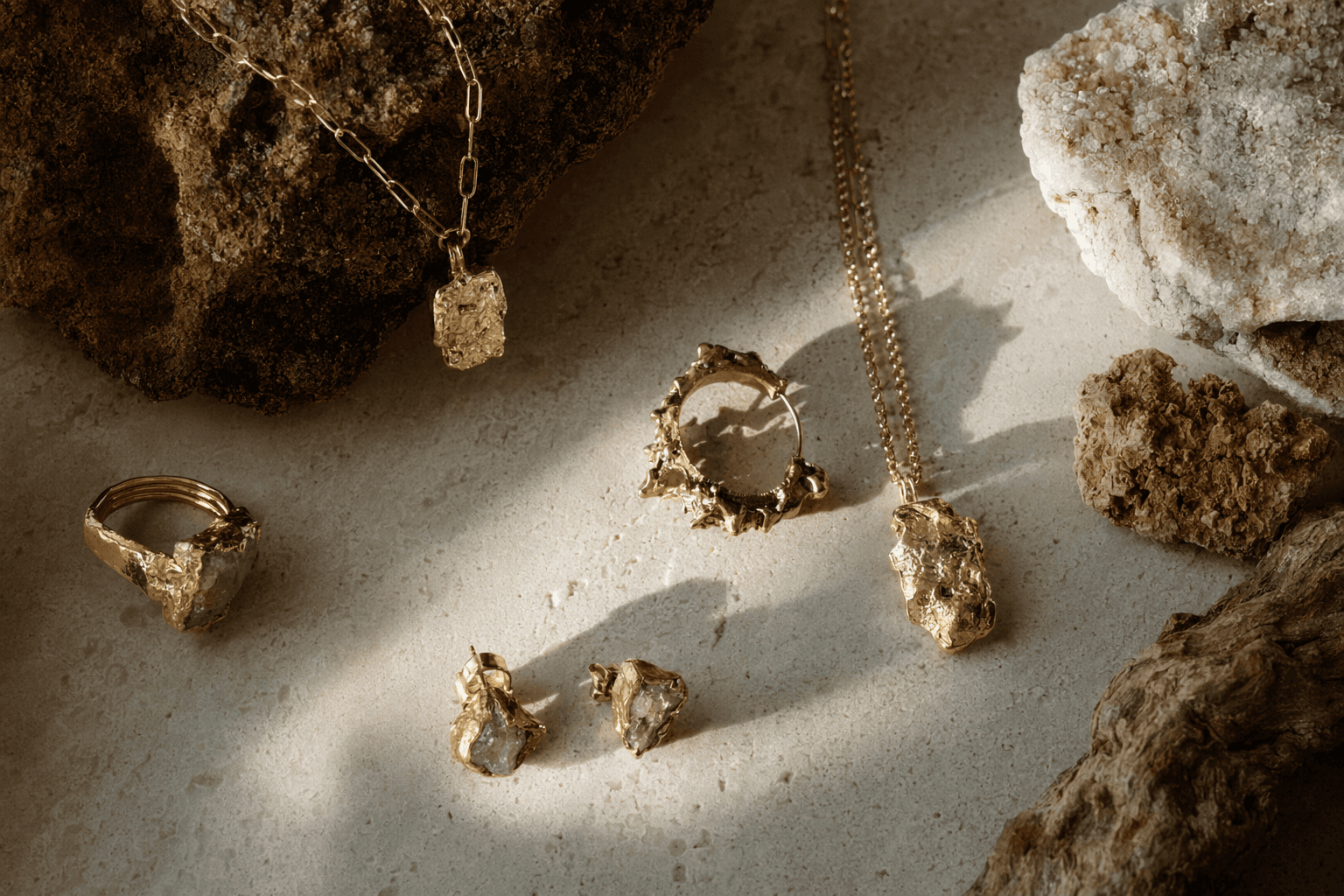
The brand describes its jewelry as handcrafted in Melbourne from sculptural solid gold and sterling silver, with most pieces made to order and all jewelry made from recycled metals. That provenance is increasingly important to buyers who want beauty without vague green claims. Recycled metal is a concrete material choice, and made-to-order production reduces the pressure to move through inventory in the way mass luxury often does.
The aesthetic language is equally specific. Naomi draws on erosion, decay, slow transformation, and weathered stone, then translates those ideas into rugged hand-carved textures inspired by stoic Australian landscapes. The result is jewelry that resists the over-polished finish dominating much of the gold market. Instead of looking sterile, it looks lived with. Instead of pretending to be untouched, it celebrates the marks of making.
Her collections span gold rings, necklaces, bracelets, and bespoke pieces, with a personal trove of natural fancy, black, and salt & pepper diamonds alongside natural sapphires available for custom work. Those stones reinforce the same idea as the metalwork: character can come from irregularity, not uniformity.
What the market data says about the bigger shift
The gold boom is not happening in isolation. The World Gold Council says total gold demand, including over-the-counter trading, topped 5,000 tonnes in 2025, a year that also logged 53 all-time highs in the gold price. In the first quarter of 2026, gold demand value hit a record US$193 billion, even as jewelry demand volumes remained under pressure from elevated prices.
That tension explains the appeal of Naomi’s approach. When raw material costs rise, the market divides. Some buyers trade down in weight or karat. Others move up into the top end, where high-ticket heritage pieces and trade-ins can help offset affordability barriers. In Australia, both forces are visible at once: pressure on volume, but resilience among buyers still willing to pay for a piece that feels substantial, distinctive, and worth keeping.
Naomi’s rough-edged gold sits right in that narrow lane. It is not trying to imitate the gleam of standard luxury. It is offering something more persuasive in a high-price market: a piece that looks made by human hands, wears easily, and carries enough texture to feel like a decision rather than an impulse. In an era of record gold prices, that can be the most convincing luxury of all.
This article was produced by Prism’s automated news system from verified source data, official records, and press releases, then run through automated quality and moderation checks before publishing. The system is built and supervised by the people who set the standards it runs under. Read our full AI policy.
Did this article answer your question?