Sotheby's London sale spotlights Cartier, Grima and textured gold jewels
Cartier’s Art Deco lapis bracelet leads a London sale where textured gold from Grima and de Temple feels newly current, and provenance is doing real price work.

Cartier’s Art Deco authority
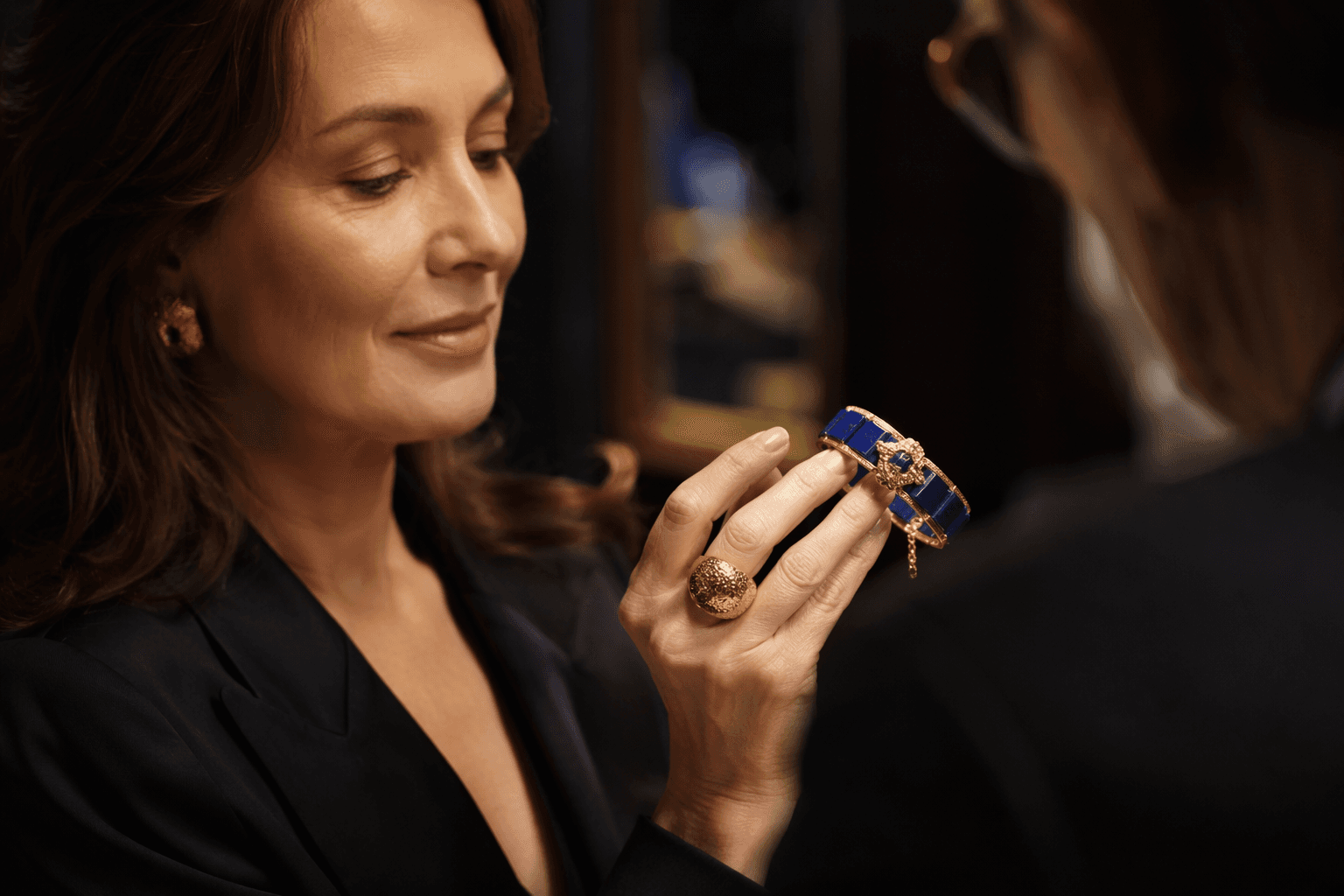
Cartier’s lapis lazuli and diamond bracelet is the kind of jewel that explains the market in a single glance: sharp geometry, a platinum mount, and a signed Cartier London stamp that carries the weight of the house’s history. Sotheby’s London Fine Jewellery Sale runs from May 20 to June 3, 2026, with 225 lots spanning the 19th century, the Belle Époque, Art Deco, bold mid-century design and contemporary pieces, while the lots are on view in London from May 29 to June 2.
Lot 44 is the sale’s clearest Cartier signal. Dated circa 1925, the bracelet is composed of buff-top sugarloaf lapis lazuli plaques with old brilliant-cut diamond terminals and a carved lapis clasp, and it carries an estimate of £10,000 to £20,000. Sotheby’s ties it to a private collection of jewels given by Jesse Frank to Phyllis Frank, née Francatelli, during the 1920s and 1930s, which gives the piece an unusually rich social history as well as design pedigree.
That provenance matters because Phyllis Frank was not just a private owner. Before her marriage she was one of the original models for Lucile Ltd, Lady Duff Gordon’s fashion house, and Sotheby’s links her to the mannequin parades that anticipated the modern runway. The bracelet’s Art Deco geometry also connects to Cartier sketches and a Musée du Petit-Palais catalogue, which helps explain why this kind of signed, documented jewel is treated less like ornament and more like a preserved fragment of design history.
Why the British designers feel newly relevant
If Cartier is the elegant anchor, the British designers in the sale are the pieces that look most alive to present taste. Sotheby’s and JCK both point to Andrew Grima, Charles de Temple, Gerda Flockinger and John Donald as designers who reshaped fine jewelry in the 1960s and 1970s by pairing unconventional stones with textured gold, a language that now reads as tactile, sculptural and easy to wear against modern clothes. The sale also includes a collection of 1960s and 1970s jewelry from artist-jewelers such as Roy King, which deepens that postwar British thread.
The estimates tell their own story. Andrew Grima’s diamond ring, lot 39, dated 1965, is signed Grima and hallmarked for 18 carat gold, with an estimate of £4,000 to £6,000. Nearby, Grima’s cultured pearl and diamond earrings, circa 1970, show the designer’s affinity for baroque pearls and detachable movement, while Charles de Temple’s cultured pearl and textured yellow-gold Wrapped necklace from 1985 is estimated at £5,000 to £8,000. These are not bargain pieces, but they sit well below the Cartier bracelet, and that gap reflects how the market still rewards named house authority and early Art Deco provenance.
What the estimates say about collectability
Cartier’s value proposition is unusually layered. Sotheby’s says the house’s most valuable jewelry is defined by design signature, historical influence, craftsmanship, rarity, condition and provenance, and that framework is visible here: the bracelet’s lapis and diamond geometry, the 1920s date, the documented private collection, and the unmistakable Cartier styling all work together. The result is a jewel that feels both collectible and legible, the sort of piece a serious buyer can justify on design terms alone before even reaching the provenance story.
The British pieces play a different game. Grima’s tiered openwork ring and his pearl earrings rely on irregularity, texture and a more organic sense of volume, while de Temple’s pearl necklace wraps the strand in yellow gold so the metal becomes part of the composition rather than a mere setting. That makes them feel less ceremonial than Cartier’s Art Deco bracelet and, in practical terms, easier to imagine with a shirt collar, a knit, or an evening look that does not need the full formality of a high-jewelry suite.
The design language collectors are chasing now
This is why textured gold has become such a magnetic category. Cartier’s Art Deco work offers the polish of architectural order, flatter on the body and framed by precision, while the British designers bring surface, heft and movement, qualities that feel newly contemporary because they read as handcrafted rather than machine-perfect. In a market that increasingly values signed jewels with a clear point of view, both languages are strong, but they speak to different kinds of collectors: Cartier rewards the eye for historical mastery, while Grima and de Temple reward the wearer who wants gold to look alive.
By the time the sale closes on June 3, the message is hard to miss. The most commanding vintage gold jewelry is not the heaviest or the flashiest; it is the work with an identifiable hand, a recognizable design vocabulary and enough history to survive close looking. In London, that means Cartier’s Art Deco discipline at the top, and the British textured-gold school rising fast behind it, more wearable than ever and finally priced like the design movement it was.
This article was produced by Prism’s automated news system from verified source data, official records, and press releases, then run through automated quality and moderation checks before publishing. The system is built and supervised by the people who set the standards it runs under. Read our full AI policy.
Did this article answer your question?