Sotheby’s previews rare Imperial Fabergé necklace ahead of June auction
A rare Fabergé necklace with aquamarines and diamonds was set to headline Sotheby’s June 17 sale, carrying a $400,000 to $600,000 estimate and Imperial Cabinet provenance.

Sotheby’s was set to bring a rare Imperial Fabergé diamond and aquamarine necklace to New York as the centerpiece of its inaugural Artistic Luxury: Fabergé, Gold Boxes, Silver & Ceramics sale, a 168-lot auction that turns fine jewelry into a lesson in what collectors actually reward. The necklace, made by workmaster Albert Holmström in St Petersburg around 1911, carried an estimate of $400,000 to $600,000, but its appeal ran well beyond the number attached to it.
The piece is the kind of necklace that tells its own history in the details. Sotheby’s describes it as set with 11 graduated round-cut Siberian aquamarines framed by rose-cut diamonds, then interrupted by graduated openwork laurel motifs centered with 11 old-cut diamond brilliants in platinized mounts. It also retains a gold clasp, workmaster’s initials, a 56 standard mark, and a length of 15 1/4 inches, or 38.9 centimeters. For collectors, those are the clues that matter: original workmanship, period materials, and a design language that still reads as unmistakably Fabergé.
Its provenance gives the necklace an additional premium. Sotheby’s says the Imperial Cabinet presented it in May 1911 to Empress Alexandra Feodorovna as a suggested gift for the planned visit of German Crown Prince Wilhelm and Crown Princess Cecilie to St Petersburg. The necklace cost 2,650 roubles at the time, but it was not selected and was returned to the Imperial Cabinet. That trail, from court commission to rejection to survival, is the sort of documented history that separates a strong jewel from a museum-grade object with market gravity.
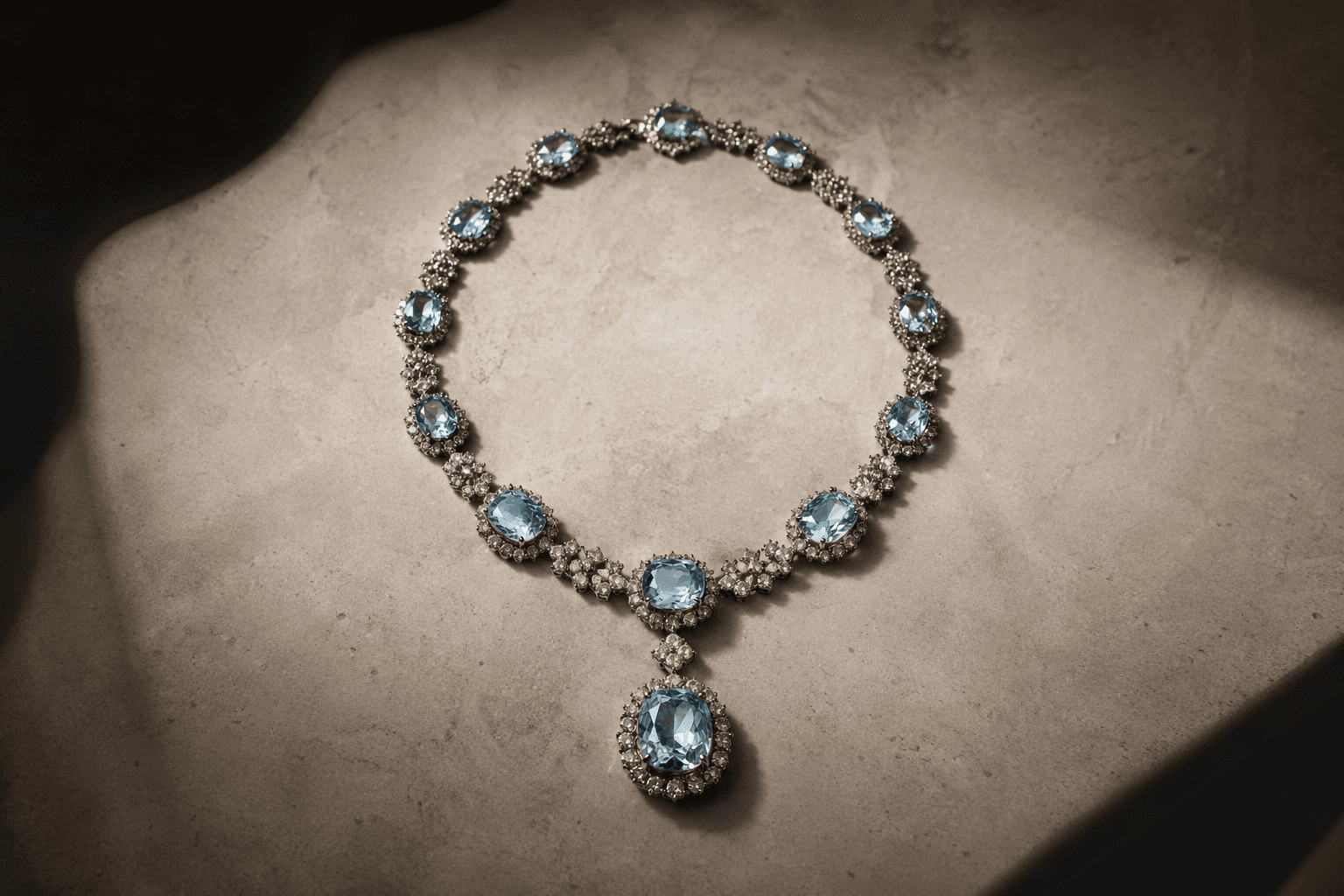
Carl Fabergé built his reputation on restraint sharpened by invention, not sheer material excess, and this necklace reflects that philosophy in miniature: cool blue aquamarines, disciplined diamond borders, and gold and platinized settings working in close balance. Helen Culver Smith, Sotheby’s global head of Fabergé and Russian works of art, said the sale was meant to showcase the marriage between luxury and artistry, with Luxury Week providing the right moment to place such material in front of buyers who know the difference between ornament and authorship.
The broader sale reached back through Russian imperial history, including silver and diamond-set flower dress trimmings tied to Catherine the Great and Empress Elizabeth Petrovna, with estimates from $30,000 to $80,000. Catherine the Great ruled from 1762 to 1796 and expanded the Imperial jewelry collection by roughly 40 percent, a reminder that the market for gold and gem-set heirlooms still follows the old rules: provenance, craftsmanship, and the survival of original design details. The preview ran June 2 to June 17, with the exhibition in New York scheduled for June 11 to June 16.
This article was produced by Prism’s automated news system from verified source data, official records, and press releases, then run through automated quality and moderation checks before publishing. The system is built and supervised by the people who set the standards it runs under. Read our full AI policy.
Know something we missed? Have a correction or additional information?
Submit a Tip