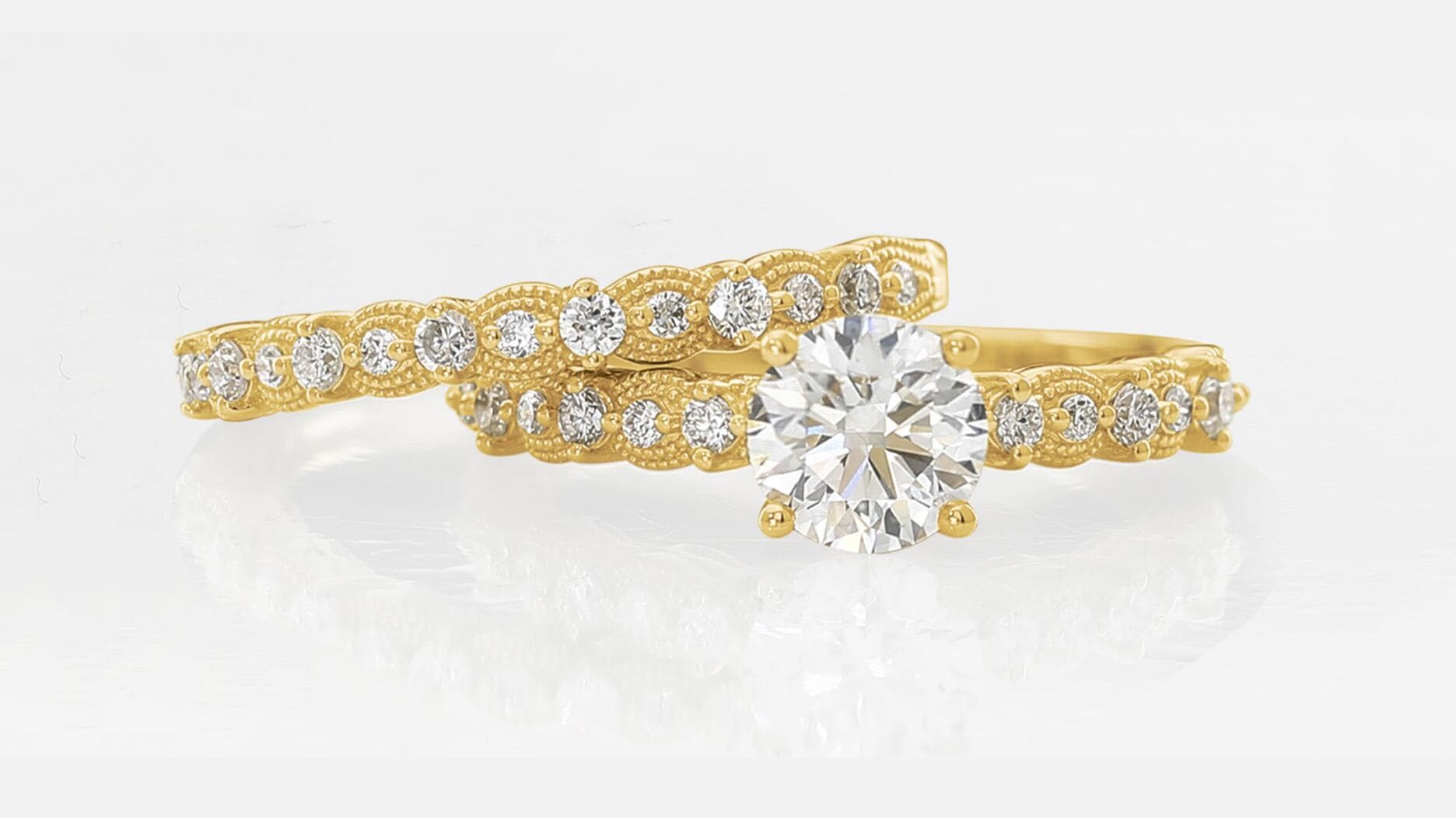
Tulane study explains why gold jewelry stays shiny for centuries
Tulane researchers show gold’s shine comes from more than chemistry: its surface can reorganize itself, helping explain centuries of tarnish resistance and where that protection ends.

Why gold keeps its glow
Gold’s most useful secret is not that it never changes, but that it changes in a way that protects itself. A Tulane study published in *Physical Review Letters* shows that the surface atoms on gold can rearrange into a protective pattern that dramatically slows oxidation, helping explain why gold jewelry can stay bright for centuries while silver, copper, and iron lose their finish far faster.
That finding matters because it turns a familiar luxury fact into a practical buying lesson. Gold’s durability is not just a matter of reputation or romance. It is rooted in the way the metal’s surface behaves when it meets oxygen, and that is exactly why a solid gold ring, pendant, or bracelet can keep its visual calm through generations of wear.
What the Tulane study found
The paper, titled “Role of Reconstruction in the Inertness of Gold toward Oxygen,” was led by Santu Biswas and Matthew M. Montemore. Their simulations focused on two common gold surfaces, Au(110) and Au(100), and found that both reconstruct into quasihexagonal structures. Those rearranged surfaces slow the dissociation of O2 by many orders of magnitude, and Tulane’s summary says oxygen reactions are suppressed by a factor of a billion to a trillion.
That is the elegant part of the science: gold’s resistance is not just about being chemically aloof. Montemore’s team showed that the structure of the surface itself is a major part of the explanation. Without that reconstruction, gold would likely oxidize quickly under ambient conditions, which would be a very different story for a metal so closely associated with permanence.
The broader implication reaches beyond jewelry cases. Gold-based catalysts are already used in some industrial oxidation reactions, and the study suggests that deliberately creating square or rectangular gold surface structures could improve catalytic activity. For Montemore, an associate professor in Tulane’s School of Science and Engineering who joined the university in January 2019, the work fits naturally into a career centered on catalysis, electrochemistry, energy conversion, and materials.
Why this matters to jewelry
For the wearer, the practical takeaway is simple: gold’s shine lasts because gold itself is unusually stable. That is why objects made from it can remain visually legible long after other metals have darkened or corroded. The Metropolitan Museum of Art notes that gold jewelry was produced in ancient Egypt from the pre-dynastic period onward, and those early pieces still have a grip on the imagination because the metal endures as well as it dazzles.
Britannica describes gold as highly malleable, durable, and naturally found in comparatively pure form. Put those traits together and you understand why gold has been prized for thousands of years. It can be shaped into fine chains, bezel-set pendants, rigid cuffs, and filigree details without surrendering the luminous surface that makes it desirable in the first place.
That said, the study also clarifies the boundary of gold’s advantage. It explains why gold resists tarnish so well, not why every object that looks gold will behave the same way. A piece’s longevity depends on whether you are holding solid gold, a lower-karat alloy, or a plated finish. The science favors gold, but the construction still decides how that advantage appears in daily wear.
How to read solid gold, gold-plated, and lower-karat pieces
Solid gold offers the most honest expression of the metal’s resistance. Because the material is gold through and through, the surface that meets the air is the same material that benefits from the reconstruction the Tulane study describes. In practice, that means the piece keeps its color and luster far better than a surface finish that can wear away.

Gold plating is different. The visible layer is gold, but it sits over another metal, so the long-term appearance depends on how thick the plating is and how much friction the piece endures. Once the coating thins, the base metal begins to govern the look, and the shine can change long before the gold itself would have tarnished.
Lower-karat gold sits between those two worlds. It still contains gold, but it is mixed with other metals to increase hardness or alter color. That makes it useful for some designs, especially pieces that need extra strength, but it also means the non-gold portion can influence how the jewelry ages. The gold may remain stable, while the alloyed metals around it can introduce color shifts or surface change over time.
A good buying rule follows from the science: the more of the surface that is genuinely gold, the more you benefit from gold’s natural resistance to oxidation.
What the study does not promise
This research does not make gold maintenance irrelevant. It explains why gold resists oxygen-driven tarnish, but it does not erase scratches, dents, grime, or wear from daily life. A bracelet that rubs against a desk, a ring that catches on a bag clasp, or a necklace that picks up lotions and oils still needs care, even if the metal itself is chemically patient.
The finding also does not mean every gold piece is indestructible. Gold is durable, but it is also soft enough to be shaped, which is part of its beauty and part of its vulnerability. A high-polish bangle can lose crispness at the edges; a finely textured surface can blur; a prong setting can wear faster than the rest of the jewel if it is thinly built. The metal may resist tarnish, but craftsmanship still determines how gracefully a piece ages.
A smarter way to buy gold
If the goal is longevity, look first at construction, then at style. A well-made solid gold piece will usually outlast a superficially dazzling alternative, especially when the design has enough thickness to survive real wear. A hollow chain, a thin vermeil layer, or a plated finish may look convincing at first glance, but none of them offers the same long-haul relationship with the metal itself.
A few practical distinctions matter:
- Solid gold keeps its surface advantage for the life of the piece.
- Gold plating depends on coating thickness and wear, not just on color.
- Lower-karat gold can still be beautiful and durable, but the added metals change how the piece ages.
- Heirloom value often tracks not only with weight and purity, but with how much of the visible surface is actually gold.
The Tulane study gives that advice a scientific backbone. Gold stays shiny for centuries because its surface can literally reorganize itself against oxygen, and that is why a gold jewel can feel almost uncanny in its steadiness. Its brilliance is not a trick of fashion. It is a material advantage, visible on the wrist, the neck, and in the museum case, where the oldest gold still looks like itself.
This article was produced by Prism’s automated news system from verified source data, official records, and press releases, then run through automated quality and moderation checks before publishing. The system is built and supervised by the people who set the standards it runs under. Read our full AI policy.
Did this article answer your question?