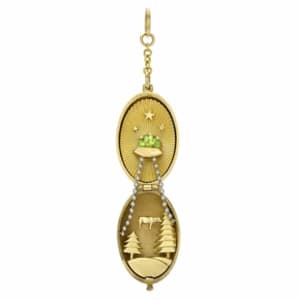
TwentyFour’s Vault charm turns 18-karat gold into a digital locket
Can an 18-karat locket keep your memories close and your phone out of the equation? TwentyFour’s Vault tries to turn gold into a private digital archive, with all the promise and risk that implies.
Can a gold locket now function as a memory vault?
TwentyFour thinks so. Its Vault charm takes the most sentimental form in jewelry, the locket, and remakes it in 18-karat yellow gold for the phone age. Instead of a curled photograph or a hidden note, the charm can hold photos, handwriting samples, voice notes, playlists, and short videos, all unlocked with a tap to a phone and no app or login required.
That simplicity is the appeal. It also defines the stakes. A traditional locket protects one tiny keepsake behind a hinged case; Vault expands that idea into a private digital archive, which makes it feel both more generous and more fragile. The question is not whether the concept is clever. It is whether a wearable memory container is genuinely useful, or whether it adds another layer of vulnerability to something meant to feel intimate.
What TwentyFour is making, and why the metal matters
TwentyFour is a New York City-based fine jewelry studio founded in 2020, and its name is a nod to the 24 parts of pure gold. That detail matters because Vault is not a gadget disguised as jewelry. It is still presented as fine gold work, made locally in NYC by a small team of artisans, with a stated emphasis on ethically sourced materials and solid gold craftsmanship.
The material choice gives the piece weight in every sense. 18-karat yellow gold has enough alloy content to improve durability while preserving the rich color buyers expect from fine gold jewelry, and it gives Vault the permanence that tech products almost never have. That tension is exactly what makes the piece interesting: the hardware may evolve, but the gold remains a keepsake in the old sense of the word.
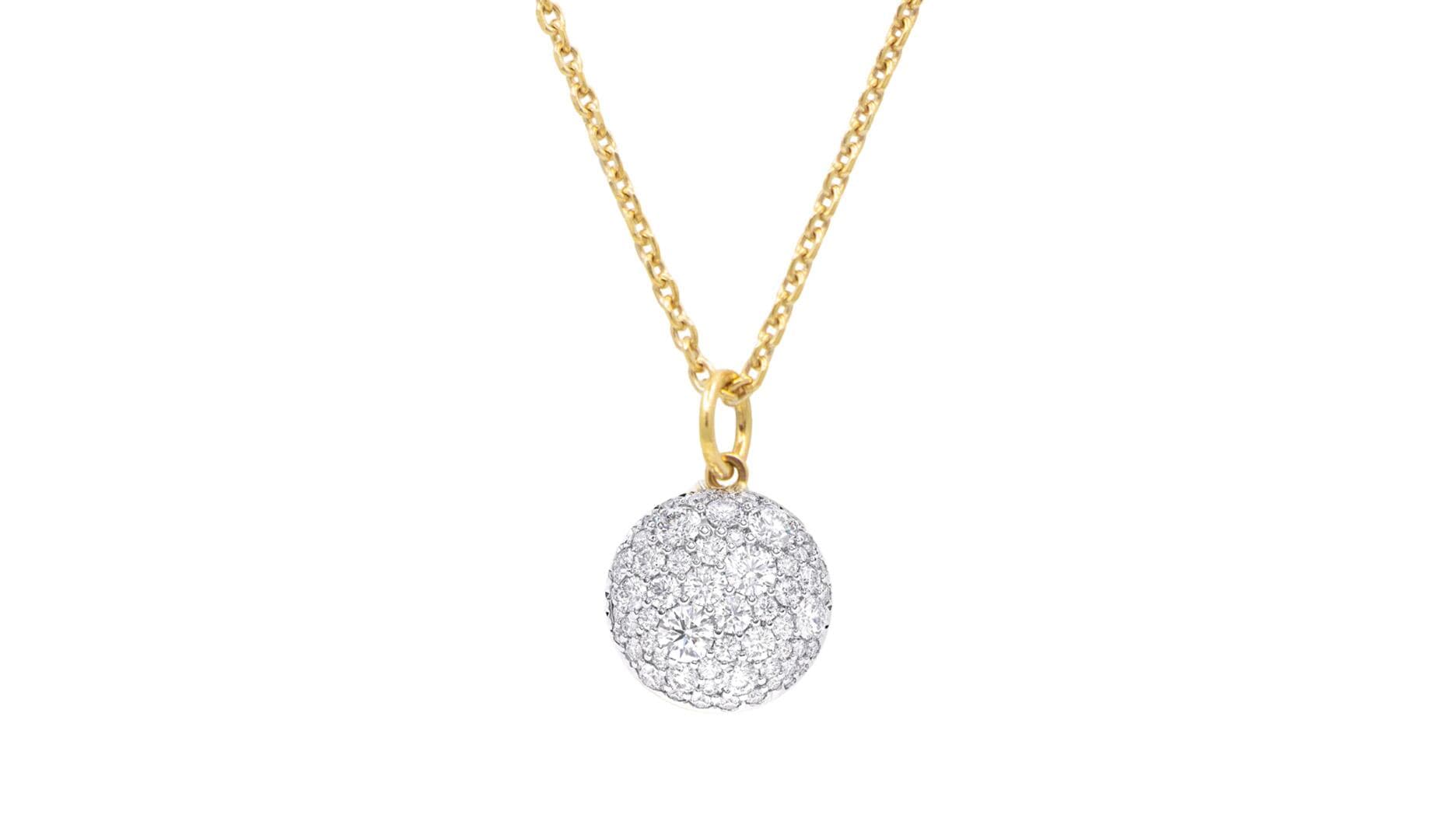
TwentyFour also positions Vault as part of a broader collection, with a diamond pendant version and a major pendant version set with a statement gemstone. That range suggests the design is not meant to be a novelty isolated from the rest of a jewelry wardrobe. It is being asked to sit comfortably beside more traditional pieces, which is a harder test than simply drawing attention on launch.
How the digital locket works in real life
Vault uses NFC technology, the same kind of short-range wireless connectivity that lets a phone read information from a nearby object. In practical terms, the wearer taps the charm to a phone to open a private page where the stored media lives. TwentyFour says no app or login is required, which lowers friction dramatically and makes the experience feel immediate rather than technical.

That convenience is the whole point of the design. A locket should feel instinctive, and Vault preserves that emotional ease while replacing static keepsakes with moving ones: a voice note, a playlist, a video, a photograph you can return to in seconds. For someone who wants memory to feel tactile but not trapped, the idea has real charm.
Still, the same frictionless access that makes it appealing also raises important questions. If the charm is meant to open with a tap, then the experience is built around ease, not layers of security. That may be fine for a private, personal archive, but it also means the wearer is trusting the object to remain both physically safe and digitally discreet. Lose the charm, and you do not just lose gold weight or a decorative pendant. You lose the container for the memories inside it.
Who actually benefits from this kind of jewelry
Vault makes the most sense for someone who wants sentiment to be active rather than purely symbolic. Think of the person who already treats jewelry as autobiography: a mother preserving a child’s voice note, a partner keeping a playlist tied to a relationship milestone, or someone who wants to carry a handwriting sample from a parent, grandparent, or spouse in a form that feels more intimate than a phone file.
It is less convincing for anyone who wants jewelry to disappear into the background. The charm’s value is conceptual as much as material, so it asks the wearer to care about the media stored inside as much as the gold outside. That makes it especially suited to gift-giving, memorial jewelry, and milestone pieces, where the story matters as much as the setting.
The strongest argument for Vault is not that it replaces the classic locket. It is that it updates the locket’s oldest purpose: protection of memory. Historic lockets once held photographs, portrait miniatures, locks of hair, and other keepsakes, and they served as sentimental jewelry throughout the Victorian era. Vault simply translates that impulse into the language of files and taps.
The privacy question no one can ignore
Any smart jewelry that stores personal media has to be judged on privacy, not only sentiment. Vault’s no-app, no-login approach is refreshingly direct, but it also means the emotional ease is built into the access model itself. That is excellent for daily use and potentially uncomfortable if the piece is misplaced, stolen, or borrowed by the wrong person.
The ideal buyer is someone who understands that a digital keepsake is not the same as a password-protected vault in the cybersecurity sense. The charm may feel like a small private archive, but it is still jewelry, which means it can be left on a dresser, dropped in a taxi, or taken from a bag. For that reason, the emotional value may exceed the practical security value unless the stored media is chosen carefully and kept intentionally limited.
This is where Vault becomes more than a novelty. It asks buyers to consider a new category of risk for fine jewelry: not just theft of metal and stones, but exposure of personal memory. If the content matters enough to store inside gold, then the wearer should be comfortable treating that content as something precious and vulnerable.
How Vault fits into the wider smart-jewelry conversation
TwentyFour is not inventing the idea of NFC jewelry from scratch. Galatea’s Momento line has been described as fine jewelry using NFC technology to store voice and text messages, images, and video links, and GIA reported in 2020 that NFC technology had already been incorporated into pearl jewelry by Galatea. That places Vault inside a broader movement rather than outside it.
The fact that the category is growing matters because it suggests the market is searching for more intimate forms of wearable tech. But it also reveals the challenge. Many consumers will appreciate the novelty of unlocking a memory with a tap; fewer will want to depend on a piece of jewelry as both adornment and digital repository. The winners in this space will be the pieces that feel like jewelry first and technology second.
Vault’s strongest quality is that it does not try to look futuristic in the usual silicon-and-screen sense. It keeps the language of the locket, preserves the visual dignity of gold, and lets the technology recede into the experience. That restraint is what gives the piece staying power.
In the end, Vault makes the most convincing case when it is treated as a sentimental jewel with a second life, not a gadget with a gold shell. It is at its best when the wearer wants one object to carry both beauty and biography, and when the story inside matters enough to justify the risk of putting memory within reach of a tap.
This article was produced by Prism’s automated news system from verified source data, official records, and press releases, then run through automated quality and moderation checks before publishing. The system is built and supervised by the people who set the standards it runs under. Read our full AI policy.
Did this article answer your question?