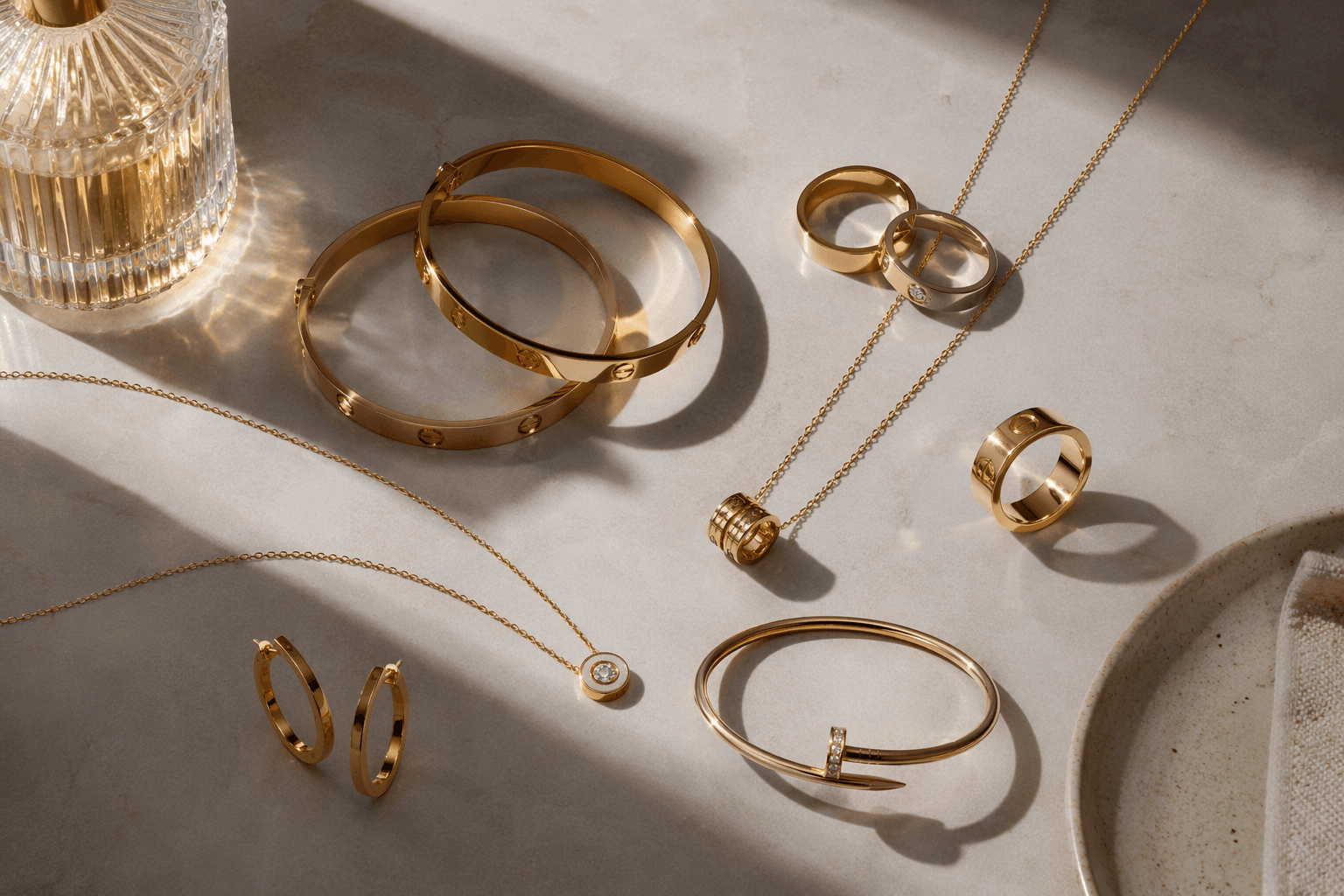
Antique chains bring historical depth to modern jewelry layering
Antique chains make a stack look inherited, not assembled, with guard chains, belchers, book chains, and pinchbeck adding depth through length, weight, and texture.
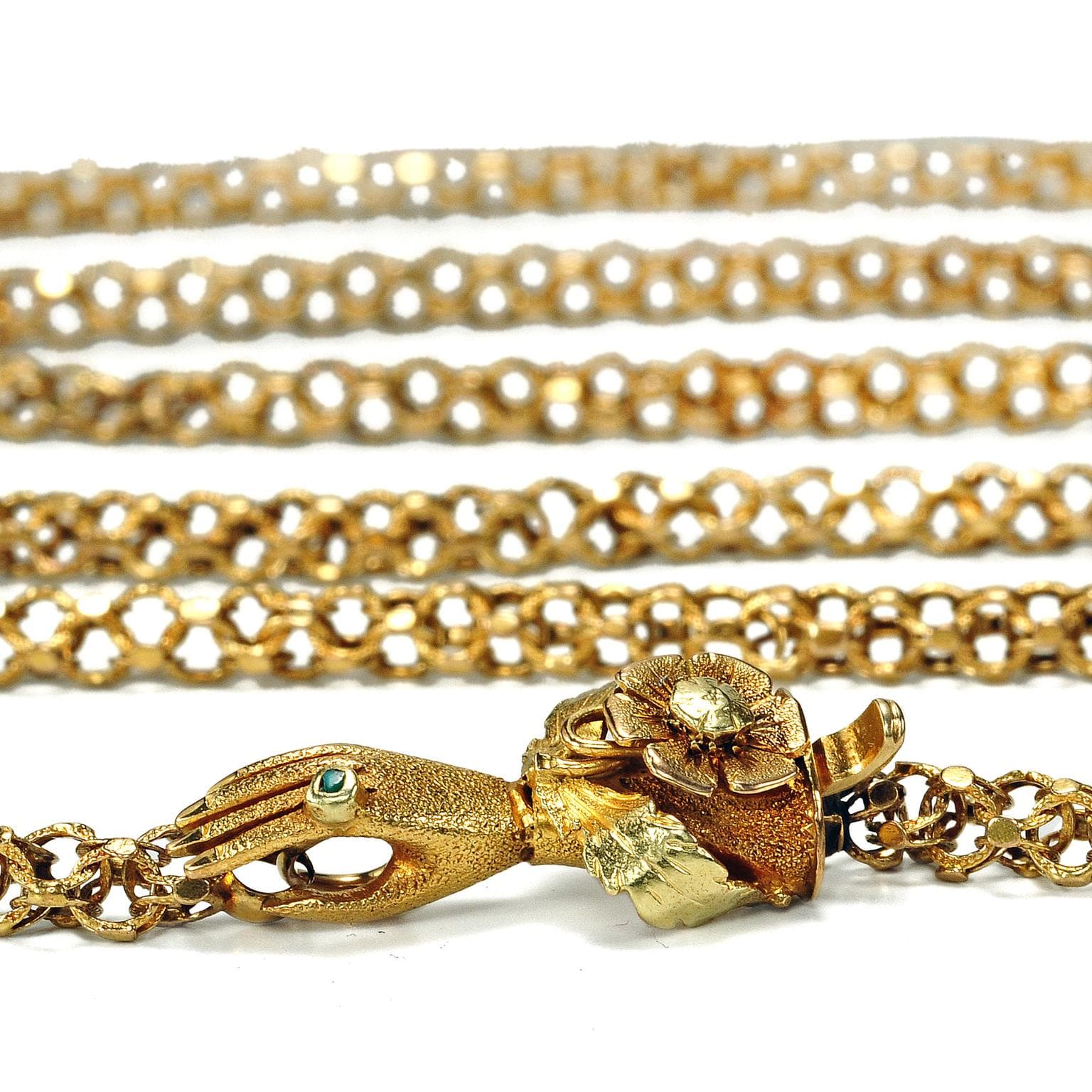
Antique guard chains can run more than 50 inches, sometimes around 56 to 64 inches. A modern stack can feel decorative; one built around historical chain forms feels composed, as if each link arrived with a past life and a purpose of its own. The renewed appetite for gold chains has been driven in part by the layering of modern and antique pendants and chains.
The antique chain that gives the stack its spine
Start with length, because length is what lets a layered necklace read as intentional rather than crowded. Georgian guard chains were originally made to hold watches, worn around the neck and tucked into a belt or watch pocket. Their length creates vertical breathing room, especially when a long chain is looped, doubled, or worn with a smaller chain close to the collarbone.
Muff chains offer the same sense of historical function, but with a softer silhouette. Popular in the 18th century, they were designed to fasten to ladies’ muffs, long enough to thread through winter accessories and practical enough to live in motion. A muff chain is a long chain worn around the neck with fasteners at the ends, and that built-in utility gives it a natural ease when you pair it with a pendant or a tighter modern strand.
Antique guard chains can sit alone as a statement or act as the longest line in a stack, where their length keeps everything else from collapsing into a single visual plane.
Why certain historic chain types layer so well
Book chains bring texture before you even add a pendant. They are Victorian chain styles made of interlocking links of flat folded metal, resembling the binding of a book, and they remained popular through the Victorian and Edwardian periods. That flat, articulated surface catches light differently from a simple curb or rope chain, which is why a book chain can make even a minimal stack feel more dimensional.
Victorian jewelry, broadly speaking, belongs to the reign of Queen Victoria from 1837 to 1901. That period produced a long run of decorative chain forms, visible in the Victoria and Albert Museum’s jewelry collection of more than 3,000 jewels spanning Europe from ancient times to the present.
The most successful layered looks often combine one chain with a strong historical profile and another with a quieter profile. An ornate book chain can sit beside a modern fine link, while a long guard chain can carry the visual weight of the whole composition. The contrast between flat folded links, smoother contemporary gold, and the occasional locket or pendant gives the stack clarity without making it stiff.

Mixing weight, length, and texture without visual noise
The trick is not to match everything. Antique chains work best when their differences are legible: a long guard chain, a shorter modern chain, and a pendant that breaks the rhythm at a deliberate point. That is how the stack looks inherited, because inherited jewelry rarely arrives as a matching set. It accumulates in layers, each with a slightly different scale and finish.
Weight matters as much as length. A guard chain can look airy despite its size, while a book chain has more visual density because of its folded-link construction. A single locket, especially a large Victorian sterling silver locket, gives the eye a resting place and makes the surrounding chains feel purposeful rather than busy.
If you want the result to feel collected rather than cluttered, let the textures disagree a little. One chain can be polished and narrow, another broader and more ornate, and a third can bring a matte or aged finish. Without that contrast, the stack reads as a row of similar objects.
What to know before you buy antique chains
Antique jewelry is generally defined as at least 100 years old, and that threshold matters because true antique chains often show construction details that reproductions do not. Weight and tooling help distinguish them, since authentic chains can feel different in the hand from newer copies. It is part of how collectors judge whether a chain has the right period character and whether the links, clasps, and joins are consistent with its age.
Price is where romance meets reality. Desirable antique examples can run from about $4,000 to $9,000, especially when the piece has strong condition, interesting provenance, or uncommon form. A long guard chain with original fittings, or a book chain with substantial visual presence, can justify that range.
Pinchbeck is the most revealing example of how material history shapes taste. Invented in the 1700s by Christopher Pinchbeck, a London clockmaker active roughly from 1670 to 1732, it is a gold-colored copper-zinc alloy made to imitate the look and weight of 18ct gold at a lower cost. The Metropolitan Museum of Art holds a 1775 table or bracket clock made of pinchbeck metal. For layering, pinchbeck is especially useful because it offers antique character and warm color without requiring an all-gold budget.
This article was produced by Prism’s automated news system from verified source data, official records, and press releases, then run through automated quality and moderation checks before publishing. The system is built and supervised by the people who set the standards it runs under. Read our full AI policy.
Did this article answer your question?