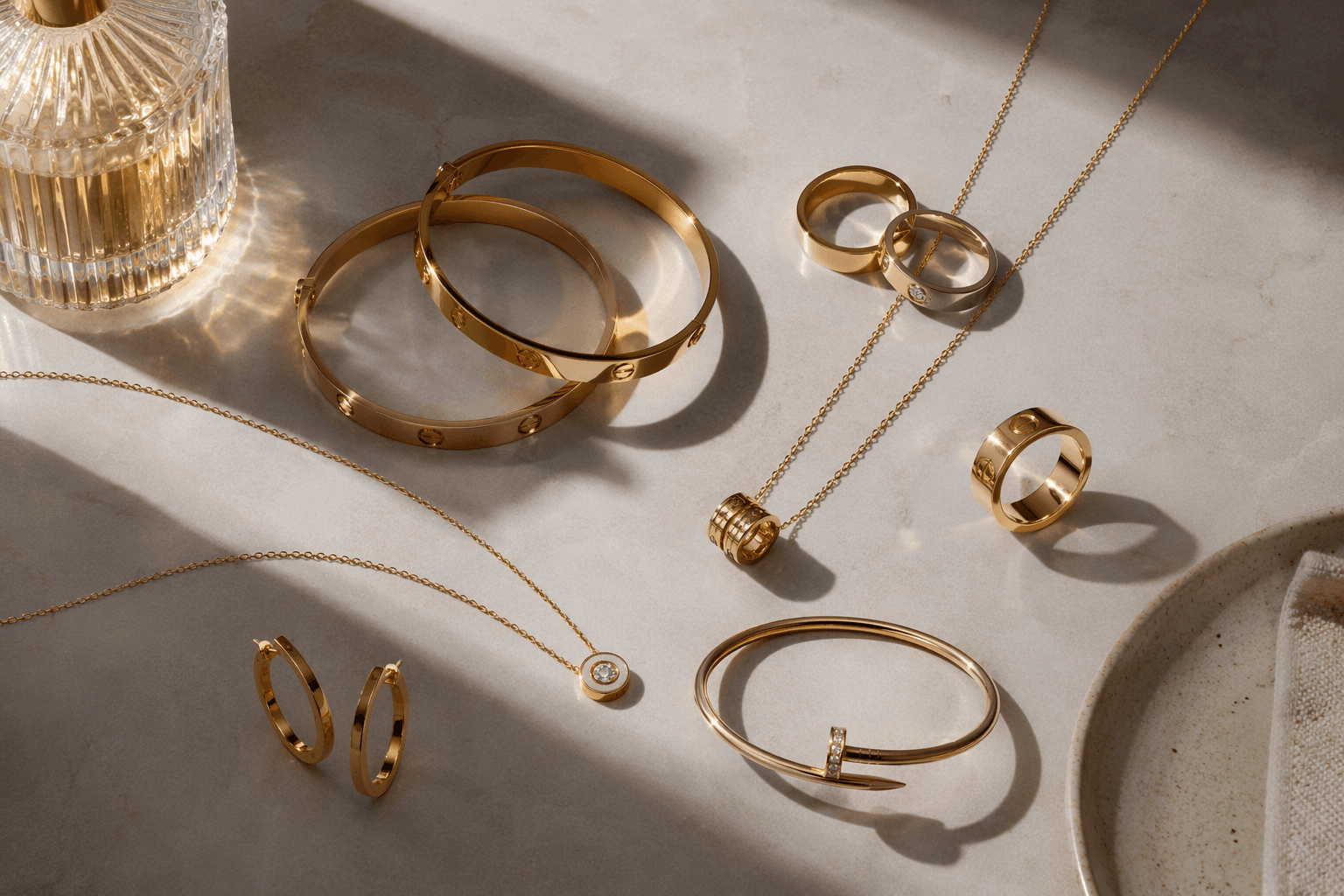
Bulgari updates gold-and-steel icons for stackable mixed-metal layering
Bulgari’s gold-and-steel icons make mixed-metal layering feel deliberate, with B.zero1 and Tubogas built to stack, contrast, and move from day to night.

Bulgari has made mixed metals feel intentional again. The maison’s renewed gold-and-steel language, running from B.zero1 to Tubogas, gives readers a clear formula for layering: let contrast do the work, keep the structure visible, and build a look that can travel from office hours to evening without changing its grammar.
Why this mix reads as modern
Mixed-metal jewelry works best when the contrast looks designed, not improvised. Bulgari’s latest approach treats yellow gold and steel as a visual system, not a compromise, which is exactly why it lands for stackable wear. Steel brings a harder, cooler line; 18 kt yellow gold adds warmth and weight, and together they create the kind of tension that makes a ring stack or wrist stack look edited rather than accidental.
That matters because the strongest layered jewelry today is not about piling on more. It is about repeating a shape, a texture, or a metal until the eye understands the rhythm. Bulgari’s renewed gold-and-steel icons are useful because the contrast is already built into the design, so the wearer does not have to force the mix.
B.zero1 as the anchor piece
B.zero1 is the easiest place to start because Bulgari itself frames it as a true icon. Launched in 1999, it was conceived at the dawn of the new millennium, and the house describes it as a fusion of Roman heritage, industrial design, and cutting-edge craftsmanship. That combination is why the ring still reads as architectural rather than decorative.
The Gold & Steel version is especially useful for layering because the specification is so direct: 18 kt yellow gold and stainless steel. Bulgari identifies it as a four-band ring, which gives it built-in volume and makes it strong enough to anchor a hand stack on its own. Instead of hiding beneath other rings, it establishes the rule for the rest of the look.
Bulgari’s own history page connects B.zero1 to Tubogas, saying the ring merges Tubogas’s industrial appeal with the circular grandeur of the Roman Colosseum. That link is more than branding language. It explains why the ring feels so effective in a mixed-metal context: it already contains both a historic reference and a modern material contrast.
Tubogas and the power of texture
If B.zero1 is the anchor, Tubogas is the texture that keeps the stack from going flat. Bulgari says the technique has been used since the 1940s and describes it as solder-free, a coil construction that turns metal into a flexible spiral with rounded contours and raised edges. That shape creates movement without adding clutter, which is ideal when you want one piece to answer another.
The history is unusually rich. Bulgari says the first Serpenti bracelet-watches, introduced in 1948, combined the spiraled Tubogas band with a geometric watch dial. The maison also notes that Tubogas appeared in watches and jewelry through the 1960s, 1970s, and 1980s, which helps explain why it still feels so adaptable now. It has always sat at the intersection of utility and drama.
For readers building a stack, Tubogas does a different job than a polished gold band. It adds surface tension. Its coil construction catches the light differently, so it works well beside the more rigid geometry of B.zero1 and beside simpler yellow gold rings that need a strong textural companion.
How to stack gold and steel without losing control
The most confident mixed-metal look begins with one dominant piece, then repeats one metal elsewhere so the eye does not have to guess the theme. With Bulgari’s gold-and-steel language, that usually means letting the B.zero1 ring set the pace, then echoing yellow gold in a slimmer ring, a bracelet, or a watch detail elsewhere in the look.
A good mixed-metal stack should feel curated, not crowded. Use the steel as the visual interruption and the yellow gold as the through line. If one piece has a lot of volume, like the four-band B.zero1, pair it with something more restrained so the hand does not lose its shape. If you add Tubogas, let its spiral finish act as the textural bridge between polished gold and stainless steel.
A simple way to think about the formula:
- Start with one statement ring that already mixes metals, so the palette is established from the beginning.
- Repeat yellow gold in another small detail, which keeps the stack coherent.
- Let Tubogas supply movement and shine variation, especially if the rest of the look is more linear.
- Keep the rest of the jewelry edited, because these designs already carry enough visual weight to do the layering for you.
This is also why the current emphasis on day-to-night versatility makes sense. A mixed-metal stack built from these signatures does not need a costume change at 6 p.m. The steel keeps it grounded in daylight, and the gold gives it evening heat.
Celebrity visibility made the case obvious
The return of Tubogas has not been presented as an abstract heritage exercise. WWD’s coverage of the 2024 Tubogas launch noted attendance from Naomi Campbell, Dakota Johnson, and Paris Jackson at the Brooklyn event, a lineup that gave the motif immediate cultural visibility. When recognizable names wear a historically loaded design, the result is not just exposure. It is permission.
That kind of validation matters for mixed-metal jewelry because many buyers still treat combining tones as a risk. Bulgari’s current framing removes that hesitation. If a house with such a deep archive is revisiting gold and steel with conviction, the mixed-metal stack no longer reads as a styling experiment. It reads as part of the language.
What the revival says about layering now
The larger lesson is that layering works best when the objects themselves are built for it. Bulgari’s B.zero1 and Tubogas are not forcing a trend onto old designs. They are showing how historic signatures can answer a modern need for flexibility, contrast, and easy wear across the day.
For readers building a jewelry wardrobe, that is the takeaway worth keeping: start with one recognizable form, repeat one metal elsewhere, and let texture do the rest. Bulgari’s gold-and-steel return proves that mixed metals are no longer a fashion gamble. When the design is this disciplined, the stack looks intentional before you add a second piece.
This article was produced by Prism’s automated news system from verified source data, official records, and press releases, then run through automated quality and moderation checks before publishing. The system is built and supervised by the people who set the standards it runs under. Read our full AI policy.
Did this article answer your question?